Quick Take
- Voice: Virtual Voice handles the dense technical language with mechanical consistency, though the AI delivery flattens moments that a human narrator might vary for emphasis; functional but not inspiring.
- Big ideas: Certification preparation, wastewater infrastructure, field safety protocols
- Atmosphere: Methodical and practical, built for focused study sessions
- Worth it?: Operators serious about passing their collection system certification will find this audiobook a solid on-the-go companion, though it works best alongside hands-on field experience.
McCaulay Writes for Operators Between Shifts
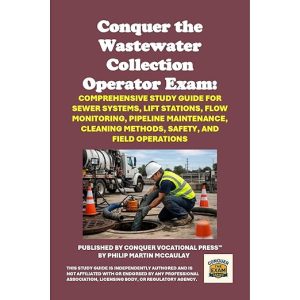
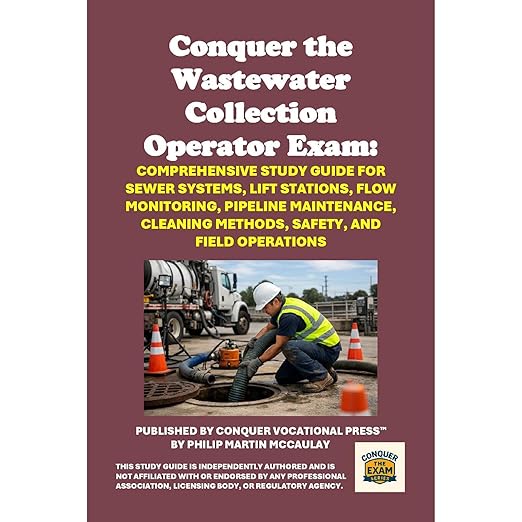
Philip Martin McCaulay has built a small catalog in the skilled trades certification space, and this wastewater collection entry follows the same formula that has served him well: dense technical coverage, structured chapter progressions, and language calibrated for working operators rather than academic readers. The audiobook runs just over six hours, fitting comfortably into a week of commutes or lunch breaks, and the material covers the full operational scope that certification boards test. From pipeline hydraulics to lift station function, from confined space protocols to debris removal methods, the content is comprehensive without padding.
This guide sits in McCaulay's Skilled Trades Exams series, a catalog built specifically around the reality that many trade workers study between shifts, during drives, or at job sites rather than at a desk. That framing shapes how the material is organized: concise explanations followed by practical application notes rather than extended theoretical tangents. For anyone who has stared down a certification exam while juggling a full schedule, the structure makes sense immediately. Wastewater collection work demands situational awareness across hydraulics, mechanical maintenance, and safety regulation simultaneously, and the guide honors that complexity without burying it in academic language.
Preventive Versus Corrective Is the Key Distinction
The audiobook covers three broad pillars: operational principles, maintenance strategy, and field safety. On the operational side, you get clear breakdowns of how hydraulic behavior changes under varying flow conditions, how to read and interpret flow patterns, and how blockage types differ in cause and corrective response. Root intrusion, sediment buildup, and debris accumulation each receive distinct treatment, which matters for operators who need to make fast field decisions rather than consult a manual mid-call.
The maintenance sections are where this guide earns its value for certification candidates. McCaulay draws a clean line between preventive and corrective strategies, which is exactly the kind of conceptual distinction that shows up on professional exams. Understanding not just how to clear a blockage but when to prioritize inspection over intervention, or how to evaluate a system's overall integrity, moves an operator from reactive to systematic. The material on mechanical and hydraulic cleaning, jetting techniques, and equipment operation gives listeners the vocabulary and the conceptual framework to answer scenario-based questions accurately. That systems-level thinking is what distinguishes operators who pass from those who know the individual components but struggle with the integrated questions that certification exams use to test real competency.
Safety receives dedicated coverage rather than being folded into operational chapters as an afterthought. Confined space awareness, traffic and work zone protocols, and emergency response principles are treated as standalone disciplines, which reflects how regulators and certification bodies treat them. An operator who only knows the mechanical side without internalizing the safety framework is an incomplete candidate, and this guide addresses that gap directly. The field operations sections particularly stand out for how clearly they connect regulatory requirements to practical job-site behavior, giving listeners rules they can actually apply rather than abstractions to memorize and forget.
Bring a Notepad, Since the Narration Won't Vary
The Virtual Voice narration is the primary limitation to be aware of before purchasing. McCaulay's technical writing is clear on the page, but technical prose narrated by an AI voice can become monotonous over a six-hour runtime. The delivery is consistent and intelligible, but it does not vary pace or tone to signal when a concept is particularly important versus when it is supporting context. Listeners who are auditory learners may find themselves rewinding more frequently than they would with a skilled human narrator who can modulate emphasis. Having a notepad nearby is more than a study suggestion here; it is nearly a requirement.
The guide is also a conceptual reference rather than a practice test. There are no sample questions embedded in the audio, no timed drills, and no explicit test-taking strategy sections. Operators looking for a format that mirrors the actual exam structure will need to supplement with practice exams separately. What this guide provides is thorough conceptual coverage: if you understand the material here, you will recognize it when exam questions invoke it. But the cognitive work of translating that understanding into exam-style answers is left to the listener. Building a companion practice question resource before exam day is the most effective way to use this audiobook as part of a broader study plan.
Field Experience Makes the Content Click
This audiobook is the right choice for working operators who already have field time and want to formalize their knowledge before sitting for certification. The language assumes basic familiarity with collection system environments, and the practical framing lands better when listeners have something concrete to attach it to. New operators with no field experience may find some sections abstract without context from actual site work.
Listeners who prefer passive audio learning during a commute will find this more accessible than most certification guides, which tend to require close reading. Anyone who has picked up a dense academic wastewater textbook and put it back down will appreciate McCaulay's commitment to plain-language explanations. Skip it if you need a practice question bank as your primary study tool; treat it as the conceptual foundation layer of a broader study plan, and it delivers solid value across its six-hour runtime. Operators who combine this guide with hands-on review and a dedicated practice question set consistently report feeling well-prepared for the range of scenarios that wastewater collection certification exams cover.
Questions Listeners Ask
Does this audiobook cover the full scope of a wastewater collection operator certification exam?
It covers the major operational domains that most state certification exams test, including pipeline hydraulics, lift station operation, cleaning methods, flow monitoring, and safety protocols. It does not include practice questions or exam simulations, so it works best as a conceptual foundation rather than a standalone exam prep tool.
Is this audiobook suitable for operators with no prior wastewater field experience?
The guide assumes some baseline familiarity with collection system environments. Operators who have spent time in the field will find the material grounds their practical experience in formal concepts. Complete newcomers may find some sections abstract without real-world context to anchor the terminology.
How does Virtual Voice narration hold up for six hours of technical content?
It is functional and intelligible throughout, but the AI delivery is uniform in tone, which makes it harder to gauge which concepts the material treats as most critical. Technical terms are pronounced correctly, but the flat pacing makes it worth taking notes as you listen rather than relying on audio memory alone.
Can I listen to this audiobook while working in the field?
That is exactly the format the Skilled Trades Exams series is designed for. The chapters are structured in self-contained segments, so you can pause and resume without losing the thread. That said, safety-critical listening environments should come first; save the more complex hydraulics and diagnostic sections for focused listening sessions.