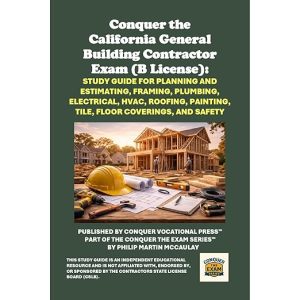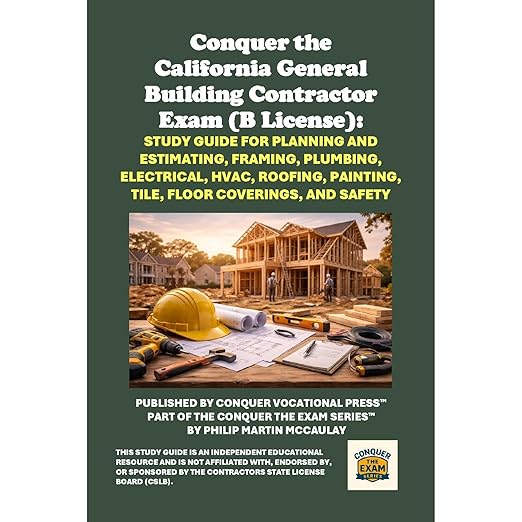
Two hours and eight minutes longer than the title advertises is where any honest assessment of this study guide has to begin. The audiobook runs 3 hours and 38 minutes against a cover promising to get a candidate through in under 90 minutes, and that is neither a rounding error nor a marketing flourish, it is the difference between a lunch break and most of an evening. Everything else about the product turns out to be considerably more reasonable than the headline suggests.
Building Logic Replaces Exam-Section Order
Foundations, framing, roofing, plumbing, electrical systems, HVAC, finishes and site work: that is the territory, and it is organized by how buildings actually go together rather than by exam section. Philip Martin McCaulay writes toward construction logic instead of recall, which the copy states outright, and for a general building license that is the right instinct. The description promises the full scope expected of a California general building contractor, and breadth is what arrives.
Estimating and planning open the sequence, which tells you what kind of guide this is. Not a code compendium and not a drill book, but an orientation to the whole shape of the profession: what has to be decided before anybody breaks ground, how the trades hand off to one another, where safety and professional responsibility sit inside all of it. Anyone who has worked a single trade for a decade and now needs the rest will recognize the problem being solved.
Nothing about the series position appears on this listing. The run is named as California Contractors State License Board exams, with no volume number attached and no indication of how many guides it contains or which classifications the others cover. A candidate who already knows they need the B license can find this by title. A candidate still working out which classification applies gets no help whatsoever.
Short Paragraphs Designed for Easy Listening
Construction logic is genuinely the right frame for spoken delivery. Sequences, dependencies and reasons travel well through a speaker in a way that code tables and load calculations never will, and the copy knows it: short paragraphs, written deliberately for listening, avoiding jargon and outdated references. Somebody thought about the medium before writing, which is rarer in self-published exam material than it ought to be, and the structure shows it.
Plain language is the other deliberate choice, and it matters more here than in most technical writing. A tradesperson studying for a general license is usually reading around a full working day, and the difference between a guide that assumes an unbroken hour and one that assumes whatever time is left between jobs is the difference between finishing it and abandoning it. Short units are the entire design principle.
McCaulay's structure runs subject by subject rather than exam section by exam section, and that choice pays off. You are never asked to hold a syllabus in your head, only to follow how a building comes together from the ground upward. The copy calls that construction logic, and it is the distinction between a guide you can work through while your hands are busy and one that requires a desk, a highlighter and a free afternoon.
When a Machine Reads the Numbers Wrong
Practice is the thing this cannot give you, and the copy is upfront about that. The description promises practical concepts and construction logic rather than memorization, and describes itself as a supplement to hands-on experience and other study materials. A guide positioning itself as supplementary is being honest with you. A title that opens with the word Conquer is not making quite the same promise, and the two sit awkwardly together.
Numbers are the weak point of the format. Estimating is the second subject named in the title, and estimating means figures, units and arithmetic arriving through a synthetic voice with no page to check against. Virtual Voice is the reading credit here, machine-generated rather than human, and a decimal or a unit misheard in a study guide becomes a fact learned wrong. Preview a passage with figures in it.
Seven months on from the December 2025 release, nothing has been rated and nothing has been written. For a self-published exam guide that is unremarkable rather than damning, since candidates buy, pass and move on without posting anything. It does mean every judgment you can make rests on the copy and the sample, with nobody who carried this into a testing center reporting back.
Work Through This One First
Candidates already working in construction are the intended buyer, and the copy says as much: this supplements hands-on experience rather than replacing it. Somebody who has framed houses for years and now has to answer questions about HVAC and finishes gets precisely what they need, which is the shape of the unfamiliar subjects rather than deep treatment of any single one. That is the honest use case, and it is a good one.
Trades workers outside California should check the scope before buying. Everything here is written toward one state board's classification system, and a general building license elsewhere is a different animal with different boundaries. Pass as well if you learn by drilling, or if you retain figures better by reading them, since neither is what a synthetic reading of an estimating chapter will ever give you.
Buy it as the first thing you work through rather than the last, and set the number in the title aside. The under-90-minutes claim describes an ambition, not the file that arrives, and pretending otherwise would do a candidate no favors at all. What you actually get is a coherent survey of nine subject areas from somebody who understands how they connect, in short units you can take in whatever order your week allows.
Key Details
- What it covers: Building systems as one connected process, estimating and planning, trade handoffs, site safety
- Feel: Brisk and orderly, a survey rather than a cram session
- Our call: A sound orientation for a working builder, provided you pair it with an actual question bank.
Frequently Asked Questions
What does the B License classification in this audiobook's title actually cover?
The listing describes it as the general building contractor license for California, which is why the scope runs from foundations and framing through roofing, plumbing, electrical, HVAC and finishes. It is the broad classification rather than a single specialty trade, so the guide favors breadth across systems over depth in any one of them.
Does the audiobook cover the law and business portion of the licensing process?
The description never mentions law, business, contracts or bonding anywhere in its scope. Everything named is technical: planning, estimating, structural systems, the building trades, safety and professional responsibilities. Anyone who needs the non-technical material for licensure should assume it is absent here and source it from somewhere else entirely.
Is this audiobook useful for a builder who is not sitting the exam?
Yes, and the copy says so directly, offering itself to anyone reinforcing their understanding of general building practice as well as to licensure candidates. A survey of how planning, structure, the trades and finishes fit together holds value well outside a testing center, especially for somebody who has specialized narrowly for years.