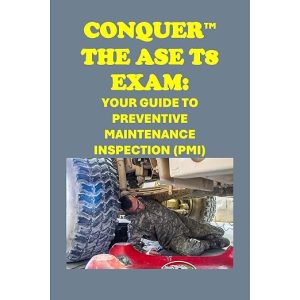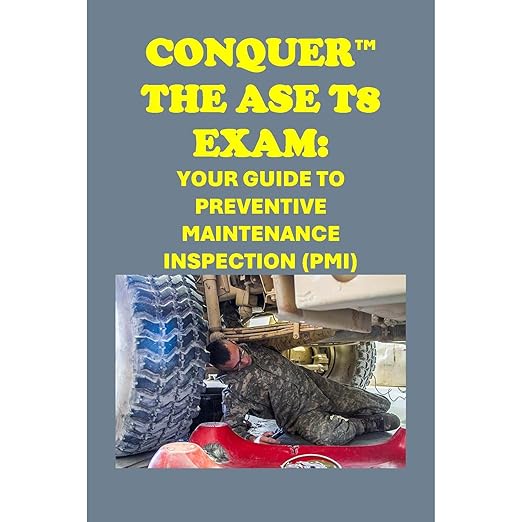
Eight inspection domains are listed in this audiobook's own title: engines, electrical, brakes, drivetrain, steering, tires, suspension and frame. The recording runs two hours and thirty-five minutes. Do that division before anything else, because it tells you what kind of product this is more honestly than the word comprehensive sitting in the same title does. Roughly nineteen minutes per system, and that is before any time is spent on exam strategy or the reasoning behind preventive maintenance itself.
Nineteen Minutes Per System, Read Aloud as Quiz
Philip Martin McCaulay's guide is built around the knowledge a medium and heavy truck technician needs for the T8 exam, and the specific ground it names is practical rather than theoretical: fluid level checks, brake system diagnostics, tire and wheel inspections, electrical system testing. Each chapter is described as combining in-depth explanation with practical tips and real-world examples, which is the standard architecture of exam prep and a reasonable one when the underlying subject is a physical procedure performed on a vehicle.
A second component follows, and it is the one worth thinking hardest about before buying. The guide includes questions and answers meant to reinforce the material and let a candidate test themselves in a format resembling the actual exam. On paper that is a self-quiz. In a recording it becomes a question read aloud, a pause of whatever length the production chose, and then the answer, with no way to commit to a response first, mark what you missed, or return to the ones you failed.
Two different titles describe the same product here. The product page runs the long enumerated version, naming all eight systems. The description calls it 'Conquer the ASE T8 Exam: Your Guide to Preventive Maintenance Inspection (PMI),' a shorter and rather different subtitle. Neither is wrong, exactly, but a buyer comparing this against other T8 materials should know the two titles refer to the same product.
Reasoning Survives Audio Better Than Checklists
Exam preparation is one of the few nonfiction categories where a short runtime is a feature. Two and a half hours can be run twice in a working week without displacing anything, and repetition is most of what certification study actually is. A technician can put this on during a drive between yards or while doing work that occupies the hands and not the ears, which is time that would otherwise produce no study at all.
A conceptual half survives the format better than the checklist half does. McCaulay spends real time on why preventive maintenance matters, framing it around vehicle safety, efficiency and longevity, and on best practices for conducting an inspection safely from start to finish. That reasoning, the logic connecting a procedure to the failure it prevents, is exactly the sort of content that transfers cleanly to audio, because it is argument rather than data.
Where the guide is most useful is as a second or third pass rather than a first encounter. A candidate who has already worked through written material and wants the structure of the exam reinforced will get something out of hearing the domains laid out in sequence, with the connections between systems audible in a way a chapter-by-chapter text can obscure. Steering, tires, suspension and frame are related inspection territory, and running them consecutively makes that relationship clearer.
Synthetic Narration Struggles With Torque Values
Return to the arithmetic, because it is the single most important thing on this page. Nineteen minutes per system is an overview. It is not enough for torque values, tolerance ranges, component-by-component wear indicators, or the kind of granular specification a written guide would tabulate. Read the word comprehensive in the title as describing coverage of the domains rather than depth within them, and set your expectations there.
Virtual Voice is the credited reading, meaning synthetic narration rather than a human performer. That matters more than usual with this subject matter, since technical material is dense with abbreviations, component names, unit measurements and numbers, and synthetic systems handle those inconsistently. Whether that lands as tolerable or as an obstacle depends entirely on your ear, so sample a few minutes of a section carrying actual specifications before committing.
Finally, the listing gives you no crowd to consult. This title carries no average rating, no rating count, and no written reviews whatsoever, published independently in September 2024. It is also filed in a series called Automotive Exams with the series number left blank, so you cannot tell where it sits among its siblings or which other certification domains the same author has covered. You are buying entirely on the description.
Pair This With a Question Bank You Can Mark
A working technician who already performs preventive maintenance inspections, and needs the exam's vocabulary and structure organized in their head, is the right buyer. If the procedures are familiar and the certification is the hurdle, two and a half hours of orderly review while your hands are busy is a genuinely efficient use of otherwise dead time, and the price of admission is low.
Paired with a written guide, a question bank you can actually mark, and hands-on shop experience, this supplies the auditory repetition layer that reading alone does not, and the safety and rationale sections give you something to think about rather than merely memorize. Used that way, the brevity stops being a limitation and becomes the reason you will replay it.
Do not make it your only preparation. A first-time candidate without shop experience needs depth this runtime cannot hold, and the self-test material does not function as a practice exam in audio form. Anyone who needs to see a diagram, a torque chart or an inspection form should buy a text edition instead. For everyone else, treat it as what it is: a compact, well-organized refresher with an unverified production behind it.
- Big ideas: Preventive maintenance inspection, medium and heavy truck systems, certification exam preparation, shop safety practice
- Atmosphere: Procedural, unhurried, closer to a checklist read aloud than a lecture
- Worth it?: A serviceable refresher for a technician who already knows the work, and far too thin to be anyone's only preparation.