- Subjects: ASE electrical certification prep, battery and charging systems, sensors and control modules, systematic fault diagnosis.
- Tone: Methodical and dry, in the way a study guide ought to be.
- Bottom line: A usable audio refresher on vehicle electrical theory, once you work out whether this is the truck book or the automobile book.
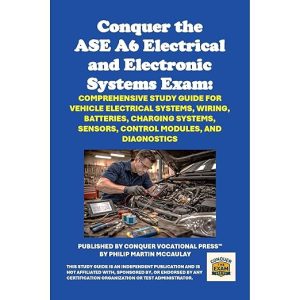
Two exam codes appear on this listing, and they are not the same test. The title sells a study guide for the ASE T6 exam, the electrical and electronic systems certification covering medium and heavy trucks. The description, from its second paragraph onward, names Conquer the ASE A6 Electrical and Electronic Systems Exam and talks about automobiles throughout. Anyone buying this audiobook to prepare for one specific certification needs to settle that question before pressing play.
Nothing about the mismatch reads as a single typo in one line. The title names medium and heavy truck electrical systems, batteries, charging systems, sensors, diagnostics and wiring. The body of the description names the A6 exam by its code, then covers automotive electrical systems, vehicle wiring networks, electronic control modules and multiplex communication, without one reference to trucks or to anything specific to heavier vehicles. One of those two documents is describing a different book from the other.
What the description does promise is coherent on its own terms. Battery operation, starting systems, charging systems, lighting circuits, wiring harnesses, connectors, grounding networks and electronic control modules. Then multiplex communication networks, signal integrity, and the diagnostic methods technicians use to isolate faults on the job. Each chapter is said to build practical understanding of how circuits operate, how sensors communicate with control modules, and how actuators respond to electronic commands. That is a legitimate syllabus for an electrical certification, whichever code ends up printed on the cover.
The rest of the listing fits the same pattern. Philip Martin McCaulay published this independently in March 2026, filed it in a series called Automotive Exams with no number attached to it, and had it produced with Virtual Voice across eight hours and three minutes. No ratings, no written responses, no companion document mentioned anywhere on the page. This is a self-published study guide converted into audio, and the sensible thing is to evaluate it as exactly that rather than as a publisher-backed course.
Highlights
The argument for studying this way is repetition. Certification exams reward recall of definitions, sequences and rules, and spoken material is unusually good at drilling those, because it runs while your hands are busy. Eight hours spread across a working week comes out at roughly ninety minutes a day of passive review, and for a technician who already works on vehicles daily, hearing the theory while doing the practice is a genuinely effective pairing.
Chapter structure helps the format along. The description says each chapter builds on the one before it, moving from how electrical power is distributed through a vehicle to how faults develop and how a technician isolates them systematically. That is a narrative shape rather than a reference shape, and narrative shapes suit listening far better than specification tables ever will. You can follow the logic of a diagnostic procedure with your eyes on the work in front of you.
It also knows what it is. The closing pitch addresses candidates who have already put the study time in and want reinforcement before the exam rather than a first encounter with the material. As a final pass over concepts you half know, taken while driving between jobs or working through a service bay afternoon, that is a defensible purchase. As anybody's only preparation it would be thin, and the description never claims otherwise.
Before You Commit to Conquer the ASE T6 Electrical and Electronic Systems Exam
Narration here is synthetic. Virtual Voice is a text-to-speech credit rather than a person, and on technical material that carries specific consequences: abbreviations, unit symbols and component numbers are precisely what synthesized reading handles least reliably, and an electrical guide is dense with all three. Nobody has posted a written response here to report how it holds up, which makes the sample compulsory rather than optional. Listen to a passage with numbers in it before you buy.
A deeper problem is visual. Electrical training runs on diagrams: wiring schematics, circuit paths, connector pinouts. A guide that explains grounding networks and multiplex communication in words alone is asking you to build those pictures in your own head, and no companion document is listed on this page to help you do it. Pair the audio with a printed schematic set, or accept that what you are getting is the concepts and not the drawings.
And nothing external exists to check any of it against. No ratings, no written responses, no track record on this particular title, which means the exam-code question has to be settled by you rather than by somebody who already bought it and reported back. If you are sitting the truck certification, look for truck-specific content in the sample before spending anything. If you are sitting the automobile version, the description reads as though the book was written for you.
Is This One for You?
Technicians already working on vehicles and preparing for an ASE electrical certification are the audience, and for them the format makes obvious sense: theory in the ear, hands in the engine bay. Anyone who learns by hearing things repeated will get more from a structured spoken run through the material than from a stack of flashcards. It suits a second or third pass over content you have already read once on paper.
Wiring diagrams do not survive the trip into audio, and neither do the specification tables a technician actually has to memorize. First-time candidates should treat this as a supplement rather than as a course in itself. And anyone who cannot tolerate synthetic narration for the length of a study guide should establish that in the first five minutes, because the credit tells you exactly what to expect and no alternative recording of this title exists.
So the recommendation comes with a condition attached to it. As a spoken review of vehicle electrical theory, sensibly organized and pitched at candidates who have already done the reading, this does the job the description sets out to do. But the title says T6 and the description says A6, and those are different certifications with different scopes. Work out which exam you are sitting, then work out which book this is, and only then spend the money.