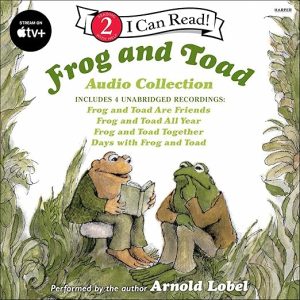
Two grandparents turn up in this review column, alongside a four-and-a-half-year-old and a set of stickers. What never turns up is a recording. All five written responses describe a physical object: a hardcover that looks fancy, pages slightly glossy where the older ones were rougher, a larger format for reading with a child, high-quality stickers on the back pages, terrific pictures on every page. The thing actually being sold is an audiobook, one hour and twenty-nine minutes of it, published in November 2004, with Arnold Lobel reading all four stories.
The Reading Level Is the Practical Line
Five minutes with the description tells you exactly what is in the package, which is not something every listing manages. Four complete books: Frog and Toad Are Friends, Frog and Toad Together, Frog and Toad All Year, and Days with Frog and Toad. All four inside eighty-nine minutes, which works out at roughly twenty-two minutes a book. That is the right scale for stories built from short chapters, and the description picks three of them to show you the register: flying a kite, resisting the temptation of cookies, searching for a lost button. The copy does contain one visible slip of its own, calling the package an audio collections, plural, inside a sentence about one single release.
Every award the copy can name is duly named. A Newbery Honor for Frog and Toad Together, a Caldecott Honor for Frog and Toad Are Friends, an ALA Notable Children's Book, a Fanfare Honor List place from The Horn Book, a School Library Journal Best Children's Book, a Library of Congress Children's Book. More usefully, it states the reading level: a Level Two I Can Read, for kids who read on their own but still need a little help. That single line is the most practical thing anywhere in this listing, and it points straight at what the format is for. Two of those honors belong to individual titles inside the set, which means the award-winning books are the ones in the package, with nothing assembled around them as filler.
The Writer Is Also the Voice You Hear
Most of the argument for the audio sits in the credit line. Arnold Lobel reads these stories, so the person who wrote all four books is the voice delivering them, and for a child at Level Two that is a particular kind of help: someone who can nearly manage the words gets to hear them at the right pace, from the person who chose them. Eighty-nine minutes is also the right length for a bedtime rotation, since every story stands on its own and nothing carries over. It is worth being precise about what the credit does and does not promise. The record names Arnold Lobel and no other performer, with no music and no sound design mentioned anywhere, so expect a reading with no production built around it. For four books of this kind that is almost certainly the right decision.
One thing the description gets exactly right is its pitch: celebrate the power of friendship. Frog and Toad do small things together, and the copy promises that whatever the situation, the two of them end up together. The earliest review on the page explains why that lasts better than any blurb could, describing books that have been around since a daughter was little, more than thirty years ago, now heading to a three-year-old grandson for a birthday. The events on offer are a kite, a lost button and a plate of cookies, which is to say that nothing here needs an effects budget and everything here needs timing.
A Badge Broken in Three Different Ways
Both halves of this page are describing different products. The five responses arrived between May 2025 and February 2026 and praise paper stock, format size, stickers and illustrations. The edition on sale is dated November 12, 2004 and consists entirely of sound. Whatever those five buyers received, it had pages in it, and none of their observations about it, however warm, survives the move to audio. Their affection for the stories does. Their inspection of the printing does not. The gap is not the reviewers' fault and it is certainly not the stories' fault. It belongs to the page, and it means a buyer looking for guidance on this recording will find five warm recommendations for something else.
Anyone checking the badge will find it broken in three ways at once. It reads 4.9 from four votes, and no arrangement of four whole-star grades reaches 4.9. Five written responses appear beneath a counter that says four. And each of those five grades is a five, which places every readable opinion above the badge meant to summarize them. None of this is unusual on a record from 2004, and all three faults tilt in one direction. The stories are not in question here. The page reporting on them is.
Reading Along on the Page While Lobel Reads
Listeners around four to seven are the target, judging by the Level Two label and by the four-and-a-half-year-old in the column who loves the stories. It works for car journeys, since each piece is short and self-contained. It works for a child learning to read, who can follow a printed copy while Lobel reads aloud, which is the use the reviewers stumble into by buying the book instead. And it works for adults who grew up with these and want the versions they remember. HarperCollins is the publisher named on the record. It suits a household that already owns the printed set, too, since eighty-nine minutes of the author reading is a different experience from a parent reading, and small children generally want both.
Here is who should look elsewhere. Anyone buying for the object should read those five responses and then go find the hardcover they are describing, because the stickers and the glossy paper belong to a different purchase entirely. Anyone hoping for a full-cast production should note that a single voice covers everything, which for these particular stories is exactly right. Anyone whose child needs the pictures should think hard, since one response singles out the terrific pictures on every page, and pictures are the one thing an audio edition cannot carry. And anyone shopping by the star average should disregard it completely. Four books, eighty-nine minutes, read by the person who wrote them: that is about as close to authoritative as a children's recording gets.
A Few Questions About Frog and Toad Audio Collection
Are the reviews on this page about the audiobook or the print edition?
The print edition, all five of them. They discuss a fancy hardcover, glossy pages, a larger format, stickers on the back pages and pictures throughout. None mentions a narrator, a runtime or a recording. Their warmth about the stories is worth having; their comments on quality apply to paper you will not receive.
How long does each story run?
The four books fill one hour and twenty-nine minutes between them, averaging around twenty-two minutes a book and much less per individual episode, since each volume collects several short chapters. Nothing carries across from one to the next, so any single piece works on its own at bedtime or in the car.
What reading level is this pitched at?
A Level Two I Can Read, defined in the copy as the stage where a child manages independently but still wants support. In practice that lands around four to seven, matching the four-and-a-half-year-old described in one response. Following along in a printed copy while the recording plays is the obvious way to use it.
How reliable is the 4.9 badge on this audiobook?
Because it cannot. The badge shows 4.9 over a counter reading four votes, a pairing no set of whole-star grades produces, and five written responses are visible where the counter claims four. Every readable grade on the page is a top mark, higher than the badge summarizing them. Read the responses, remembering that they describe a printed book.