
Before You Press Play
- Performance: Kathleen Gati handles seventy-five minutes of genuinely difficult material for an elementary audience, landing serious without turning frightening, according to reviewers.
- What it covers: Holocaust history, elementary-age nonfiction, WWII introduction
- Feel: Sober but carefully calibrated, not something to rush through despite the short runtime
- Our call: Four reviewers, all with young kids in mind, rated this a perfect five, and the substance backs that reaction up.
Explaining the Holocaust to an eight-year-old in just seventy-five minutes is one of the harder assignments in children's nonfiction, and this audiobook takes it on directly rather than softening the subject past the point of usefulness.
Twelve Million Deaths Explained for Age Eight
Gail Herman's entry in the New York Times best-selling What Was? series traces the rise of Hitler and the Nazis, the escalation from humiliating anti-Jewish laws to ghettos across Eastern Europe, and finally the Final Solution, naming the scale plainly: as many as twelve million people killed in Nazi death camps, six million of them Jews. Herman presents just enough information for an elementary-school audience, in the synopsis's own words, in a readable, well-researched account of one of the most horrible periods in modern history, paired in the print edition with eighty illustrations and sixteen pages of black-and-white photographs.
Pssmom's review calls this a difficult topic made genuinely manageable, noting it sparked real interest in World War II that continued well past the book itself, with new information connecting back to what the family had already learned. Jamie's review frames it as a natural next step after Who Was Anne Frank, another entry in the same series, describing the book as presenting the facts of what happened to Jewish people and others targeted by the Nazis honestly, while also noting plainly that plenty gets left out of what victims actually endured, given the age of the intended audience.
Seventy-Five Minutes as an Editorial Achievement
At just one hour and fifteen minutes, this is a genuinely short listen for a subject this weighty, which speaks to how tightly Herman had to compress the material for an elementary reader without losing the core facts a child needs to actually understand what happened and why it matters. That compression is itself a real editorial achievement, distinct from simply writing a shorter book.
Four Five-Star Reviews Outscore a 4.8 Badge
Kathleen Gati narrates seventy-five minutes of genuinely difficult material pitched at an elementary audience, and the four reader reviews on record for this title describe the tone landing exactly where it needs to: honest and serious without tipping into anything frightening or graphic. Yenem's review describes checking the book first for anything gory or inappropriate before handing it to an almost-eight-year-old, and coming away satisfied it handled the material carefully, giving a good basic overview of the lead-up, the Holocaust itself, and its aftermath.
The rating data on this listing is genuinely worth pausing on. The badge shows 4.8 stars from two counted votes, a number that cannot come from only two whole-star ratings under any standard rounding method, but the more striking detail is the other direction entirely: all four of the written reviews visible on this listing give the book a full five stars, meaning the actual visible evidence argues for a higher number than the badge displays, not a lower one, an unusually clean case of the displayed rating undercounting its own reviews.
C's review adds a useful data point too: a seven-year-old who listened learned a real amount from the book, according to the parent reviewing, which suggests the age range this works for may run slightly younger than the eight-to-twelve range often assumed for the broader What Was? series, at least with a parent listening alongside or available for questions afterward.
No page count or ISBN accompanies this particular listing, ordinary for a shorter, illustration-heavy title where the print and audio editions are cataloged somewhat differently, but worth a brief mention since it means anyone comparing formats before buying will need to check the print listing separately instead of relying on this one for those specific details.
Filed as Religions Despite Its WWII History
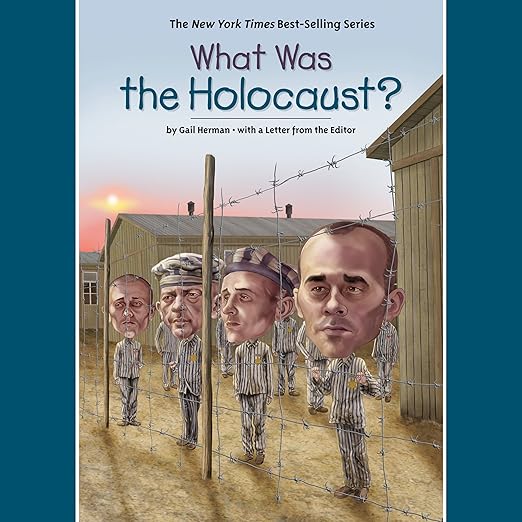
C's review raises a specific, honest critique worth passing along directly: the caricature-style, large-headed illustrations of prisoners that run through this series struck that reviewer as an odd, slightly off-putting stylistic choice given how serious the subject matter is, even while acknowledging the same visual style appears consistently across the entire What Was? series and is not unique to this particular title.
The listing tags this title under Religions rather than history or biography, worth a brief note since the content itself is WWII genocide history, not devotional or specifically religious material, a small classification quirk more than a meaningful signal about the book's actual content or approach.
Listening Library published the audio edition, and given the subject matter, parents may want to preview the seventy-five minutes themselves first or plan to be present for at least the first listen, not because any reviewer flags graphic content specifically, but because a topic this heavy tends to generate questions a young listener will want to ask someone right away rather than sit with alone.
Jamie's review also notes something worth repeating for any parent weighing how much detail is too much: even while praising the book's honesty, the same review points out that plenty of what victims actually endured gets left out, a deliberate editorial choice for the age group, not an oversight. That balance, honest about scale and consequence while withholding the most graphic specifics, seems to be exactly what the four reviewers rating this a perfect five responded to.
Pair This With Who Was Anne Frank
Parents introducing Holocaust history to elementary-age kids, particularly around the seven-to-eight range multiple reviews mention directly, will find this a carefully calibrated starting point, especially alongside Who Was Anne Frank as a natural companion listen. Four reviewers, all writing with young kids specifically in mind, rated this a perfect five, and the substance backs that reaction up rather than just the enthusiasm. The one reason to hold off is the series' particular illustration style, flagged honestly by one reviewer here, if that is something you would rather avoid entirely, since the audio narration itself does not carry that specific concern with it.
Frequently Asked Questions
How can this audiobook be rated 4.8 stars from just two votes when every review shown gives it a perfect five?
It is a genuine data inconsistency worth flagging rather than trusting outright. Two counted votes cannot mathematically produce a 4.8 average under any standard rounding, and all four visible written reviews rate the book a full five stars, actually higher than the badge displayed.
Is this Holocaust audiobook too graphic or scary for a seven-year-old?
Reviewers say no. Multiple parents specifically checked for gory or inappropriate content before letting young kids listen, and found the book handled the subject honestly but without graphic detail, appropriate for the seven-to-eight age range several reviews mention directly. That careful calibration appears to be exactly what drove the book's uniformly strong ratings among the parents reviewing it.
Should I read Who Was Anne Frank first, or does this one work as a standalone?
It works as a standalone, though one review specifically recommends it as a natural next step after Who Was Anne Frank, suggesting the two titles complement each other well as a pair within the broader What Was? series for young readers.
Do the print edition's illustrations factor into the audio experience at all?
Not directly, since the audiobook itself is narration only. But one review raises a real critique of those illustrations anyway, describing the series' caricature-style, large-headed drawings of prisoners as an odd, slightly off-putting choice for such serious subject matter. Parents specifically curious about that visual approach should check sample pages of the print edition before deciding either way.






