
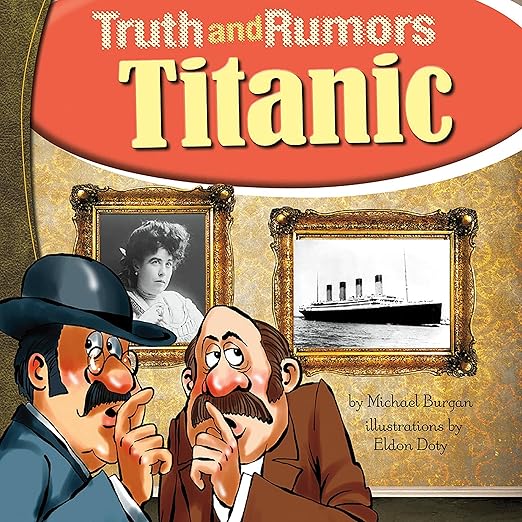
Michael Burgan's Titanic is a children's audiobook covering one of history's most retold disasters in a format designed for young listeners. At just 22 minutes, this production delivers the essential facts of April 15, 1912, the night the RMS Titanic sank in the North Atlantic, in a format a first or second grader can follow without adult mediation. This listing does not credit a narrator by name, which is worth noting upfront: the anonymous delivery is clear and functional, if unremarkable, and families who prioritize named narrator performances should factor that absence in before purchasing.
Burgan Separates Fact from James Cameron's Myth
Burgan's approach separates fact from rumor, which is the right editorial choice for young audiences who have likely absorbed a mix of accurate history and Hollywood mythology about the disaster. The Titanic story has circulated in children's media for decades, often in forms that blend factual accounts with dramatized elements that obscure what actually happened on the night of April 14 to 15, 1912. This production holds to the documentary record, covering the ship's construction and maiden voyage, the iceberg collision, the insufficient lifeboat capacity, and the rescue operation that reached survivors too late for most of the 1,500 people who died. At 22 minutes, the coverage is necessarily brief, functioning more as a reliable introduction than a comprehensive account. The reviewer who brought it home from a school library and listened alongside a 7-year-old describes it as one of those rare finds that worked for both parent and child simultaneously, which reflects exactly the cross-generational accessibility Burgan achieves. That reviewer notes a specific appreciation for the separation of truth from rumor, a feature that makes this particularly useful for children who have encountered the James Cameron film's more romantic framing of the disaster. A second reviewer purchased an additional copy as a gift for an adult Titanic enthusiast, which suggests the factual content has substance beyond the early elementary bracket, though that remains a secondary audience. Burgan has written extensively in the children's nonfiction space, and his approach to the Titanic story reflects his understanding that young readers benefit from a narrator who takes the subject seriously without converting a tragedy into either cautionary parable or pure disaster spectacle. The production does not simplify the essential sadness of the event, but it handles the material with the calibrated care that young listeners aged 6 to 9 need to process a large historical death toll without distress.
22-Minute Runtime Corrects the Film's Romance
The 22-minute runtime is both a limitation and a genuine practical asset. A child who becomes interested in the Titanic through school, a museum visit, or a reference in another book can get reliable foundational information in less time than a single car journey. Burgan's writing for early readers consistently favors precision over elaboration, and this production reflects that discipline. The anonymous narrator reads at a pace that matches the target age group without condescending. For a child who has been exposed to the 1997 film, the corrective value of straightforward nonfiction is real: the audiobook does not deal in romance and spectacle but in the structural failures, the missed iceberg warnings, the inadequate lifeboat provision for the passenger manifest, and the conditions of the North Atlantic that night. Parents who want to introduce historical catastrophe to young children in an age-appropriate framework will find this a reliable tool. The brevity of the production also makes it repeatable: children who want to return to the material can do so without the commitment that longer nonfiction audiobooks require. The fact-versus-rumor framing also opens a useful conversation for parents and children about how historical events become distorted in popular retelling, which gives this 22-minute production more educational leverage than its runtime might suggest.
Class Divisions Receive Only Minimal Treatment
The brevity of the production means significant aspects of the story receive minimal treatment. The class divisions aboard the Titanic, the distribution of lifeboat access by passenger deck, and the political aftermath of the inquiry are acknowledged rather than examined. Children who want to go deeper after this introduction will need additional resources. Because the narrator is anonymous, the production value here is functional rather than distinguished. No music, no sound design, and no performance texture beyond clear articulation at a steady pace accompanies the reading. This is a reading of a children's nonfiction book rather than a produced audio experience. With only two ratings attached to this listing so far, extended review evidence is genuinely limited, but both of those ratings hold at five stars, and the school library context behind both reviews confirms the educational suitability of the material. For a 22-minute production, expectations should be calibrated accordingly: this is a factual starting point, not an immersive documentary, and it serves that function reliably. Families looking for a fuller treatment of the Titanic for young listeners should treat this as a first step rather than a final resource on the subject.
Ages 6 to 9 Get a Reliable Introduction
Children ages 6 to 9 who have developed an interest in the Titanic story through school or popular culture will find this a reliable, age-appropriate introduction to the actual historical facts. Parents and teachers looking for a concise nonfiction supplement to classroom units on historical disasters or maritime history will find the 22-minute format perfectly suited to a single session. Adult Titanic enthusiasts looking for depth or analysis should look to longer-form nonfiction productions. This audiobook serves the early elementary audience it was designed for and does that job without overreach, functioning as a trustworthy starting point for a topic that children frequently want to explore further.






