
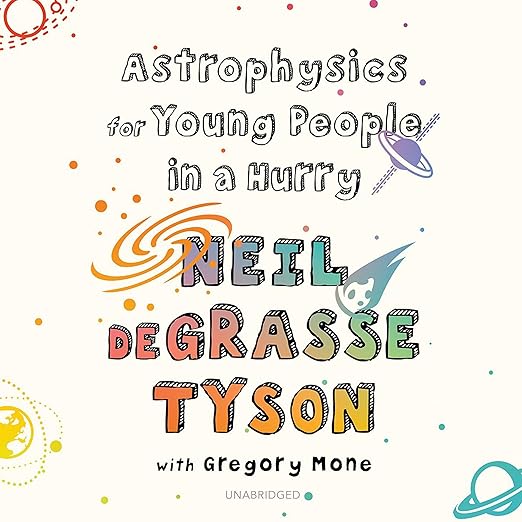
Gregory Mone gets the byline on this audiobook, and the book underneath the byline belongs to somebody else. The author field on the listing reads Mone. The description talks about Neil deGrasse Tyson's number-one bestselling guide to the cosmos, adapted for young listeners, with Mone credited inside the summary for the adaptation and for the extra explanations that make the trickiest concepts land. Both facts are true and the listing presents them in the wrong order, which matters because adaptation for young readers is a genuine craft job and the person who did it here is being quietly credited as the author of a book that arrived already written.
Burton's Pacing Must Slow Before Hard Ideas
The adaptation is the whole product, so it deserves the attention the listing withholds. Taking a bestselling book on the nature of space and time and cutting it into pieces a ten-year-old can hold is not abridgement, it is translation between two audiences. The description is specific about the method: the fundamental rules and unknowns of the universe described clearly, Tyson's characteristic wit kept in place, and additional explanation added wherever a young listener would otherwise fall off. The result runs three hours and thirty-two minutes, which counts as a serious runtime for a children's science title and a laughably short one for astrophysics.
LeVar Burton is credited with the reading, and the demands here are unlike those of a children's novel. No cast needs differentiating and no plot needs suspense. What explanatory nonfiction for young listeners actually requires is pacing that slows before a hard idea and moves briskly through the setup, plus emphasis placed exactly where the sentence turns. Get that wrong and a curious child stops following at minute forty. The listing tells you only who is reading, so the credit is the whole of the available evidence, and it is a credit the publisher clearly chose deliberately.
Ages Range from Eight to Twelve in the Column
Parents in the review column supply something the marketing copy never does, which is a real spread of ages and outcomes. One entry describes an eight-year-old who has listened many times and keeps coming back to it. Another describes a twelve-year-old who found it dry and over her head, while the adult who bought it as supplemental homeschool material found it fascinating. A third says even adults can appreciate it, and a fourth calls it a fun read for little curious minds. The pattern that emerges is not about age at all, it is about how badly the kid already wants the subject.
T's entry is the one to read twice. If your kid is invested in science, this works, and that reader's own child has come back to it repeatedly. Then comes the honest part: most kids realistically will not have the desire or the attention span, because the material is still astrophysics no matter who adapted it. The same entry adds a detail some families will care about, noting that Tyson's extra opinions are largely absent here and the content stays on the science.
That runtime lands close to ideal for this kind of purchase. Long enough to cover real ground, short enough that a child who likes it can replay it on a couple of car trips, and comfortably inside a single road journey. One reviewer calls the scientific information captivating in the way it is written, which is the outcome an adaptation like this is aiming for, and repeat listening from the youngest reader mentioned in the column is stronger evidence than any single star rating.
Kathy Praises Pictures in an Audio Edition
The rating badge cannot be taken at face value. It displays 4.8 against a counter reading two votes, and no pair of whole-star ratings produces 4.8 under any rounding convention in use. Five written responses sit below that counter, which is three more than the counter admits to. Whatever population generated the average, it is not the one you can read, so use the written entries and disregard the decimal.
Kathy's entry praises the pictures in the book as a nice feature, which is a true statement about an object this edition is not. Purchases in this column are visibly mixed between print and audio, with one parent describing it as supplemental curriculum and another using the language of buying a physical copy. The plot-free nature of the material means very little is actually lost in the move to audio, apart from the illustrations, but it does mean several of these verdicts were reached while looking at a page.
Wit is the promise that carries the most risk. The description guarantees Tyson's characteristic humor survives the adaptation, and humor in a children's science book is almost entirely a matter of timing, which makes it the narrator's problem rather than the author's. The listing also gives no recommended age anywhere, leaving the column to fill that gap with a twelve-year-old who struggled and an eight-year-old who did not. Anyone buying this as a gift is working without the one number that would help most.
For the Kid Who Asks About the Universe
Science-forward kids are the target, and the evidence in the column suggests roughly eight and up if the interest is already there, older if it needs coaxing. Families who listen together in the car get a bonus, because the adult in the front seat is very likely to enjoy it too, and at least two reviewers say exactly that. Adults who want the cosmos explained quickly and cleanly, without the length of the original edition, will find this a legitimate shortcut rather than a compromise.
Families whose children need narrative to stay engaged should think twice, since nothing here is a story and the strongest warning in the column comes from someone who liked the book. Anyone buying for the illustrations should buy the print edition instead. Give it to the kid who already asks what the universe is made of, and skip it for the kid you are hoping to convert.
- Narration: LeVar Burton reads three and a half hours of explanatory science for young listeners, where the job is pacing and emphasis instead of character work, and the publisher clearly picked the voice on purpose.
- Themes: The basics of physics, the nature of space and time, scientific inquiry as a habit of mind.
- Mood: Brisk, curious, genuinely funny in places.
- Verdict: Buy it for the kid who already asks about the universe; it will not create that kid from scratch.






