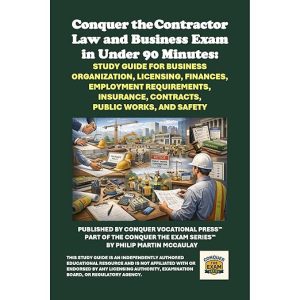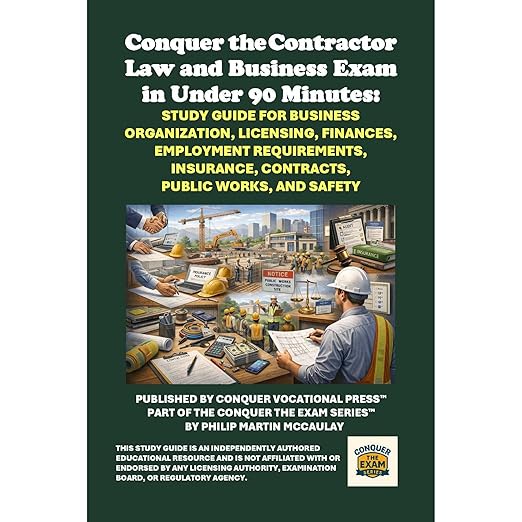
Conquer the California Contractor Law and Business Exam in Under 90 Minutes sits in a specific and underserved category of audiobook: the professional licensing study guide designed to deliver regulatory knowledge efficiently to listeners who need to pass an exam, not write a dissertation. Philip Martin McCaulay's approach across the Conquer the Skilled Trades Series has been to strip away academic scaffolding and deliver the essential frameworks of each licensing domain in concentrated form. At 1 hour and 23 minutes, this audiobook is not attempting to replace comprehensive study materials. It is attempting to organize what you already know and identify the structural logic beneath California contractor law so that the exam's multiple-choice architecture becomes navigable rather than random. For contractors approaching the California State License Board exam who want a final orientation pass rather than an intensive course, that distinction matters considerably.
Payment Timing Gets Clearer Than in Longer Guides
The guide's structure follows the actual shape of what the California contractor licensing exam tests. It opens with the regulatory and business identity of contractors as licensed entities: how licensing classifications shape the legal authority a contractor holds, what professional representation requires, and how compliance with state standards is both an operational and reputational matter. These early chapters frame contracting as a disciplined business practice, which is a useful reframing for tradespeople who think of themselves primarily in technical rather than business terms. The financial chapters address cash flow, job costing, payroll administration, and business oversight with a practical orientation. The guide's treatment of how money moves through a contracting business, particularly around variable payment timing and the structural lag between work completion and invoice settlement, is more coherent than similar content in longer study materials that bury the same information under accounting theory that most working contractors have no use for.
McCaulay's framing throughout treats contracting not as a purely technical trade but as a disciplined business practice, which is the perspective the California exam is testing. Contractors who have spent years developing technical skill but less time on the business and regulatory dimensions will find this reframing useful as an exam-prep orientation, even if they already know much of the content intuitively from practice.
Contracts, Payments, and Safety Share One Framework
The employment law and insurance sections form the middle of the guide and address workforce relationships, supervision structures, workers' compensation, bonding, and the ways in which labor decisions intersect with legal liability. For contractors who have operated informally or who are formalizing existing businesses to meet licensing requirements, this section makes the connection between operational choices and legal exposure explicit in ways that informal experience does not always reveal. The final sections cover contracts, payment protections, public works requirements, and safety obligations. The guide synthesizes these as interconnected rather than separate domains, showing how risk allocation in a contract, payment rights preservation through proper lien procedures, and regulatory compliance in public construction all belong to the same framework of professional responsibility. That synthesis is where the guide earns its claim to be useful in under 90 minutes: it provides a structural map rather than a comprehensive reference, and structural maps are exactly what exam anxiety tends to scramble. Listening to the full guide twice in the final days before the exam is a realistic and efficient use of the runtime.
AI Narration Skips the Pedagogical Pauses
The Virtual Voice narration presents a real consideration for exam-prep listening. In educational audio, the narrator's emphasis, pause structure, and pacing serve a pedagogical function. Emphasis signals what is most important. Pauses create retention windows. AI narration does not deploy these tools with the same intentionality as a human narrator who understands the material being taught. Listeners using this audiobook for active exam study should supplement the audio with a written outline or set of notes that they build during or after listening. The material is structured enough to support note-taking, and the chapter organization provides natural breakpoints for review. No listener reviews are currently available for this title, which is worth noting: the series targets a professional rather than general readership, and the audience for exam-prep audio tends to be task-focused rather than review-writing. This audiobook functions best as one component of a study system rather than as a complete preparation strategy on its own.
California Contractors Get a Final-Review Tool
This audiobook is specifically designed for contractors in California preparing for the CSLB law and business licensing exam, and its value is concentrated for that audience. It works well as a final-review tool in the days before an exam, a structural orientation resource early in the study process, or a supplement for tradespeople who have strong practical knowledge but gaps in the regulatory and business dimensions of California contracting law. It is not suitable as a primary study source for someone with no prior exposure to contractor licensing concepts, and it should not be treated as a comprehensive legal reference. Listeners outside California will find limited direct relevance, since the guide's content is jurisdiction-specific, organized around the CSLB framework and California's specific regulatory environment for contractors. For its intended audience, the runtime alone, covering seven distinct content areas in under 90 minutes, makes it an efficient investment of listening time before the exam.
Quick Take
- Narration: Virtual Voice handles the dense regulatory and legal content functionally, though the AI delivery lacks the pedagogical emphasis a skilled human narrator would bring to exam-focused material.
- Themes: California contractor licensing, construction business finances, employment and safety compliance
- Mood: Direct and practical, structured for retention
- Verdict: A concise audiobook study companion that covers California contractor law and business principles efficiently, best used alongside written notes or a printed outline for exam preparation.
Is this audiobook sufficient on its own to prepare for the California contractor licensing exam?
No. At 1 hour and 23 minutes, the guide provides a focused structural overview and synthesis of key legal and business principles, but it is designed as a review and orientation tool rather than a complete study course. Most candidates will benefit from using it alongside more detailed written study materials and practice questions.
Does this audiobook cover all sections of the CSLB law and business exam, or only parts of it?
The guide covers licensing and business organization, financial management, employment law, workers' compensation and insurance, contracts, public works requirements, and safety obligations, which corresponds to the main content domains of the California contractor law and business exam. It does not go into trade-specific technical content.
How does the Virtual Voice narration affect usability for exam preparation?
Virtual Voice delivers the content clearly but without the pedagogical emphasis that a human narrator would apply to exam-critical material. Listeners are advised to take notes during or after listening to compensate for the absence of vocal cues that signal what matters most, and to replay sections covering unfamiliar regulatory or financial concepts.
Is this audiobook specific to California, or does the content apply to contractor licensing in other US states?
The content is specifically structured around California contractor law and the CSLB licensing framework. While some of the general business and financial principles apply broadly, the regulatory specifics, including licensing classifications, public works requirements, and certain insurance and bonding rules, are California-focused and may not apply in other jurisdictions.