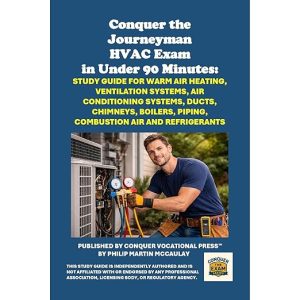
Seventy-seven minutes is what this audiobook actually runs, against a title promising to get you through California C-20 material in under ninety. That claim checks out, which is worth confirming rather than assuming, because a title that advertises its own running time is making a testable promise. What the title does not resolve is which credential the content inside is aimed at, and that turns out to be the real question on this page.
Philip Martin McCaulay has built this as a refresher rather than a textbook, and the description is unusually honest about it. The intended buyer already works with these systems and wants a structured review before a test date, not somebody meeting a furnace for the first time. That framing is accurate and it is the most important sentence on the listing. Study guides in this category routinely oversell what they can do for a beginner, so a product that names its ceiling before you buy is already behaving better than the shelf around it.
Coverage is broad for the length: furnaces, boilers, air conditioning systems, ductwork, chimneys, venting, fuel delivery, controls, insulation and refrigerant fundamentals. Special attention goes to combustion air, ventilation pressure relationships, refrigerant piping integrity, hydronic circulation and commercial kitchen exhaust, alongside chilled and condenser water piping and firestopping. That is a long list for a little over an hour of audio.
Virtual Voice appears in the reading credit, which means a synthetic reading rather than a performer. On this material that is a specific trade-off rather than a general one. The vocabulary is dense and unforgiving, and words like hydronic, firestopping and condenser have to survive text-to-speech intact for the review to be usable at all. Check the sample against those terms before relying on it.
Combustion Air Concepts Are Easy to Half-Remember
Combustion air and ventilation pressure relationships are exactly the sort of topic where an audio refresher earns its keep. They are conceptual rather than numerical, they get tested, and they are easy to half-remember. Hearing the logic restated between jobs is a different kind of rehearsal from rereading a chapter, and it reaches a slot in the day when reading is impossible.
An hour and change forces the guide to choose, and the description says plainly what it chose: system behavior and operational logic ahead of theory. It explains how components act as an integrated assembly rather than as a parts list, and it says it avoids unnecessary theory while keeping the depth needed to understand real operating conditions. For an exam testing judgment about performance, that is the right priority.
Audio suits this structure better than most study material manages. The description states the content was arranged for efficient listening, and the topic order, running from heat sources through distribution to controls and refrigerant, follows the way the systems physically connect. That sequencing is what makes a linear format tolerable when skimming is not available to you. Each topic arrives roughly where the previous one hands off, which is how the systems behave in a building, and it means a listener can follow the argument without needing to jump backward to a section they missed.
Journeyman Language Doesn't Match the C-20 Title
Journeyman is the word that should stop you. The title sells a Contractor Exam and names the C-20 license; the description then describes journeyman-level systems and, separately, areas often tested at the journeyman level. Those are different credentials with different scopes, and nothing on this page reconciles them. Compare the topic list against the outline for the exam you actually registered for.
No ratings and no written responses appear on this listing at all. Independently produced and dated February 2026, it arrives with no reception to consult, no ISBN and no page count, and the series field names a skilled trades series while leaving the position inside it blank. Everything you can judge comes from the description and the sample.
Anyone expecting practice questions should look again at what this is. The description promises a focused technical review, not a question bank, and calls itself an efficient refresher rather than an exhaustive textbook. It is a way to reload concepts, not a way to rehearse the format of a timed exam, and those are different preparation problems. The value sits in the last week before a test, when the material is familiar and the job is holding it all in your head at once rather than learning any of it for the first time.
Save This for Listening in the Truck Later
Tradespeople already working in HVAC who need to consolidate before a test date are the intended buyer and the correct one. If you install and service these systems every week, this restates what you know in the vocabulary the exam uses, which is frequently the actual gap between competence and a passing score. Technicians who learned on the job often know exactly how a system behaves without knowing the phrase an examiner will use for it, and a compressed review in exam vocabulary is a direct fix for that specific problem.
First-timers should not start here, and the description makes no claim otherwise. Someone learning combustion principles from scratch needs diagrams, worked calculations and time, none of which a listening-first refresher can supply. The same applies to anyone who needs code references written down, since a spoken citation is not something you can check later without a search.
Load this onto whatever you listen to in the truck and treat it as the last pass before a test rather than the first. It costs little time, it is accurate about its own length, and its weakest point is the gap between the license named in the title and the level described in the copy. Confirm which exam you are sitting, then decide.
- At its heart: Combustion and airflow logic, hydronic circulation, refrigerant fundamentals, exam-oriented review
- Vibe: Dry, compressed, strictly functional
- Short version: An accurate short refresher for working HVAC technicians, undercut by a title and a description naming two different credentials.
Frequently Asked Questions
Does the audiobook really fit the material into under 90 minutes?
It does. The entry runs one hour and seventeen minutes, so the promise in the title holds, which is worth verifying rather than assuming on any title that advertises a duration. What it cannot do inside that window is teach anything from the beginning, and the description does not claim it will.
Is this aimed at the C-20 contractor exam or at a journeyman test?
The title names the contractor license, while the description twice describes journeyman-level content and topics tested at that level. The page never resolves the difference. Set the topic list beside the official outline for whichever exam you registered for before treating this as targeted preparation for it.
Are there practice questions in the audiobook?
No. The description calls it a focused technical review and an efficient refresher rather than an exhaustive textbook, and nothing on the page promises a question bank, worked problems or timed drills. Use it to reload concepts, and take your question practice from a source built specifically for that.
What does the Virtual Voice credit mean for material this technical?
It means a synthetic reading rather than a human performer. On terminology like hydronic, firestopping and condenser water, pronunciation and pacing carry more weight than they would in fiction. Play the sample and confirm the technical vocabulary comes through cleanly before you depend on it the week before a test.