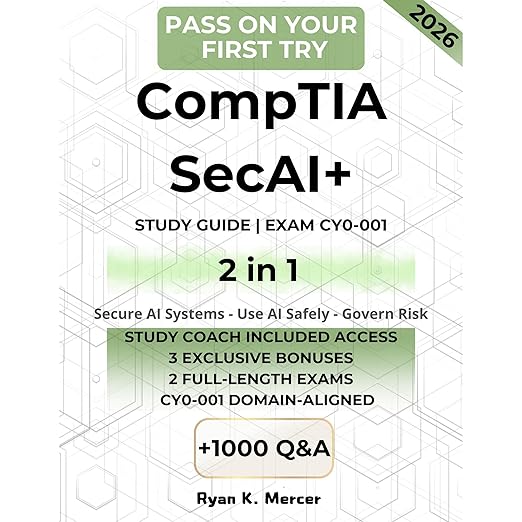
At a Glance
- Subjects: securing large language model applications end to end, prompt injection and data poisoning, guardrails and monitoring, evidence-ready governance
- Tone: dense, procedural, briskly commercial
- Bottom line: The explanation half is worth hearing and the workbook half cannot survive the format, so buy it as a companion rather than as a course.
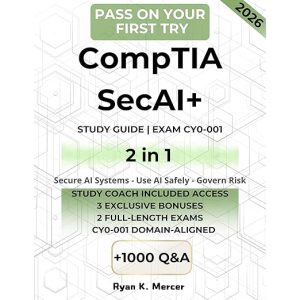
Workbooks are strange things to hear read aloud, and this listing is two products welded together: a study guide, which audio can carry, and a workbook, which audio cannot. The subject is new enough that most candidates have no reference point at all. CompTIA's SecAI+ exam, coded CY0-001, covers the security of systems built on large language models, and this audiobook spends eighteen hours working through the domains, the threats and the controls.
Prompt Injection Vocabulary Is the Actual Exam
Value sits in the domain list, and that list is specific. Securing AI systems end to end means inputs, outputs and gateways, retrieval pipelines, embeddings and vector stores, and the data protection wrapped around all of it. The threat side names prompt injection, including the indirect kind, data poisoning, model extraction and inversion, and compromise arriving through the model supply chain. That vocabulary is the exam, and it is equally the part of the job most security teams are currently improvising.
Synthetic Narration Handles Definitions Better Than Expected
Heard rather than read, that material behaves better than you would expect. Definitions, threat taxonomies and control lists are exactly the content a listener absorbs on a second pass, and the book is organized so that each chapter closes with what the copy calls a toolkit: checklists, playbooks and a framework for what to do first. Spoken procedure sticks. A candidate who wants the concept layer loaded before drilling questions on a screen is well served by that arrangement.
Credits are where confidence has to be rationed. The byline reads YneCha Publishing rather than a named practitioner, so nothing on the page attaches this material to a person with a track record in AI security, and the publisher line reads as an independent release. The reader is credited as Virtual Voice, which means synthetic narration rather than a human performance, a workable trade for reference material and a demanding one across eighteen hours of it.
Guardrails Become Engineering Rather Than Policy
Threat taxonomy is the strongest reason to press play. Prompt injection is a term most security professionals can name and few can defend against systematically, and the copy is careful to include the indirect variety alongside the obvious one. Model extraction, inversion and poisoning belong to the same family of problems, and hearing that whole family laid out in a single sequence is an efficient way to build the map that later reading hangs on.
The operational chapters are the second argument. Guardrails get treated as engineering rather than as policy: retrieval authorization, tool gating, output controls, logging, monitoring and incident response, with a separate strand on using AI inside a security operations center, where the questions concern triage, automation boundaries and how an analyst verifies what a model produced. Anybody whose organization is deploying assistants faster than it is governing them will recognize every one of those headings.
Governance closes the loop, and the copy is unusually concrete about it: policies, approvals, control mapping and audit artifacts, described as evidence-ready. That framing matters more than it sounds, because the gap between holding a control and being able to prove you hold it is where audits get lost. Timing is the other advantage. A certification this new has almost no study material standing behind it, and being early with the vocabulary carries value by itself.
Ninety Practice Questions Read Aloud Aren't Practice
Now the problem this listing never acknowledges. Half of the advertised product is a workbook: two full-length practice exams of ninety questions each, more than a thousand exam-style questions spread across chapter drills, domain review sets and final mixed reviews, plus scenario labs. Multiple-choice practice read aloud is not practice. You cannot cover the answer, cannot time yourself honestly, and cannot mark the ones you missed for a second attempt next week.
Two artifacts of the print edition survived the conversion untouched. The bonus pack, which bundles extra full-length exams, a flashcard set and access to a study coach, is unlocked by a QR code described as printed inside the book, and a listener has no way to scan a page nobody is holding. The description then closes by instructing you to scroll up and click Buy Now. Neither line was written for audio, and no companion file is named anywhere here.
No listener evidence exists to fall back on either. The page carries no rating and no written response, which for a February 2026 release means nobody has publicly finished it, and the exam is new enough that no consensus about study materials has formed anywhere yet. The copy also states plainly that the book is not affiliated with, sponsored by or endorsed by CompTIA, which is standard for third-party preparation and worth hearing before you assume otherwise.
Buy This for Vocabulary, Buy Questions Elsewhere
Candidates sitting CY0-001 who already work in security are the right buyer, particularly anyone who wants the concepts in place before starting on questions. The copy names its audience precisely: security professionals moving into AI security, analysts and engineers using AI tools in daily operations, and the risk and governance people who have to sign off on what those tools are allowed to do. Each of those three groups has chapters written for it.
Anyone hoping to pass on the recording alone should reconsider, because the assessment half of this two-in-one does not exist here in any usable shape. The same goes for a complete beginner in security. The vocabulary assumes you already know what a gateway, an authorization boundary and an incident response process are, and nothing in the description promises a foundation course underneath the AI material.
Certification audio has one honest use, which is repetition during the hours when reading is impossible, and a domain this new rewards repetition more than most. Buy this for the explanations, the threat vocabulary and the operational chapters, then buy your questions somewhere you can see them. Judged as half a product delivered in the right format and half a product that could not survive it, it earns a place beside your drilling, not in front of it.
Good to Know
Can I prepare for CY0-001 with this audiobook alone?
No. The recording carries the explanation half of the product perfectly well, but the assessment half needs a screen: timed attempts, visible answer choices, and a record of what you got wrong. Pair it with any question bank you can look at, and use the audio for concepts and vocabulary between those sessions.
Who narrates the audiobook?
The credit reads Virtual Voice. That means a machine-generated reading rather than a hired performer, and for definitions and checklists the trade is tolerable, while across a listing this long it becomes the main comfort question. Play the sample and decide whether the voice holds your attention through a dense technical passage before spending anything.