
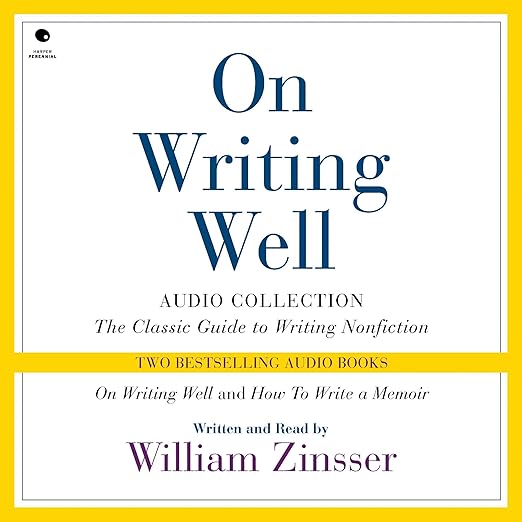
William Zinsser's famous opening provocation, that few people realize how badly they write, sounds different when you hear him say it. The On Writing Well Audio Collection pairs two of Zinsser's most significant works on writing craft, the foundational On Writing Well and the shorter How to Write a Memoir, in a single two-hour and twenty-three-minute audiobook narrated by Zinsser himself. Given that On Writing Well has sold over a million copies and grew out of a Yale course on the craft of writing, this audiobook belongs in a small category of works that have actually shaped how serious nonfiction writers think about their prose. That it is narrated by its author at a stage in his career when he had spent decades applying his own principles makes the listening experience something beyond instruction.
A Book About Voice That Has One
The central argument of On Writing Well is not complicated: good writing is clear thinking made visible on the page, and every element of prose that obscures meaning, every unnecessary adjective, every passive construction, every jargon term that avoids precise language, is a failure of respect toward the reader. Zinsser has spent decades making this case in terms that are themselves a demonstration of the principle. His sentences are short, specific, and load-bearing. The Yale course from which the book grew produced what he describes as a generation of writers looking for clues to clean, compelling prose, and the course notes' evolution into book form reflects how those principles scale from classroom instruction to general guidance.
The memoir companion piece, How to Write a Memoir, addresses a more specific formal challenge with the same clarity. Zinsser draws the distinction between memoir and autobiography with precision: autobiography is comprehensive chronological self-documentation; memoir is the writer deciding what matters and why, then rendering it with the full force of their specific voice and perspective. The examples he draws on, Annie Dillard's management of compression, Frank McCourt's handling of difficult childhood material, Eudora Welty's attention to the texture of place, are not decorative references but working demonstrations of the principles being discussed. For anyone who has been circling a personal story without knowing how to enter it, Zinsser's guidance on how a memoir earns its focus is among the most practically useful thirty minutes in the collection.
Reviewer Lorilyn Roberts describes reading the book twice and finding that it has depth and soul where a conventional writing manual would have only recipes. That quality, the sense that Zinsser is writing about writing with all the same convictions he is advocating for, is what elevates the book beyond handbook status. Reviewer Diana Paraskevas noted the conversational tone as a standout feature, which is itself a formal achievement: a book about voice that has one.
The Right Word Over the Almost-Right Word
Zinsser narrating his own work is the definitive case for self-narration in nonfiction writing instruction. His voice carries the warmth and precision of a teacher who has spent years in conversation with his subject, and when he reads a passage about the importance of the right word over the almost-right word, the care with which he has chosen each syllable of the sentence is audible. Two hours and twenty-three minutes is a short commitment for a work of this standing, which makes it particularly well-suited to writers who return to it periodically rather than reading it once and moving on.
The Yale origin gives the content a specific pedagogical coherence, each principle earned through classroom test and student feedback, that differentiates it from the more impressionistic writing advice that fills the genre. Zinsser is not offering personal style preferences dressed up as rules; he is describing what works and what does not in terms developed through decades of teaching writers across many different disciplines and backgrounds. The audio format suits both works in this collection, as On Writing Well is already written to be read aloud, its rhythm and sentence structure shaped by a consciousness of how prose sounds.
Two Complete Works, One Curated Presentation
The two-hour and twenty-three-minute runtime is genuinely short for two complete works, and listeners should understand that what they are receiving is a curated audio presentation rather than an unabridged reading of both full texts. The condensed format preserves the essential arguments and many of the specific examples that make Zinsser's case concrete, but readers who want the complete versions of both texts should supplement the audio collection with the full print editions, particularly for the longer On Writing Well which contains additional chapters on specific nonfiction forms, including science writing, business writing, and sports journalism.
The content reflects Zinsser's particular orientation toward nonfiction prose with a journalistic and literary base. Writers working primarily in genre fiction, technical documentation, or academic writing will find some of the principles directly applicable and others less so. The memoir guidance is specific to the personal essay and memoir tradition rather than to life writing in a broader institutional or documentary sense.
Making the Case by Practicing It Aloud
This audiobook is for anyone who writes nonfiction and wants their prose to be better: cleaner, more precise, more genuinely useful to the reader. It is particularly valuable for journalists, essayists, memoir writers, and anyone who writes in a professional context where clarity is the primary virtue. Zinsser's Yale-rooted approach is not prescriptive in a rigid way; he is teaching a sensibility rather than a set of rules, which means the guidance travels well across different writing contexts. Writers who have never encountered Zinsser should start here before reaching for more specific craft guides. Those who know the books in print will find the self-narrated audio collection adds a dimension that the page cannot provide: the author's voice, with all its authority and warmth, making the case for good writing by practicing it out loud.
The Short Version
- Read by: William Zinsser reading his own work is one of the rare instances where self-narration is not just appropriate but essential. His voice carries the warmth, wit, and practiced clarity that On Writing Well advocates for on every page, making the listening experience a demonstration of its own principles.
- At its heart: The craft of nonfiction writing, memoir and personal voice, clarity and simplicity as ethical commitments
- Vibe: Warm and exacting, with the authority of someone who has thought about sentences for a very long time
- Short version: Zinsser reading Zinsser is a genuine event in audiobook form, offering two hours of distilled writing wisdom that functions as both instruction and inspiration for anyone who works with words.
Good to Know
Is this audiobook useful for fiction writers, or is it primarily for nonfiction writers?
Zinsser's guidance is grounded in nonfiction writing, journalism, and memoir. Many of the principles around clarity, voice, and precision apply across forms, but fiction writers looking for genre-specific craft guidance will find the direct application narrower. Nonfiction, essay, and memoir writers are the core audience.
Why does William Zinsser narrating his own audiobook make a difference to the listening experience?
Zinsser's prose is written with a strong sense of how it sounds. Hearing him read his own sentences, with the care and precision he advocates for throughout, makes the listening experience a demonstration of the principles he is teaching. The authorial voice adds an authority and warmth that a third-party narrator reading the same text could not replicate.
Is the memoir companion piece in this audiobook suitable for someone writing their first memoir?
Yes. How to Write a Memoir addresses the fundamental questions of memoir writing from the beginning, including the distinction between memoir and autobiography, how to choose what to write about, and how to maintain authentic voice. The examples from Dillard, McCourt, and Welty make abstract craft principles concrete and approachable.







