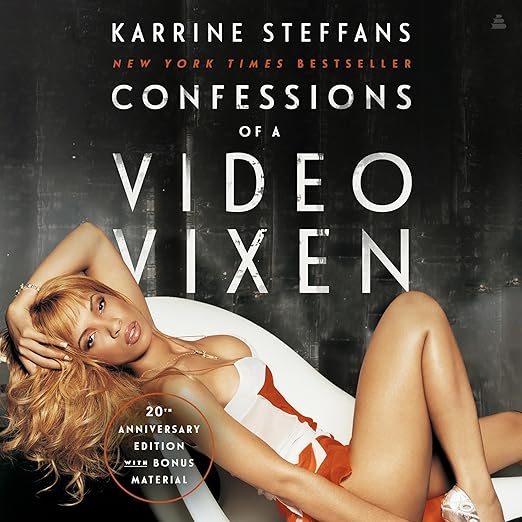
Twenty years after her original memoir first rattled the hip-hop industry, Karrine Steffans returns to narrate this post-Me Too update herself, and the passage of time changes how the material lands. This audiobook isn't simply a reissue with a new cover; it adds a new foreword and bonus chapter reflecting on watching the industry's reckoning unfold from the outside, after having lived through exactly the abuse that reckoning eventually named publicly. Steffans made as much as twenty-five hundred dollars a day dancing in music videos for artists like Jay-Z, R. Kelly, and LL Cool J, and was cast by director F. Gary Gray in A Man Apart alongside Vin Diesel, a career peak the book treats as inseparable from the physical abuse, rape, and addiction she survived by the age of twenty-six. The synopsis frames Steffans as someone who championed sex positivity before that language entered the mainstream, and the book's stated goal now is direct, help younger women recognize warning signs she didn't have the vocabulary for at the time, and offer a way to climb out of what she calls, with real specificity, a cycle of hopelessness and despair.
Orsayor Simmons Titles Her Review 'Knowing Your Worth'
Self-narration carries real weight in memoirs like this one, and it's especially true here. Steffans isn't reading someone else's interpretation of her life here; she is instead revisiting her own words two decades later with the perspective that only time provides, and you can hear that layered awareness in how she frames the new material bookending the original text. One reviewer, Orsayor Simmons, describes having connected personally with Steffans, who now goes by Elisabeth Ovesen, both through the book and directly, and credits both the writing and the woman herself with a lesson about knowing your own worth. That kind of testimonial from someone with actual personal history with the author adds a layer of credibility a stranger's review can't match. CakeyFaithy's review pushes back gently against the book's reputation, noting it wasn't the salacious tell-all she'd been led to expect, and instead found what she calls incredible storytelling about a confused young woman searching for something amid years of abuse. The book holds a 4.1 rating across 45 ratings, and Orsayor Simmons titles her own review Knowing Your Worth, a framing that lines up closely with the synopsis's own stated goal of helping younger women recognize their value before repeating the patterns Steffans survived.
An Early Warning Bell Before the Reckoning
The reframing is the whole point of this particular edition. The original Confessions arrived years before the wider industry reckoning that eventually forced a public conversation about exactly the kind of abuse Steffans described, and the new foreword and bonus chapter let her respond to that shift directly rather than leaving the book frozen in its original 2005 context. That's a genuinely rare thing for a memoir to offer, a chance to hear the author reckon with how the culture caught up to what she'd already survived and written about. The synopsis frames her as having been discussed in some quarters as an early warning bell for the industry's later reckoning, and whether or not you'd go that far, the basic timeline checks out: she named specific patterns of abuse in the hip-hop and video industries well before doing so became a mainstream story. Naming those specific industry working relationships already established in the opening synopsis carries obviously different weight in a post-reckoning cultural moment than it did when the original memoir first published two decades ago, before the wider culture had the vocabulary to fully process what she was describing. Nichole Cook's brief review simply calls it a good read worth returning to, which speaks to the book's staying power beyond its original news-cycle moment.
Not the Salacious Tell-All Its Reputation Promises
The abuse and addiction material is not softened for the audio format, physical abuse, rape, drug and alcohol abuse, and homelessness are all described directly and at length, so this isn't a casual pick for a light afternoon of listening. Steffans narrating her own trauma adds power, but it can also make certain passages harder to sit with than if a professional narrator were creating some emotional distance from the material. CakeyFaithy's review is a useful corrective to whatever reputation precedes this book: if you're expecting a purely salacious industry tell-all, that isn't quite what's on offer here. The actual through-line is closer to survival storytelling than gossip. And because this is explicitly the post-Me Too updated edition, listeners looking specifically for the original 2005 text and nothing more should know this version adds substantial new framing material rather than reproducing the original unchanged. It's also worth noting that not every review attached to this listing engages directly with the book's content, one simply praises the physical copy's condition, a reminder that star ratings on a memoir like this can reflect a mix of reactions rather than a single consistent read on the material itself.
Nearly Seven Hours, Told in Her Own Voice
Anyone who read the original Confessions two decades ago has a clear reason to come back, if only to hear Steffans reckon with her own history in real time rather than through someone else's retrospective. Readers newly interested in hip-hop industry history, particularly the treatment of women within it, will find this a primary document rather than a secondhand analysis, since it's written and narrated by someone who lived the specific abuses other later accounts only reference. Listeners drawn to survivor memoirs generally, regardless of the entertainment-industry setting, will recognize the underlying arc: abuse, addiction, and the slow, nonlinear work of building a new life afterward. Listeners interested in early-2000s hip-hop culture specifically, including Steffans's brief film role opposite Vin Diesel in director F. Gary Gray's A Man Apart, get a genuine insider's account of that era's video industry alongside the survivor narrative.
The abuse and addiction content is real and sustained, so this isn't the right choice if you're looking for something light or purely celebrity-focused, despite the glossy world it's set inside. The synopsis credits her sensual dancing with helping multi-platinum artists sell millions of albums, a detail that underscores exactly how much commercial value the industry extracted from her before ever reckoning with the cost to her personally. Go in expecting a survivor's account first and an entertainment-industry memoir second, and the nearly seven hours, run through her own voice rather than a stand-in narrator's, will land the way Steffans clearly intends them to reach a listener who needs to hear exactly this kind of story told firsthand.
Common Questions
Does Karrine Steffans narrate this audiobook under her current legal name?
One reviewer refers to her as Elisabeth Ovesen, her current name, though the audiobook listing itself credits Karrine Steffans, the name under which the original memoir was published.
How graphic is the abuse content in this audiobook?
The synopsis and reviews both describe physical abuse, rape, and addiction discussed directly and at length, so listeners should expect sustained, serious content rather than a glamorized industry tell-all.