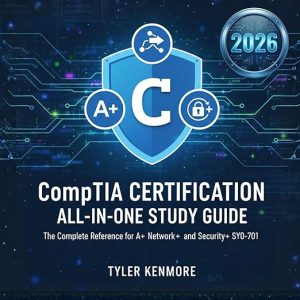
CompTIA certification exams sit at the foundation of most IT careers, and the preparation market for A+, Network+, and Security+ is enormous and noisy. Most of it is built for visual learners: textbooks with diagrams, flashcard apps, video courses with screen captures. Tyler Kenmore's CompTIA Certification All-in-One Study Guide takes a different approach. This audiobook is explicitly designed for audio-first study, and the opening acknowledges that directly: if you are hoping to wing the exam with random YouTube videos, stop now. That tone sets up what follows accurately. Narrated by Jason Haines, the guide runs 11 hours and 23 minutes and covers the full progression from A+ hardware and OS fundamentals through Network+ real-world networking to Security+ SY0-701, the current exam version. The structure is immediately evident: this is not three separate books awkwardly bundled together but a single coherent progression where each certification builds on the last, making the logic of the sequence clear from the first chapter.
The A+ sections establish vocabulary and conceptual grounding in hardware and operating systems that the later network and security content depends on. This is the right pedagogical sequence, and it matters more than it might seem. Many candidates who struggle with Security+ material do so because they are trying to learn cybersecurity concepts without a firm foundation in what they are securing. Kenmore threads the progression deliberately, and Haines narrates the transitions between sections in a way that signals the shift without losing momentum. The plain-English explanations of ports, protocols, Zero Trust, and incident response are written for listeners who need to hold these concepts in working memory while commuting or exercising, not readers who can pause to study a diagram. The emphasis throughout on concrete steps rather than abstract theory gives the material genuine utility for listening rather than reading.
The guide's most useful feature is its approach to exam-style question breakdowns. Rather than simply listing correct answers, it teaches listeners how to think like CompTIA's test writers when a messy real-world scenario is presented. This is the difference between memorizing that port 443 is HTTPS and understanding why a question about a compromised web server might involve both 443 and 80 simultaneously. For the Security+ exam especially, scenario-based questions represent a significant portion of the content, and Kenmore addresses this directly. Haines handles the walkthrough sections with a slightly different delivery cadence, slowing marginally during the reasoning-through-a-question segments. It is a small but effective performance choice that separates concept delivery from applied reasoning in a way that benefits the listener. The progression system Kenmore describes, listen, pause, recap out loud, and mentally walk through each example, is not generic advice but reflects how audio retention actually works differently from page-based reading.
Haines Slows Down for Reasoning-Through Segments
The practical argument for this audiobook is straightforward: IT workers who are pursuing certifications while holding down jobs have constrained study time. Turning a commute, a gym session, or a lunch break into productive preparation requires material structured for audio consumption. The combination of three certifications in a single structured audiobook also eliminates the context-switching cost of moving between separate study guides. A candidate working toward all three credentials can follow a single narrative arc from foundational hardware through advanced security, with each section reinforcing the previous one rather than starting from scratch. The framing toward the serious candidate who wants a clear step-by-step path distinguishes this guide from more casual prep resources. Kenmore's system assumes you are doing the work, not just listening passively, which is the right assumption for certification candidates whose exam date has real career stakes attached to it.
One Guide Erases the Context-Switching Cost
Practical lab experience is irreplaceable for these certifications, and no audiobook can substitute for hands-on time with hardware, virtual machines, or network configurations. Listeners who have no prior IT exposure may find some of the A+ hardware sections abstract without the ability to physically handle the components being described. Additionally, CompTIA updates its exam objectives periodically, and the Security+ SY0-701 content reflects the current exam version at time of publication. Candidates should verify that the objectives covered align with the exam version they are scheduled to take. The audiobook does not include the kind of full-length practice exam experience that timed mock tests provide. Using this guide as a conceptual and strategic foundation and supplementing with dedicated practice test software will give candidates the most complete preparation. Those who learn best through repetition should note that returning to specific sections on replay will consolidate the material more effectively than a single linear pass through the full eleven hours.
Screen-Free Study Fits Those Who Struggle With Video
IT professionals pursuing entry-level or associate certifications while managing full-time schedules will find this audiobook a practical daily companion that makes genuinely productive use of otherwise idle time. Career changers entering the IT field who learn effectively through audio and want a single logical progression through all three foundational certifications will get real value from the structured approach. Experienced technicians who know the practical work but need to systematize their knowledge for the written exams will benefit from the exam-thinking framework Kenmore builds throughout, particularly the scenario-question reasoning methodology. Those who struggle with video courses or textbooks because their schedules do not allow for screen-based study are the ideal audience. If you need a mock exam experience or hands-on lab simulation, this guide works best as one component of a broader study plan rather than a standalone resource.