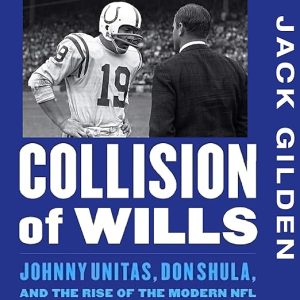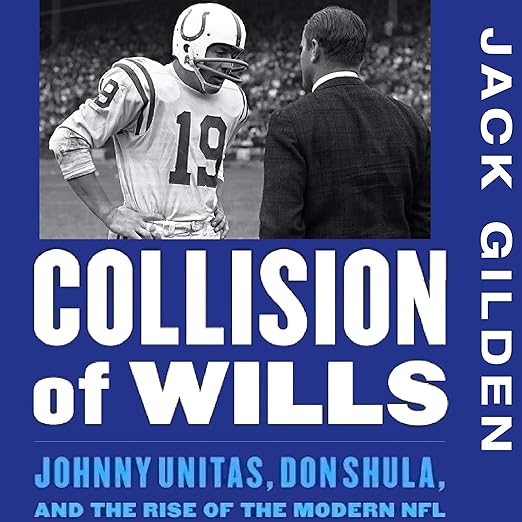
Jack Gilden's account of the Baltimore Colts in the 1960s arrives at a conclusion that most football histories avoid stating plainly: the most interesting sports stories are often the ones about the teams that did not win the championship. Collision of Wills makes that case through the specific and strange dynamic between Johnny Unitas and Don Shula, two men who built something remarkable together while apparently struggling to tolerate each other. This audiobook is most compelling when it leans into that paradox, and it leans into it consistently.
At 12 hours and 48 minutes, the audiobook is the right length for the material. Gilden is working with several overlapping narratives: the football history of the Colts franchise, the personal histories of Unitas and Shula, the broader context of the 1960s (Vietnam, civil rights, the sexual revolution), and the NFL's transformation into the dominant American sport. Kevin F. Spalding's narration handles the shifts between these registers capably, slowing for the analytical passages and quickening for the game descriptions in ways that keep the pacing from feeling mechanical.
Is Collision of Wills Worth Your Time?
Gilden's central contention, that Unitas and Shula had a higher winning percentage than Lombardi's Packers during their seven years together, lands with the impact it deserves because most football history has been written around Green Bay. One reviewer makes this point directly: students of 1960s NFL have had more than enough Packers lore. The Colts deserve the serious attention Gilden provides, and the book's reframing of the decade's football history around Baltimore rather than Green Bay is one of its most valuable contributions.
What makes the book more than a revisionist sports history is the character study at its center. Unitas and Shula are drawn as men who share competitive intensity and perfectionism while differing fundamentally in temperament and self-conception. Shula is the coach who believes in systems and discipline. Unitas is the quarterback who believes in his own judgment and resents constraints on it. Their earlier history as teammates, competing against each other for roster spots, adds psychological depth to the professional relationship that follows. Gilden traces the private tension between them through the big losses, the 1964 championship game against the Browns and the shocking Super Bowl III loss to Joe Namath's Jets, with a care for psychological cause and effect that elevates the book well above game recounting.
The audio format rewards the social history portions of the book especially well. Gilden embeds the Colts story within the larger turbulence of the 1960s, and the connections between the football culture of the era and the social pressures around it are illuminating without being forced. The NFL's growing dominance as a television sport, the racial dynamics of professional football during the civil rights movement, and the masculinity codes that shaped how players and coaches understood themselves all appear here with enough texture to reward an engaged listener.
Spalding's narration manages the book's dual ambitions effectively. When Gilden is deep in strategy and game analysis, Spalding conveys the tactical precision without losing non-specialists. When the book opens out into cultural history, his pacing shifts appropriately. One reviewer identifies the book as needing an editorial tightening to reach its full potential, and there are passages where the research sits on the surface rather than being fully digested into narrative. In audio, these moments register as slightly flat, but they are infrequent enough not to undermine the overall achievement.
Before You Commit to Collision of Wills
Two threads are worth tracking with active attention. First, the book's treatment of near-misses as a distinct category of sports experience. Gilden argues that the Colts' losses, the 1964 game and Super Bowl III in particular, were not just defeats but defining events that shaped the franchise and the men who suffered them in ways that winning would not have. This is counterintuitive enough to be genuinely interesting, and it is developed with more care than the summary implies.
Second, watch for the Namath angle. Super Bowl III, in which Joe Namath's Jets upset the heavily favored Colts in one of professional football's most significant games, is treated here not just as a football event but as a cultural inflection point. Namath's public persona, his guarantee of victory, his embodiment of a new masculine archetype that contrasted directly with the Unitas model, receives substantive attention. For listeners who know the game primarily through its mythology, Gilden's account of what it meant within the specific dynamics of the Colts franchise adds considerable depth.
Should You Listen to Collision of Wills?
Football readers who want serious historical analysis rather than nostalgia or hagiography will find this audiobook more rewarding than most titles in the genre. Listeners with interest in 1960s American culture more broadly will find the social context well integrated rather than tacked on. The University of Nebraska Press origin gives the book a scholarly credibility without making it academic in the forbidding sense.
Casual football fans who want game-by-game narrative above everything else may find the character study and cultural history elements slower going. And listeners who expect a conventional biography of either Unitas or Shula individually will find that Gilden is more interested in the relationship between them than in either figure separately, which is the book's strength but also its organizing principle that shapes everything else.
Does this audiobook require deep knowledge of 1960s NFL history to follow?
No. Gilden provides enough background on the era's football landscape that listeners who are not specialists can follow the narrative. Familiarity with the names Unitas, Shula, and Namath helps, but prior expertise is not required.
How much of the audiobook focuses on game analysis versus the personal dynamic between Unitas and Shula?
The balance shifts throughout, with game analysis and cultural history framing the personal story rather than replacing it. The relationship between the two men is the organizing spine, and the football material serves to illuminate character rather than dominate the narrative.
Is Kevin F. Spalding's narration a good fit for this kind of sports history audiobook?
Spalding handles both the tactical football analysis and the broader cultural history sections capably, shifting his pacing appropriately between the two registers. He does not sensationalize the drama, which suits Gilden's measured analytical approach.