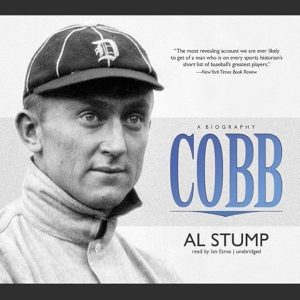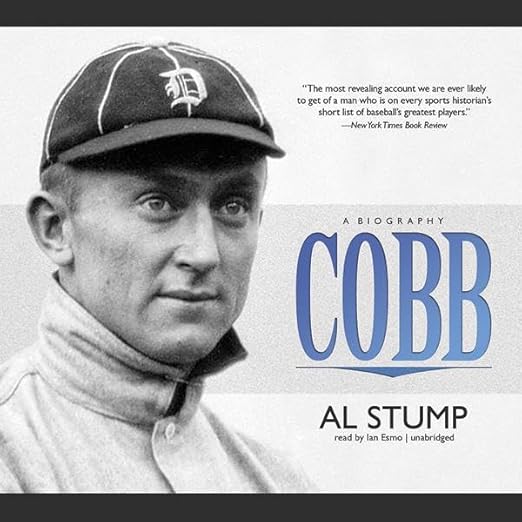
Ty Cobb died alone with a loaded pistol in one hand and a paper bag of cash and securities beside him, having driven off everybody who might otherwise have sat with him. That image opens the description, and the whole book exists to explain it. Al Stump had been hired by Cobb in 1960 to ghostwrite the authorized autobiography. This audiobook is what Stump wrote afterward instead, and it is a very different document.
John A. DeBin, five stars in July 2013, gives the cleanest account of why it works: a book you start and cannot put down, following Cobb from rural Georgia to dying isolated after alienating everyone close to him, offering a portrait deliberately less sympathetic than biographies usually manage. That response calls this the unauthorized version, which is exactly the right frame for it. Stump had the access, then declined the terms that came with it.
Stump's position is the most interesting thing about the book and also its central problem. He was inside the house, hired by the subject, writing the version the subject wanted, and then produced a second account once Cobb had died. That is either extraordinary honesty or a serious breach depending on who you ask, and the description presents it as a fascinating window without pausing to note that the window belonged to somebody else.
Blackstone Audio recorded this in October 2000, which makes the audio older than every response posted underneath it by at least a decade. The gap has a consequence nobody flags. A print biography can be reissued with a new introduction answering later challenges to its reliability. A recording made in 2000 cannot. Ian Esmo reads a text frozen at the moment it was made, and everything argued about it since sits outside the file entirely.
Why Cobb Works as an Audiobook
Georgia in the 1890s is where the book starts, in a place still carrying the humiliation of the Civil War, and the February 2011 four-star note identifies the detail that reframes everything after it: the death of Cobb's father at the hands of his mother. That response arrived knowing little about the Georgia Peach and came away understanding a very troubled man. The book earns that shift honestly, without ever excusing what the man became.
Records are the other half of the appeal, and the same 2011 note puts it plainly: numbers that are hard to comprehend in an era of big-dollar baseball. Statistical dominance from a century back tends to flatten into trivia on the page. This book keeps it attached to a person, so the achievement and the cruelty arrive inside the same sentence, and neither one cancels the other.
Cruelty is not incidental to the story. Conflicts with players, umpires and fans run through the entire account, and that four-star note points to the end of the book as the most telling stretch of Cobb's life, though the sentence is cut off before it says what the closing passage compares. A sports biography that likes its subject is easy to write. One that respects the record while refusing to soften the man is considerably harder, and that difficulty is why this book still gets argued about.
Weak Spots in Cobb
Writing in May 2025 at three stars, Ryan Schroer raises the most serious objection on this page. Stump was not at Cobb's cabin during the last year of his life and did not travel with him, according to that response, and Cobb's family has confirmed as much. If the claim holds, the horror stories Stump reports witnessing while living alongside Cobb are inventions presented as firsthand reporting rather than as reconstruction.
Accuracy is not a matter of taste here, and the charge should change how you listen. The same response argues the portrait was engineered, turning a real person into an over-the-top cartoon villain because that was what sold. It also concedes the obvious point: it remains a good story. Both things can be true simultaneously, and a listener who does not know the dispute exists will take the entire book as reportage.
Neither the description nor the recording carries any warning about it. The page presents the fascinating window claim at face value, the audio predates the objection by a quarter of a century, and the only place the argument surfaces is a three-star response most buyers will scroll straight past. That is arguably the most important thing on this listing, and it is buried at the bottom of it.
Sports and Outdoors is where the listing sits, filed under Baseball and Softball, which is not wrong so much as insufficient. This is a biography, and a contested one. The bare title does nothing to help either. Cobb, with no subtitle anywhere on the page, tells a browser nothing about the period, the argument being made, or the fact that the author was standing in the room.
The Right Listener for Cobb
Robert's five-star note from January 2025 speaks for the audience this was made for: a wish to have met Ty Cobb, a blunt verdict that the book is outstanding, and an assessment of the man as one hell of a person on and off the field. That last phrase does a lot of quiet work. It is admiration with the rough edges deliberately left in, which is roughly the reaction the book is built to produce in a sympathetic listener.
Fans wanting a straightforward sports biography should understand they are buying a character study with a disputed foundation instead. Baseball history is the setting rather than the subject. Nearly twenty hours goes to the psychology of one difficult man, his childhood, his enemies and his death, and the on-field material is there to explain the person rather than the reverse.
Cobb remains worth the time, provided you hold it at the right angle. Take it as the most vivid account anybody has of how one player was remembered, told by somebody with an obvious stake in the telling, and check the dispute before repeating the more lurid anecdotes anywhere in public. The storytelling is superb. Whether every scene in it happened is a genuinely open question, and the recording will never tell you which is which.
Before You Press Play
- Read by: Ian Esmo reads a Blackstone recording made in October 2000, older than every response on the page and unable to carry the corrections that arrived later
- At its heart: A ghostwriter turning on his subject, baseball greatness beside documented cruelty, a childhood marked by a father's death at his mother's hands
- Vibe: Lurid and propulsive, permanently under suspicion
- Short version: Superb storytelling whose factual standing has been seriously challenged, and worth hearing with that challenge in mind.