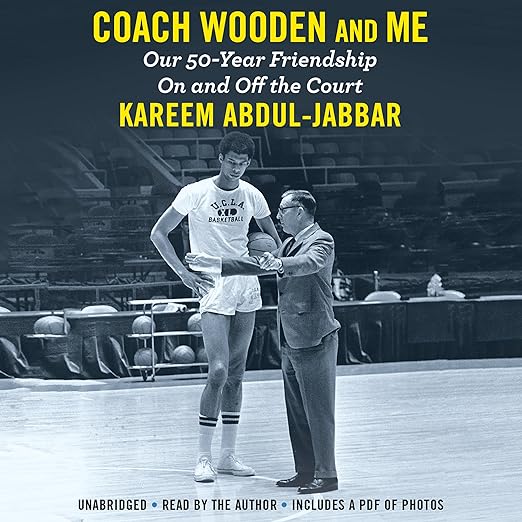
Bonnie Sawyer read half of this book on paper and then, traveling across the country, heard the rest of it as an audiobook on CD, in the author's own voice. That review is the only firsthand account anywhere on this page of what the recording is actually like, and it belongs to a reviewer who knew Coach Wooden, his wife Nellie, and his daughter Nan. It ends with tears in several places. No credit line or marketing paragraph on a listing can compete with that.
The Review
Most sports memoirs are about winning, and this one largely is not. Kareem Abdul-Jabbar arrived at UCLA at eighteen, still called Lew Alcindor, a high school prospect out of New York City who had chosen the school mainly on the strength of John Wooden's reputation as a winner. He and his teammates then took an unprecedented three NCAA championship titles. The book treats all of that as setup. What it is actually about is the half century that came afterward, when the coaching had stopped and the friendship had not.
Both halves of that friendship get named plainly in the description and rather more sharply in the column. Rick Spell asks the question outright: how could a thin, tall athlete with left leanings sustain such an intimate relationship with a much older, conservative Midwesterner? The publisher's summary reaches for the same contrast in gentler language, describing two men sharing cultural, religious, and family values while facing some of life's biggest obstacles. The gap between those two framings is roughly the gap between a jacket and a reader.
Nothing in the jacket copy sticks the way the socks do. On the first day of practice, the players were taught the importance of putting on their athletic socks properly, and from there the book moves to the Pyramid of Success, then to the ugly racism confronting Black athletes during the Civil Rights era, then to losing loved ones. The socks are a joke and a thesis at once. A coach who begins with the smallest possible detail is telling you what he thinks discipline is made of.
What Makes Coach Wooden and Me Worth Hearing
The narrator credit repeats the byline. Kareem Abdul-Jabbar reads his own memoir, which for a book this personal is anything but a technicality: the grief in the closing chapters belongs to the man delivering it, and so does the reticence that several reviewers spend their paragraphs describing. Jordan Sollitto notes that a stoic public demeanor had concealed how deeply sensitive, introspective and warm the author actually is. On a recording, that same voice performs both the concealing and the revealing.
Four more people have written here than the rating counter admits exist. The badge reports 4.7 drawn from a single vote, and five signed reviews sit beneath it, dated between June 2017 and April 2022. The practical instruction is straightforward: ignore the number and read the names. The column runs five stars, five stars, five stars, four stars, five stars, and the four belongs to the one person who came to it through a book club instead of through basketball.
That column also holds a spoiler the description takes care to avoid. Jordan Sollitto reports sharing the author's grief when Coach dies in the final pages, which tells you exactly where the book stops. The publisher's copy ends instead on a lifetime of personal fulfillment and never once mentions the death. Whether that matters depends on how much you already know, but it is worth understanding that the last stretch is an ending and not a summing-up.
The Caveats
If you do not follow basketball, one review here was written expressly for you. Bookhandler Press opens by admitting that a book club was the only reason for picking it up at all, reports no interest in sport whatsoever, and then finds the writing conversational and gently revealing, easy to take even when the topic is basketball. Two things surprised that reader in particular: that the conversion to Islam had spiritual roots and no political ones, and that Wooden ranked becoming a great ball player fifth on the list of what his players needed to learn.
Where the blurb ends is worth a look of its own. Three separate accolade lines close it out: an instant bestseller on two national lists, a former president's favorite book of 2017, and a best-of pick from two more outlets. Those are real credentials, and they are also the last thing a prospective listener needs. What the column supplies instead is texture: a reviewer who knew the family, a fan who grew up during the UCLA heyday, and a reader who came in with low expectations and had them far exceeded.
One detail on the listing is oddly clean. The running time is six hours, with no minutes attached, which is either a coincidence or a rounded field, and either way it is short for fifty years of friendship. A book that compact has to move in scenes instead of chronology, and the reviews bear that out: everybody who writes here remembers moments, the socks, the fifth item on a list, a death, and nobody attempts a summary. Grand Central Publishing dated the release May 16, 2017, about a month before the earliest response beneath it.
Should You Listen to Coach Wooden and Me?
Everything about this column points to a wider audience than the shelf implies. The tags read basketball, coaching, and sports history, while the people who liked it best include somebody who does not watch sport at all, somebody who knew the coach and his family, and a Wooden fan who opened it braced for disappointment. If you like memoirs about long relationships, the basketball here is a setting and not really a subject, and six hours is a small price for the company.
What will not suit everyone is the warmth. This is an admiring book about a mentor, written by a student who says as much on the first page of the description, and not one reviewer here reports finding a critical edge anywhere in it. Listeners hoping for the complications of a very public life examined at length, or who want the Civil Rights material given more room than the friendship, should understand that the balance runs firmly the other way.
A memoir in its author's own voice is a different object from a memoir performed by an actor, and this listing hands you the first without saying a word about the distinction. Six hours, one voice, one friendship, and a single reviewer who heard it on a CD while traveling across the country and cried in several places. Kareem Abdul-Jabbar reads his own grief here, and that is the entire argument for choosing this over the printed version.
Frequently Asked Questions
How many people have actually rated this audiobook?
The counter says one, while five signed reviews sit underneath it, posted between June 2017 and April 2022. No rounding rule turns one whole-star vote into a 4.7, so the badge and the column are not measuring the same thing. Take the signed entries as your evidence, four of which award five stars.
Does Kareem Abdul-Jabbar read the audiobook himself?
Yes, the narration credit repeats the byline exactly. One reviewer describes hearing him read it on a CD while crossing the country, having taken the first half in print, and reports being moved to tears at several points. That is the only firsthand description of the performance anywhere on this listing.
Is it worth listening to if basketball means nothing to you?
One reviewer answers that from experience. A book club selection, taken up by somebody who states plainly that they are not a sport fan, produced four stars and praise for a conversational, gently revealing style that stays easy even on basketball. The relationship is the subject and the game is only where it happened.
Beyond the UCLA years, what else does the book cover?
Most of the fifty years that followed them. The summary travels from a first practice about athletic socks and three championships to the Pyramid of Success, the racism Black athletes faced during the Civil Rights era, and the loss of loved ones. One reviewer reveals that the friendship runs all the way to its end inside these six hours.