- Voice: Virtual Voice narration handles the conversational, instructional prose without difficulty, though the warm personal tone of the text would benefit from a human reader.
- Big ideas: Decluttering methodology, home organization, mental clarity through physical space
- Atmosphere: Warm and encouraging, structured around practical momentum rather than perfectionism
- Worth it?: A brief, focused audiobook that distinguishes decluttering from organizing and offers a checklist-driven approach tailored to people managing busy households.
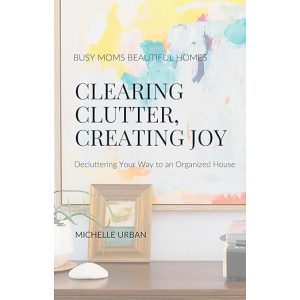
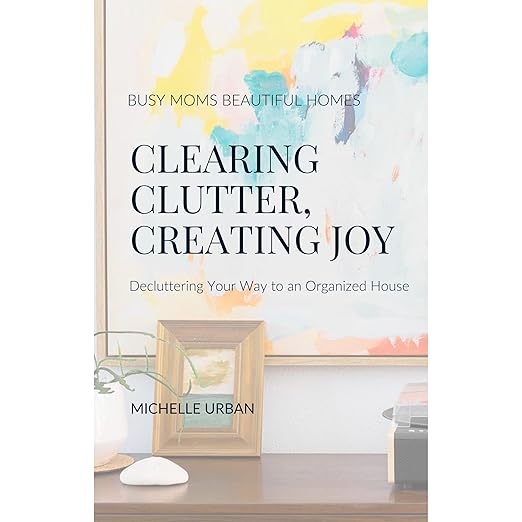
Michelle Urban's audiobook Clearing Clutter, Creating Joy begins with a distinction that most home organization books skip or conflate: the difference between decluttering and organizing. Urban treats these as related but genuinely separate skills, arguing that most people who struggle with ongoing household chaos are attempting to organize things that should have been removed in the first place. That reframing is not entirely new to the genre, but Urban applies it with enough specificity and structure to make it feel operational rather than merely philosophical. At 1 hour and 2 minutes, this is an extremely short audiobook, which requires some genuine recalibration of expectations before you press play.
Designed Around Forty-Five Minutes and a Messy Kitchen
Urban's approach is explicitly calibrated for busy households, and she makes the practical constraint of limited time central rather than peripheral to her advice. The organizational strategies she offers are not designed for someone with a free weekend and boundless energy; they are designed for someone who has forty-five minutes and a kitchen that needs attention before the next obligation begins. That specificity to actual life conditions, rather than idealized decluttering scenarios that assume unlimited time and emotional bandwidth, is what distinguishes this audiobook from genre titles that describe aspirational systems without accounting for the reality of implementation.
The book includes what reviewers describe as a 100-plus item decluttering checklist and a National Donation Guide, both of which are more naturally suited to a visual format than to audio listening. Urban also incorporates real-life accounts from people who have successfully worked through the system, which adds texture and specificity to what could otherwise be a dry instructional sequence. Reviewer Kelly Cuadra, describing herself as "a busy individual, not just a mom," found the book helpful beyond its explicit target audience, suggesting Urban's framing is more broadly applicable than the marketing might initially imply.
A SMART Framework for an Overwhelmed Home
The SMART goal-setting framework that Urban applies to household organization provides a structural spine that prevents the book from reading as a loose collection of tips with no connective logic. Structure matters considerably in a book of this kind because the central problem Urban is addressing, the overwhelm that comes from not knowing where to start or how to prioritize, is itself a failure of structure. A book that replicates that disorganization in its own presentation would undercut its premise. Urban avoids that trap by building toward a specific process rather than simply listing advice without sequence.
The emotional dimension of clutter is taken seriously here in a way that purely practical guides sometimes miss entirely. Urban acknowledges that the difficulty of letting go of objects is rarely purely logistical. People hold onto things for reasons connected to identity, memory, guilt, and aspirational self-images, and a decluttering strategy that does not account for those emotional layers tends to stall at the same points for the same reasons each time it is attempted. The book's supportive guidance sections address this directly, which reviewers noted as one of the reasons the advice felt actionable in practice rather than merely aspirational in theory.
Sixty-Two Minutes Trades Depth for Speed
The audiobook's brevity is both its strength and its primary constraint. At 62 minutes, Urban covers the essential framework without the padding that afflicts many books in this category, but there is a meaningful difference between an audiobook that is concise and one that is thin in its coverage. Some of the specific topic areas, particularly the decluttering checklist and guidance on particular room categories, are handled in less depth than a longer format would allow. Listeners who want detailed room-by-room guidance, seasonal decluttering protocols, or comprehensive coverage of sentimental objects will find the content sufficient to orient them but not comprehensive enough to handle every situation they encounter.
Virtual Voice narration, which handles this title, is serviceable for instructional content of this kind but removes some of the warmth that Urban's conversational prose seems to be reaching toward. The book is written to feel like a supportive and encouraging conversation rather than a list of instructions, and a human narrator would have amplified that intended quality in ways the AI delivery cannot fully replicate. For a book about creating calm in a chaotic home, the choice of a warm human voice would have been the right production decision.
For Anyone Who Has Stalled Before
This audiobook works well for people who have attempted and repeatedly stalled on decluttering projects and are looking for a simpler, more emotionally honest framework than the aspirational systems that dominate the genre. Urban's emphasis on getting started rather than getting it perfect addresses one of the most common and consistent failure points, and the short runtime makes this an easy first recommendation for someone who does not want to commit to a multi-hour listen before knowing whether the approach will resonate with their particular situation.
Listeners who already have an established organizational system and are simply looking for motivation to apply it consistently will find the book unnecessary. Similarly, people expecting highly detailed methodologies or room-specific deep dives will need a longer format than this one provides. But for anyone who has looked at a cluttered room and felt immediately overwhelmed before doing anything at all, Urban's clear differentiation between the act of decluttering and the act of organizing offers a starting point that genuinely differs from simply being told to start small and work through it.