The Short Version
- Performance: Tom Parks brings composed, unhurried clarity to material that swings between hard science and intimate portraiture, never straining for drama the reporting doesn't need.
- What it covers: climate displacement, working-class maritime tradition, faith confronting extinction
- Feel: Elegiac but clear-eyed, grounded in specific people rather than abstraction
- Our call: A serious, rewarding listen for anyone drawn to narrative nonfiction about places running out of time, though it asks for patience.
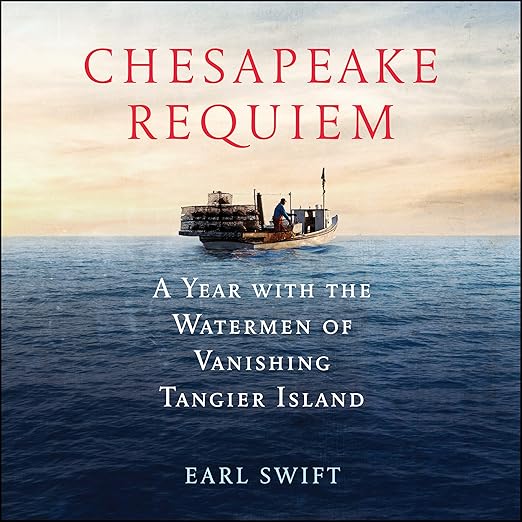
Tangier Island loses fifteen feet of shoreline every year, which means the crabbing community Earl Swift spent two years documenting is arguably disappearing in real time, one tide at a time. I put this audiobook on during a long drive up the Eastern Shore, half expecting a straightforward environmental report, and instead got something closer to a character study of four hundred and seventy people who know, more precisely than almost anyone else in America, how many years their home has left. Swift lived among Tangier's watermen, crabbed and oystered alongside them, and sat in their kitchens while tide charts and scripture both got treated as authority. That dual fluency, in salt water and in faith, is what makes Chesapeake Requiem land as reporting rather than elegy written in advance.
A Decade With Tangier Before This Book Existed
Tangier was mapped by John Smith in 1608 and settled during the American Revolution, and Swift uses that long history as a counterweight to the book's central fact: the island has lost two-thirds of its land since 1850, and experts reckon the remaining population could be forced to abandon their home within twenty-five years without federal intervention. The book does not treat that number as an abstraction. It follows specific watermen through specific storms, specific funerals, and a specific twelve-mile boat crossing that separates Tangier from the mainland it depends on for supplies, medical care, and increasingly, hope.
What's easy to miss from the marketing copy is that Swift had already spent a decade with this exact subject. His 2007 story collection, The Tangierman's Lament, put him in this same community years before Chesapeake Requiem existed, which means this isn't a journalist parachuting in for a hot climate story. It's a return visit from someone the island already half trusted, backed by a body of other narrative nonfiction, including The Big Roads and Auto Biography, that shows a writer comfortable spending years inside one subject rather than skimming several.
Scripture and Crab Pots Share the Same Morning
The hardest material here isn't the erosion data, it's watching a conservative, deeply religious community read their own disappearance through the lens of scripture and end times, even as they keep crabbing every morning like nothing has changed. Swift resists the easy move of mocking that framework or using it to score a political point about climate denial. He just reports what he heard in Tangier's kitchens and lets the contradiction between daily routine and existential threat sit there, unresolved, which is a harder and more honest choice than a tidier book would have made.
Tangier's fleet built its reputation specifically around softshell crab, harvested during a precise, narrow window in the molting cycle that demands watermen check their pots multiple times a day at the height of the season, often before sunrise and again well after dark. Swift renders that economic dependency in granular, specific detail: a single bad storm season doesn't just erode land in the abstract, it threatens the exact narrow-window harvest that gives Tangier crabbers their livelihood and the island its claim to being the softshell capital of the world, which is why the erosion data in this book always circles back to a real paycheck, not just a shrinking coastline on a map.
The twelve-mile boat crossing to the mainland isn't a scenic detail either. Swift traces what that isolation actually means in practice: what happens when a medical emergency and a hurricane warning arrive in the same week, how supply runs get planned around tide and weather rather than convenience, and how thoroughly the island's daily rhythms are still dictated by water in a way almost no other American community's are anymore.
Tom Parks Narrates Without Dramatizing the Erosion
Tom Parks has built a career narrating long-form nonfiction without dramatizing material that doesn't call for it, and a twelve-hour, fifty-one-minute book that has to carry both erosion-rate science and intimate portraits of individual crabbers needs exactly that kind of restraint. He doesn't perform grief or urgency; he lets Swift's reporting supply both, which keeps the book from tipping into disaster-narration even when the subject matter would justify it.
The critical reception stacked up here is unusual for a book about a five-hundred-person crabbing town: ten best-of-year lists, from Smithsonian and Popular Science to the Washington Post and NPR. Bill McKibben, who has spent his own career writing about climate change, called it 'powerful,' and that endorsement carries specific weight given how much overhyped climate journalism McKibben has presumably had to sit through. Hampton Sides' 'beautiful, haunting and true' gets quoted for a reason: it's an accurate three-word summary of the tonal balance Swift pulls off.
Listeners who want an entry point into narrative nonfiction about vanishing American places will find Chesapeake Requiem does something most examples of that genre don't: it stays with people who are still there, still working, still arguing about zoning and jetty funding, rather than treating the place as already a memory.
Tagged Photography, Actually About a Disappearing Culture
This listing is tagged under arts and entertainment with a photography label, which undersells what's actually here by a wide margin. No meaningful visual or entertainment-industry component runs through this book at all; it's ground-level narrative journalism about climate displacement and a disappearing maritime culture, and a listener browsing by that category tag could easily scroll past a book that has nothing to do with either photography or entertainment.
At nearly thirteen hours, this is a serious time commitment, denser and slower-paced than a typical climate-journalism feature. It rewards patience with individual watermen's backstories rather than rushing toward policy conclusions, so listeners wanting a brisk, data-forward climate briefing should recalibrate expectations before starting.
Readers who've spent time with other immersive, place-based narrative nonfiction, the kind of total-embed reporting Susan Orlean or Ben Fountain have built careers on, will recognize Swift's method here: sustained proximity over a defined stretch of time rather than a survey assembled from a research desk. That means the book earns its considerable length the way those comparable works do, through accumulated specific detail rather than a tight argumentative arc, so listeners should come in ready for patience rather than a fast-moving narrative.
The book is organized less around a traditional chapter arc than around a full calendar year on the island, moving through crabbing seasons, church calendars, storm seasons, and town-meeting cycles in roughly the order Swift lived through them himself. That structural choice means the pacing sometimes slows to match the actual rhythm of island life rather than a writer's sense of narrative momentum, which is a deliberate trade-off worth knowing before you commit to all twelve hours and fifty-one minutes of it.
People and Place First, the Data Second
This suits listeners drawn to place-based narrative nonfiction, particularly anyone who's read work about vanishing American subcultures and wants the audio equivalent: patient, character-driven, unafraid of contradiction. Climate journalism readers will find real substance here beyond the usual disaster framing, since Swift treats Tangier's residents as people making daily choices rather than case studies.
Skip this one if you want fast-moving popular science or a policy-focused climate book; Chesapeake Requiem spends its considerable runtime on people and place first, data second, and listeners hoping for a tight scientific argument may find the pacing too unhurried for that purpose.
Good to Know
How does narrator Tom Parks handle the mix of scientific detail and personal storytelling in this audiobook?
He keeps a steady, unhurried register throughout rather than shifting tone dramatically between the two, letting Swift's own reporting supply whatever emotional weight a scene carries instead of performing it himself.
Why is this audiobook categorized under arts and entertainment with a photography tag?
That's a metadata mismatch worth ignoring. No meaningful photography or entertainment-industry content runs through this book; it's ground-level narrative journalism about a vanishing maritime community, and the tag likely reflects a cataloging error rather than the book's actual content.
Do I need prior knowledge of the Chesapeake Bay or the crabbing industry to follow this audiobook?
No. Swift explains the watermen's trade, the local geography, and the relevant regulatory history clearly enough for a listener with zero prior exposure to the region to follow every thread.