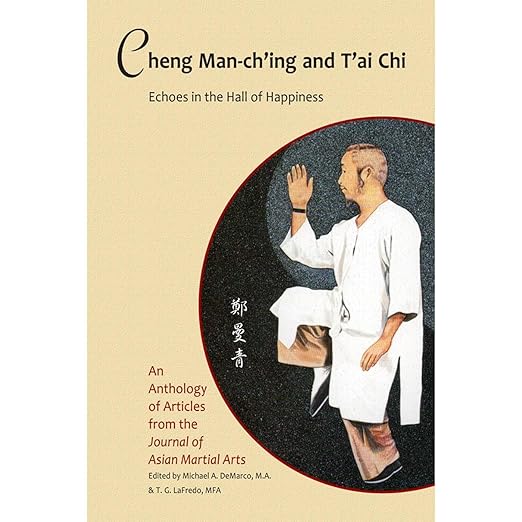
Specialized scholarly anthologies about martial arts history rarely make it to audio, which makes this audiobook of Barbara Davis's Cheng Man-ch'ing and T'ai Chi an unusual artifact in the listening catalog. The collection gathers essays originally published in the Journal of Asian Martial Arts, makes them available in a more accessible format than academic journals typically allow, and uses a Virtual Voice narrator for the presentation. If you practice tai chi in the Cheng Man-ch'ing tradition, or if you want to understand how one of the twentieth century's most influential tai chi teachers actually thought about his art, this anthology is among the few places that information is collected in any format at all.
The Review
Cheng Man-ch'ing, born in 1902 and deceased in 1975, played a defining role in how tai chi ch'uan spread outside China and how it is practiced today across much of the world. Davis's anthology gathers rare scholarly content about his history and thought from authors who are described as 'uniquely qualified for producing some of the highest-quality writings in this specialized area.' The essays were originally written in academic style, which limited their reach, and the republication in book form aims to correct that. The reviewer L. Comerford, specifically speaking to generations of students who did not know Professor Cheng personally, calls this one of the rare books on the subject worth reading because 'it separates fact from speculation by presenting the facts.'
That separation matters. The tai chi world, particularly the Cheng Man-ch'ing lineage, has accumulated a body of mythology and hagiography that has gradually displaced the historical record. Davis's anthology is corrective in intent: it aims to present what can actually be documented about Cheng's life, his tai chi theory and practice, and his role in the art's global spread, against a background of what the reviewer accurately describes as 'a huge body of writings and video representations' that often 'obscure Cheng's message.' This is a book for practitioners who want the historical substrate under their practice, not an introduction for newcomers.
Why Cheng Man-ch'ing and T'ai Chi Works as an Audiobook
The argument for this audiobook is straightforward for its intended audience: the content it contains is not readily available elsewhere. L. Comerford notes that 'very little of the text is about technique,' which is a useful warning for practitioners who want instructional guidance and a useful signal for those who want historical and theoretical understanding. The essays address questions like who Cheng actually was as a person, what his tai chi theory genuinely claimed, and how his teaching influenced the way the art is perceived internationally. GLC's review, calling it 'a marvelous collection of essays that illuminates the life of Prof. Cheng,' confirms the anthology achieves what it sets out to do.
The audio format serves the essay collection well at the level of accessibility. Academic writing in print requires an active reader who can re-read dense passages; the audio format encourages a more patient, sequential engagement that suits the cumulative argument of an anthology. Chay's review notes that 'so much in this book has been carefully curated and made available for the first time in decades,' and that curation is genuinely valuable for anyone trying to understand the Cheng tradition's actual intellectual inheritance rather than the received mythology.
The Caveats
The Virtual Voice narration is the primary production limitation. Essays written in academic style, dense with historical names, Chinese romanization, and specialized martial arts vocabulary, require a narrator who can signal sentence structure and argument progression. Virtual Voice handles the English text cleanly but lacks the capacity to differentiate authorial voice between essays or to add the interpretive weight that human narration brings to argumentative prose. For content this specialized, that limitation is more significant than it would be for, say, a historical biography with a clear narrative thread.
The essay format also means the listening experience is cumulative and layered rather than linearly progressive. This is not a book that builds toward a single climactic conclusion; it is a collection of perspectives on a complex historical figure, each valuable in its own right, that together build a composite picture. Listeners who prefer single-voice sustained argument may find the anthology structure less satisfying than the individual essays' quality warrants. The high rating across fifty-one reviews suggests the specialized audience finds the content worth the format's limitations.
Listening to this anthology as an audiobook means engaging with each essay sequentially rather than moving between them as the print format permits. That linearity is actually an asset for this particular collection because the essays build on each other in ways that become clearer when heard in order rather than dipped into selectively. The Virtual Voice presentation keeps the delivery clean and consistent across all the essays, which matters for a collection with multiple authors: a human narrator would inevitably inflect their individual voice onto each piece, whereas the synthetic voice maintains a neutral consistency that lets the different authors' perspectives come through via content rather than performance. For an academic anthology where the arguments matter more than the delivery, that neutrality has its own logic.
Who Should Pick Up Cheng Man-ch'ing and T'ai Chi
Tai chi practitioners who study in the Cheng Man-ch'ing lineage and want access to the scholarly historical and theoretical foundation of their art will find this anthology the most substantive resource available in audio. The content is genuinely rare and the curation is careful. History and martial arts scholars interested in how Chinese martial arts traditions were transmitted and transformed in the twentieth century will also find value.
General listeners curious about tai chi but unfamiliar with the Cheng Man-ch'ing tradition specifically will find this anthology premature. This is a resource for people who already practice or study the art and want to understand its intellectual inheritance more precisely. At over eight hours, it rewards patient, repeated listening from the right audience more than it rewards casual discovery listening.
In Brief
- Narration: Virtual Voice handles the English academic text cleanly but cannot differentiate authorial voice between essays or add the interpretive weight that dense scholarly prose benefits from; the content carries the experience.
- Themes: Cheng Man-ch'ing's historical and theoretical legacy, tai chi transmission and mythology, martial arts scholarship, Chinese cultural history
- Mood: Scholarly and precise, quietly authoritative for its specialized audience
- Verdict: A genuinely rare scholarly anthology on Cheng Man-ch'ing's tai chi legacy, valuable primarily to practitioners and historians who want documented fact over accumulated mythology.