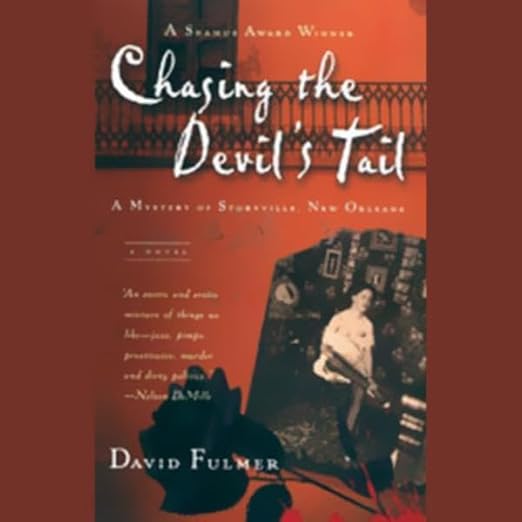
Storyville runs on vice in 1907: two thousand prostitutes work its streets, cocaine and opium sell over the counter, and rye whiskey moves through the district like its own bloodstream. Someone is murdering the women who work there and leaving a black rose on every body. David Fulmer's audiobook Chasing the Devil's Tail, narrated by Dion Graham, drops Creole detective Valentin St. Cyr into that investigation and into a cast pulled straight from history: political boss Tom Anderson, madam Lulu White, a young piano player who will become known as Jelly Roll Morton, and Buddy Bolden, the man credited with inventing jazz itself.
Real History at the Same Table as Fiction
The choice to seat real historical figures at the same table as an invented detective is what gives this book its texture. Tom Anderson and Lulu White anchor Storyville's actual power structure, while Bolden and a teenage Morton root the story in the exact moment jazz was being born a few blocks from where the murders are happening. Patrick Scullin's review title calls it 'A Time Machine With Pages,' and that captures the effect well: St. Cyr's fictional investigation becomes the thread that lets a reader walk through a real, specific place at a real, specific hinge point in American music.
As a mystery, the mechanics are straightforward on paper, a serial killer marking victims with a black rose, a detective assembling the pattern, but the atmosphere carries more weight than the plot machinery. Reviewer A Listener notes this is the first book in a series featuring Valentin St. Cyr, set inside what the review calls the city's 'special district,' the zone New Orleans carved out for legalized vice at the turn of the century. That real historical detail, an actual designated red-light district rather than a novelist's invention, does a lot of the book's world-building work before the plot even gets moving.
The black rose itself functions as a classic serial-killer signature, a small but effective structural device that gives Valentin St. Cyr's investigation forward momentum against an otherwise sprawling, atmosphere-heavy backdrop. Fulmer uses that recurring marker the way genre mystery has long used calling cards: as a promise to the reader that however wide the historical canvas gets, the plot itself is still tightening toward an answer.
The synopsis is explicit that this is 'no ordinary mystery,' framing itself instead as 'a chilling portrait of musical genius and self-destruction' at the exact moment jazz was born. That framing raises the bar past a standard whodunit; Fulmer is asking the black-rose murders to carry real thematic weight about art and ruin, not just supply a plot engine, and the historical cast of real musicians is what makes that ambition plausible rather than pretentious.
No Direct Performance Record for Graham
Dion Graham's catalog runs through warm, historically grounded narration, from African American historical nonfiction to a music-industry memoir like My Life with Earth, Wind & Fire, and that background suggests real comfort with material that has to hold both a specific historical setting and a musical undercurrent at once. This particular book is a different register for him, historical noir fiction rather than nonfiction or memoir, so this exact title carries no direct performance record to measure him against, but the adjacent strengths line up well with what Storyville's atmosphere demands.
One reviewer, identified as Customer, says he was struck by the historical period and the setting, describing New Orleans at the birth of jazz as the real draw, and calling Fulmer's prose vivid in creating that picture. That kind of place-first praise matters for an audiobook specifically, since a narrator who can sustain atmosphere across eleven hours does more for a book like this than one who simply moves the plot along efficiently.
Dion Graham's catalog elsewhere shows real range for tonal shifts within a single project, moving between comedy and anxiety without either register feeling like a costume change, and Storyville's mix of jazz-club energy and genuine dread is exactly that kind of tonal balancing act. A narrator who can let both the music and the menace breathe in the same scene is doing real work for a book this atmospherically layered.
Patrick Scullin's review singles out the writing as 'evocative,' a word that lines up with what an atmosphere-driven historical mystery needs most from its narrator: a reading that lets sensory, place-specific detail land with real weight rather than rushing past it to get back to plot.
Real Vice, Real Victims, No Sentimentality
This is not a cozy historical mystery despite its cultural pedigree. The setting trades in real vice, drugs sold openly, sex work as the district's entire economy, and murder victims chosen specifically because they were prostitutes, and the book's historical and musical prestige shouldn't obscure that the content itself stays dark and unsentimental about what Storyville actually was.
Because this is confirmed as the first entry in a series, listeners drawn in by St. Cyr, Storyville, or the Bolden-and-Morton-adjacent jazz history should know the series continues well beyond this opening case if it lands with them. That is worth flagging as a genuine positive rather than a caveat, but it does mean the ending resolves this particular case without necessarily closing every thread Fulmer has opened for St. Cyr as an ongoing character.
Because A Listener's review confirms this is the first entry in an ongoing series, listeners who fall for Valentin St. Cyr and this version of Storyville should know a real payoff awaits that investment: more books exist to follow him into. That is worth deciding on early, since a series opener this steeped in setting rewards continuing more than it rewards treating the book as a one-off.
Jazz Buffs Get Bolden and Morton as Bonus
Jazz history enthusiasts, historical mystery readers, and anyone drawn to atmospheric, morally murky noir set in a real, well-documented American place will find a lot to like here. The presence of Bolden and a young Morton as background characters gives music history buffs a specific reason to choose this over a more generic period mystery.
Readers who enjoy Southern-set literary crime fiction with a strong sense of place, in the tradition of atmospheric noir built around real cities and real historical texture, will find a lot to recognize in how deliberately Fulmer roots every scene in a specific, verifiable Storyville detail rather than a generic period backdrop.
A reader wanting a fast modern thriller pace, or a mystery that keeps its violence and vice at arm's length, should recalibrate expectations before starting. Storyville's real history is grim by design, and Chasing the Devil's Tail does not sand down that grimness to make the setting more comfortable.