Key Details
- Performance: Matthew Biddulph delivers Dan Martin's voice with the right blend of directness and warmth - the narration reflects Martin's self-described forthright spirit without the self-aggrandizement that too many sports audiobooks mistake for authenticity.
- What it covers: fear and resilience in professional cycling, the romanticism of sport versus its modern realities, acceptance of mortality and mortality-adjacent risk
- Feel: Reflective and propulsive by turns
- Our call: One of the more honest cycling autobiographies in audio - Martin's willingness to name his fears gives the book an emotional credibility that pure achievement narratives cannot match.
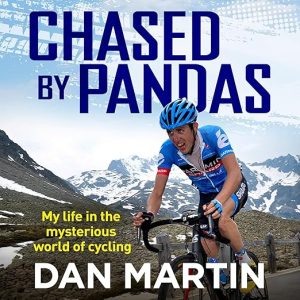
Dan Martin's autobiography takes its organizing principle from a paradox: a career built on fearlessness structured entirely around chapters named for fears. Fear of losing a race. Fear of mountains and downhills. Fear of doping. Fear of death. That architecture is not a publishing gimmick. Martin, who retired at the end of the 2021 season and spent his years racing as what observers called one of road cycling's last romantics, understands that the sport's appeal and its cruelty both derive from the same source - the fact that fear is never eliminated, only managed. Chased by Pandas is an audiobook narrated by Matthew Biddulph, running nine hours and sixteen minutes, and it makes that paradox its sustained subject.
The fear-of-death chapter is the one that carries the most weight. Martin raced in an era of high-profile cyclist fatalities and serious crashes, and he was not shielded from those realities by team protocols or public relations messaging. He discusses doping - one of cycling's most politically charged subjects - with the same directness that characterizes his approach to his own weaknesses, neither minimizing the culture nor performing the outrage that has become standard in post-Lance Armstrong cycling memoirs. Written with his long-time friend and author Pierre Carrey, the book has the collaborative polish that writing-with-a-co-author provides while retaining the specific texture of Martin's voice.
What Martin has that most sports autobiography does not is genuine interior life. He discusses food, money, friendship, betrayal, and physical suffering with equal candor, and the effect is a portrait of professional cycling that includes everything the sanitized team communications version excludes. The money chapter, in particular, is unusually frank about what the sport pays its middle tier of professionals - riders who are good enough to race at the highest level but not famous enough to command the contracts that protect them from the sport's economics. Martin was not in that middle tier, but his perspective on what the racing circuit requires financially of all its participants is one of the more honest accounts of how professional sport actually functions.
Several reviewers noted that certain chapters kept them reading into the early hours of the morning, which is a significant claim for a nine-hour listen. Biddulph's narration sustains the energy across both the racing sequences - where pacing and momentum are critical - and the more reflective sections that give Martin's account its emotional depth. The Mark Twain quotation that runs through the book as a structural touchstone - courage is resistance to fear, not absence of fear - is not deployed as inspirational shorthand. Martin earns it through the specific incidents and feelings that the fear-chapter structure accumulates across the full runtime.
Highlights
The racing sections are where Biddulph's narration is most technically demanding, and he delivers them well. Cycling race coverage on audio is a specific challenge - the peloton dynamics, the tactical calculations, the physical geography of climbs and descents - all of which require a narrator who can convey spatial and temporal information while maintaining the breathless momentum that the racing itself generates. Biddulph manages the breakaway sequences with the quality a reviewer described as a refreshing deep description of being at the business end of the breakaway, which is exactly the register the book's most dramatic chapters require.
Martin's discussion of what it means to race in an era defined by technology, power meters, and the transformation of cycling from a sport of suffering and instinct into a sport of data and optimization is one of the more culturally interesting sections of the book. He is not a reactionary - he does not pretend the old way was better across the board - but he is a genuine romantic in the sense that he values what data cannot capture, and the audiobook's best passages are those where he articulates what that looks like from inside a peloton that is moving in a direction he did not choose.
Before You Commit to Chased by Pandas
The title itself comes from a chapter about a specific race incident, and when it arrives it functions as both comedy and revelation. Martin's capacity to find the absurd in the extreme is one of his most distinctive qualities as a narrator of his own life, and the panda chapter exemplifies how he uses humor not to deflect from difficulty but to establish his perspective on it. The willingness to be embarrassed, to be funny, to admit that professional cycling contains genuinely ridiculous moments alongside the authentic suffering, is what makes Martin's voice trustworthy when the serious chapters arrive.
The retirement section deserves slow listening. Martin retired at thirty-five, which is young in most professions but the natural end point for a road cyclist of his generation. His account of how he made peace with leaving the sport, and what it meant to accept that the version of cycling he fell in love with had largely already disappeared, is as honest as any of the fear chapters - and in some ways more demanding, because it asks him to grieve something he loved without the drama of injury or scandal to organize the grief around.
Is This One for You?
This audiobook is for cycling enthusiasts who want more than a victory lap through a famous career, for sports readers who value psychological honesty over achievement narration, and for anyone who has ever loved a sport seriously enough to wonder what it costs the people who pursue it professionally. Casual cycling fans will find the race tactical sections demanding but rewarding. Readers with no cycling background may find the middle chapters dense with context they lack. The book will appeal most to listeners who have followed road cycling for at least a few years and know Martin's name, but the fear-chapter structure makes the human material accessible enough that non-specialists will find genuine value in the emotional core of the book.
A Few Questions About Chased by Pandas
Does the Chased by Pandas audiobook require prior knowledge of professional cycling to be enjoyed?
Casual familiarity helps but is not essential. The fear-chapter structure gives the book a universal emotional framework that makes Martin's specific racing experiences accessible even to listeners without detailed cycling knowledge. Those with a few years of following road cycling will have more context for the tactical sections and the doping discussion, which will deepen their experience considerably.
How does Matthew Biddulph's narration handle the more personal and emotional chapters in this audiobook?
With appropriate restraint. Biddulph does not over-perform the vulnerability in Martin's account - he trusts the material rather than adding vocal texture that the writing does not require. The result is a narration that feels like a direct transmission of Martin's voice rather than an actor's interpretation of it, which is the right approach for autobiography.
Does Chased by Pandas the audiobook address doping in professional cycling honestly?
Yes, more directly than most cycling memoirs. Martin discusses the culture without the performed outrage that many post-Armstrong accounts default to, and his directness reflects his wider approach to the book - naming the difficult things because not naming them would make everything else less credible.