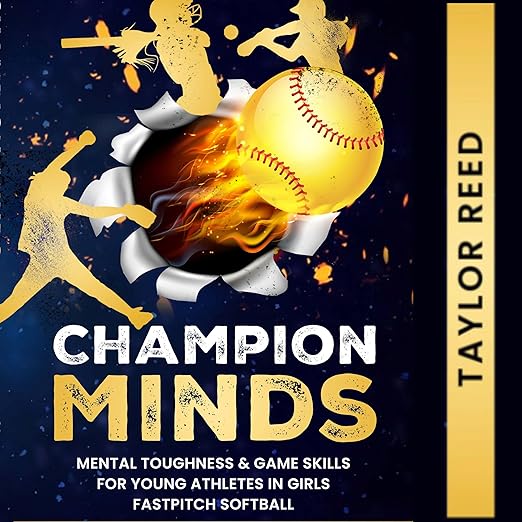
Softball is the sport this audiobook is actually about, and the title never says so. Champion Minds could belong to anything with a scoreboard, while the description opens on the on-deck circle, the opponent's ace pitcher glaring back, and a promise to turn softball players into living legends. Three hours and fifteen minutes of mental-toughness coaching sit underneath that, and the distance between a generic title and a single-sport text is the first thing a buyer needs to price in.
What Taylor Reed Delivers
Zach Wilson is the name occupying the publisher field, which is unusual enough to stop on. Taylor Reed is credited with writing the book and Alaura Howery with reading it, so the third name belongs to no imprint that appears anywhere else on this listing. None of that is disqualifying, and independent sports psychology is a large and frequently useful category, but it does tell you how much editorial machinery stands behind the advice: a person's name in the slot where a company would normally sit.
Second person is the register from the first line, and the description demonstrates it before you have paid anything: imagine the moment, heartbeat echoing in your ears, sweat sliding down your palms, the pitcher glaring back at you. Then the same scene replayed with the nerves converted into razor-sharp focus. That device works on the page and asks a great deal in audio, since direct address has to be sustained for three hours without tipping into a locker-room speech.
Masterpiece is the word the copy applies to itself, immediately before the list of contents, which tells you the marketing register: confident, unembarrassed, written for a parent scrolling fast. The list underneath is considerably more measured than the pitch around it. Inspiring stories of softball legends who met adversity with perseverance, commitment and goal-setting, the role of a strong support network, the route to unshakeable on-field confidence, and tips for balancing sport with school and a social life.
What Taylor Reed Gets Right
Fastpitch is the word a four-star from September 25, 2024 uses, and it is more precise than anything on the rest of the page. That response calls the book a valuable resource for aspiring female athletes, credits it with combining mental strategies and practical skills, and names the ground it covers: building confidence, managing pressure, and fostering a winning mindset. Clear and actionable is the verdict, and for a book aimed at teenagers playing under genuine competitive stress, clear and actionable is the correct target to hit.
Three hours and fifteen minutes is the right size for the job. Sports psychology usually arrives padded to three hundred pages, and a teenager with practice, homework and friends is never going to finish that. A file this length fits the drive to a tournament, and the topics as listed are separable rather than sequential, so it survives being taken in pieces and returned to before a game that matters.
Nerves are the real subject, whatever the contents list says, and the description's twin scenes make the entire argument in miniature: one player, one at-bat, one set of symptoms, read first as fear and then as focus. Everything taught here follows from the claim that the second reading can be trained rather than merely wished for. That is a defensible position, and it is also why the material carries over to exams, auditions and job interviews about as well as it carries to a diamond, whether or not a book sold on softball imagery wants to admit as much.
Where Taylor Reed Loses Some Ground
Age is the question the copy dodges. It promises value whether you are a budding athlete or a seasoned player, a range no single book covers, and the written responses locate the real audience more precisely than the description does. One parent, writing on January 4, 2026, reports a ten-year-old daughter following most of it while some passages went over her head, and that same reader found plenty of usable advice in it as an adult. Read it as a book that works from roughly middle school upward, with ten at the young edge.
Sport specificity cuts both ways, and the listing gives a buyer no help with it. Every example belongs to one game: the diamond, the on-deck circle, the pitcher, the bat. A basketball player or a swimmer can translate mental-toughness material without much difficulty, but they will spend three hours doing the translation, and neither the title nor the category nor the tag warns them in advance. Filed as sports psychology, this is more precisely a softball book with sports psychology inside it.
Who Should Pick Up Champion Minds
Reluctant readers are, on the evidence of this page, the group that gains most. The December 9, 2024 response describes precisely that: a daughter who does not enjoy reading and could not put this one down. That response is describing a printed copy rather than this recording, and the point still carries, because a reader who finishes something she did not want to start is telling you the material moves. Audio only removes the last obstacle standing in front of the next one.
Buy it for a specific player: a girl in fastpitch, twelve or older, losing at-bats to nerves rather than to mechanics, whose coach has run out of ways to say relax. Buy it for the parent who wants shared vocabulary for that conversation on the drive home. Do not buy it expecting a general survey of athletic psychology, and do not expect the packaging to have told you any of this, since the one place this record admits which sport it is about is the description itself.
Is the audiobook only about softball?
Effectively yes. Every scene and example in the description belongs to one sport: the diamond, the on-deck circle, the opposing pitcher, the bat. Athletes in other sports can translate the mental-toughness material without much trouble, but they will be doing the translating themselves, and nothing in the title or the category flags it.
Who is the audiobook written for?
The description claims to serve budding athletes and seasoned players alike, while the contents point younger: balancing sport with school and social life is one of the promised topics, and the scenes are written for somebody still trying to earn a place. Treat it as material for a competitive school-age player.
Does the audiobook cover practical skills or only mindset?
Both, according to the topics listed: commitment and goal-setting, the role of a strong support network, building on-field confidence, and managing the competing demands of sport, school and friends. The framing stays psychological throughout, so expect approaches to pressure and preparation rather than drills, mechanics or conditioning.