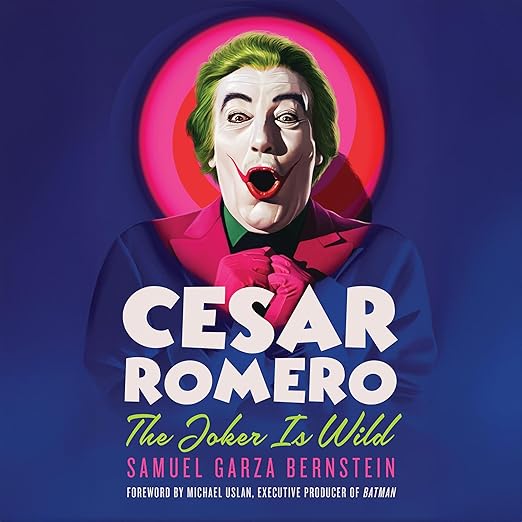
- Read by: Gary Galone delivers Bernstein's detailed biography with solid professional clarity, appropriate for a book that is primarily a documentary record rather than a character performance.
- At its heart: Hollywood identity and performance, the Latin lover stereotype, gay identity in Golden Age cinema
- Vibe: Affectionate and detailed, with an undercurrent of cultural criticism
- Short version: The first full biography of Cesar Romero is a genuine contribution to Hollywood history, particularly for listeners interested in the intersection of ethnicity and queerness in studio-era cinema.
Cesar Romero spent six decades in Hollywood and is best remembered for painting over his trademark mustache to play the Joker in the 1960s Batman television series. That detail, the refusal to shave for a role, is both a biographical footnote and an encapsulation of Romero's entire relationship to his public persona: deeply protective of a carefully constructed image while simultaneously willing to caricature it. Samuel Garza Bernstein's biography, the first book-length treatment of Romero, arrives as an audiobook narrated by Gary Galone and runs just over seven hours.
Elegance Under Decades of Constraint
Romero presents a particular kind of biographical challenge. He was, by all accounts, a genuinely private man who sustained a public career of nearly unparalleled duration and warmth. As a closeted gay man of Cuban and Italian ancestry operating in an industry that policed both sexuality and ethnicity with different instruments, he navigated decades of professional and personal constraint with what reviewers consistently call elegance. Bernstein's approach is to document that navigation rather than to judge it, and the result is a biography that respects Romero's own careful relationship to disclosure while providing the context that posthumous candor makes possible.
The Double Bind of the Latin Lover Label
The book opens with Romero's childhood and adolescence, which received little attention in previous accounts. Bernstein's research into these early years establishes the family background, the Latin American heritage that would both advance and constrain his career, and the artistic aptitudes that led him to dance, performance, and eventually Hollywood. The trajectory from New York nightclub performer to Hollywood contract player to television Joker is traced across the six-decade career, with particular attention to how Romero managed the "Latin lover" label he privately disdained.
The discrimination angle is one of the book's more substantive contributions to the historical record. Romero found the "Latin lover" label, as Bernstein documents, constrictive both in terms of his range as an actor and "as a man who kept his sexuality private." The conflation of ethnic and sexual stereotyping operated as a double constraint: cast him as exotic and romantic, never as a fully dimensional dramatic lead. His more than 400 film and television credits demonstrate a career sustained across that limitation through sheer professionalism and personal charm rather than the dramatic range he might have deployed in a less discriminatory environment.
Immortal as the Joker, Steadied by Galone
Bernstein covers the full span of Romero's career, from the 1930s co-stars including Shirley Temple, Marlene Dietrich, and Carmen Miranda to his later television work alongside Kurt Russell and Jane Wyman. The breadth is genuinely impressive and makes the biography valuable as a document of mid-century Hollywood history more broadly, not only as an account of one actor's career. Romero appears in enough significant productions across enough decades that following his career becomes a way of watching the industry itself change.
The Batman chapter, which covers the 1960s television series and Romero's specific approach to the Joker, is naturally one of the book's most anticipated sections, and Bernstein handles it with appropriate attention. The decision to paint over his mustache rather than shave it is discussed in the context Romero provided it: a matter of professional identity maintenance rather than prima donna behavior. The Joker role made him immortal in the cultural sense, as Bernstein observes, but it did not make him a star in the studio era sense, and the book is careful about that distinction.
Gary Galone's narration is competent and consistent across the seven-hour runtime. For a biography of this scope, competent and consistent is the right target. Romero's story does not require theatrical interpretation; it requires clarity and forward momentum. Galone provides both, making the documentary density of Bernstein's research followable without becoming a lecture.
A Loving Tribute That Handles Sexuality With Discretion
The biography is relatively short for a six-decade career. At 147 pages in print, translated to seven hours of audio, the coverage is necessarily selective. Reviewers who found the book too brief are not wrong to note that multiple significant periods of Romero's career receive less attention than they might in a longer study. Bernstein acknowledges that available documentation placed limits on what could be written with confidence, particularly regarding Romero's private life, and the book reflects that constraint honestly.
The ratings for this audiobook include a cluster below four stars, and the critical reviews tend to focus either on the brevity or on the tonal quality, described by one reviewer as "loving tribute" rather than critical biography. That framing is fair. Bernstein writes with affection for his subject, and listeners expecting a more ambivalent or analytically detached assessment may find the consistently admiring register limiting. The book does not build a case for Romero's canonical importance so much as it documents his career and lets readers draw their own conclusions.
The treatment of Romero's sexuality is handled with discretion throughout. He never publicly disclosed his orientation, and Bernstein does not retroactively out him in any definitive sense; rather, he establishes the context of Romero's private life as a closeted gay man in a way that is respectful of the choices Romero made while providing what historical distance now permits. Listeners expecting explicit biographical revelation will find the approach more circumspect than they may have hoped.
Filling a Real Gap in Hollywood History
The audiobook is particularly valuable for listeners interested in Golden Age Hollywood, in the history of Latino representation in American film, or in the cultural history of gay identity in studio-era cinema. Romero occupies a specific and underexplored position at the intersection of all three interests, and Bernstein's biography is the only full account available. Batman fans who want the complete Joker context will find the chapter on the television series satisfying within the broader career context.
Listeners who want a long, comprehensive biography with extensive coverage of every production Romero appeared in will find the seven-hour audiobook too selective for that purpose. Those who want analytical detachment rather than affectionate documentation may also find the tone less critical than they prefer. Within its actual scope, the biography does what it sets out to do: fills a genuine gap in Hollywood historical literature with documented evidence and appropriate care.
Is the Cesar Romero audiobook primarily about the Batman TV series, or does it cover his full six-decade career?
It covers the full career, from Romero's early 1930s work through his final television appearances. The Batman chapter receives appropriate attention given its cultural significance, but the biography positions the Joker role as one major chapter in a much longer story rather than the defining event. Listeners who want primarily the Batman context will find it, surrounded by substantial coverage of his earlier Hollywood work.
Does the audiobook address Cesar Romero's private life and sexuality, or does it stay focused on his public career?
Bernstein addresses both, with discretion. The biography establishes Romero's identity as a closeted gay man and discusses how that shaped his public persona, without making claims beyond what can be documented. Romero never publicly disclosed his orientation, and Bernstein respects that while providing the historical context his career demands. The treatment is factual and respectful rather than sensationalized.
At only seven hours, does the Cesar Romero audiobook feel complete, or does the short runtime leave gaps?
The seven-hour runtime reflects the 147-page print edition, which Bernstein acknowledges is limited by what documentation exists. Multiple reviewers noted a wish for more coverage of specific periods. The audiobook is complete in the sense of covering the full career arc, but selective in how much depth any given production or decade receives. For a debut biography of a previously undocumented figure, what is here is substantial; for listeners wanting exhaustive detail, it will feel abbreviated.