In Brief
- Big ideas: ISC2 CCSP preparation, cloud security domains, shared responsibility, scenario question strategy, structured study planning.
- Atmosphere: Businesslike and unhurried, built for repetition rather than for pleasure.
- Worth it?: A sensibly structured exam companion whose machine narration and missing index make it a supplement, not your only copy.
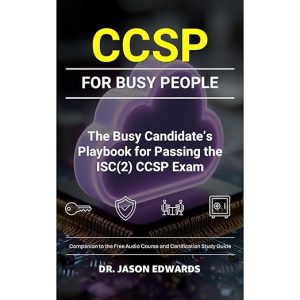
Cloud security certifications reward recall under pressure, and Jason Edwards has built this audiobook around that fact rather than around comprehensiveness. CCSP For Busy People is aimed at professionals who can already function in IT and are preparing for the ISC2 CCSP exam while holding down a job and a household. The promise is a move from having worked with cloud systems to being able to explain and defend cloud security decisions under exam conditions, and the file runs twenty-two hours and forty-six minutes.
Domain Organization Built Around Exam Pedagogy
Edwards organizes the material by exam domain rather than by technology, which is the correct choice for a certification guide and an awkward one for audio. The description walks through cloud concepts, architecture and design, governance and risk, cloud data security, cloud platform and infrastructure security, cloud application security, and cloud security operations. Each area is treated with a single question in view: what does the exam actually test here, and how do you separate a nice-to-know detail from something you have to apply?
Pedagogy here is more specific than most study guides bother to be. Definitions that stick, control intent, shared responsibility thinking, and the security consequences of design choices are named as the four things the book optimizes for, and the writing is described as plain English reinforced by showing how each concept appears in practice and how it is commonly tested. That last move, teaching the shape of the question rather than only the answer, is what separates a useful guide from a textbook summary.
Nothing on the Page Says Who Narrates
What the listing does not tell you is who is speaking. The narrator slot reads Virtual Voice, which means synthesized speech rather than a performer, and no rating or written response exists on the page to indicate how that lands across a file of this length. Anyone who has bounced off machine narration before should treat that as the single most important fact here, well ahead of the content.
Thirty-Four Sessions to Get Through the Material
Study time is the scarce resource this book is built around, and audio solves a real problem for the audience it names. The recommended pattern is a chapter pass to build understanding, a second pass for recall, and targeted review of weak areas, in blocks of twenty to forty minutes. Run the arithmetic against the running time and a single pass works out at roughly thirty-four sessions at the long end of that range, or around sixty-eight at the short one. Two passes double it. Plan the calendar before you buy.
Honest framing is rarer in certification marketing than it ought to be. No shortcuts are promised, no claim is made that you can pass on a weekend, and the assumption throughout is that you already have professional experience the book is trying to convert into exam-ready reasoning. Turning what you already do into what an examiner wants to hear is a narrower and more achievable goal than teaching cloud security from nothing.
Scenario questions get particular attention, and that is where the audio format genuinely helps. The hardest part of the CCSP is choosing the best answer among several defensible ones, which is a judgment habit rather than a knowledge gap, and habits are built by repetition in the background. Hearing control intent explained for the fourth time while you do something else is closer to how that instinct actually forms than rereading the same page would be.
Textbook Language Describing an Audio Product
Nearly twenty-three hours of synthesized speech is the commitment on this page, and the description was plainly not written for it. It refers to dense textbook pages, to what you should do when you cannot read, and to a chapter pass followed by a second pass, all of which assume an object you can hold and flip through. The copy also advertises a free audio course included with the main book, which is an odd thing to promise a buyer who is already purchasing the audio.
That mismatch has a practical edge. Certification study depends on returning to a specific definition the day before the exam, and a file of this size offers no index, no searchable text and no way to jump to shared responsibility without hunting. The advice here is straightforward: treat this as the reinforcement layer and own the text as well, which is precisely the arrangement the description itself describes.
Other gaps on this listing deserve a mention. It sits in a named series, Bare Metal Cyber Study Guides, with the series number left blank, so nothing tells you where this falls among the other guides or whether an order is intended. No ratings and no written responses exist at all, which for a study guide matters more than usual, since the only verdict that counts is whether previous listeners passed.
Machine Narration Is the Cost of Entry
Certification candidates who already work in IT and have a date circled on the calendar are the whole audience, and the book says so without hedging. Experience is assumed rather than taught, the domains are covered at exam altitude rather than at implementation depth, and the entire structure is built for someone squeezing preparation into gaps in an existing week. For that person, structured review in a format that survives a commute is a genuine advantage.
Leave it alone as well if you need practice questions. The description promises a way to approach scenario questions and explanations of how concepts are commonly tested, which does not amount to a question bank, and no audio file can deliver one usefully anyway. Anyone new to cloud computing should also start elsewhere: this converts experience into exam performance and has nothing to convert if you arrive without it.
Working professionals get the most out of this format, since the whole design assumes attention that is already spoken for. Machine narration is the cost of entry, and on technical vocabulary a synthetic voice at least never mispronounces an acronym twice in different ways. Treat it as a companion to the printed guide rather than a replacement for it, and the twenty to forty minute blocks the author recommends become genuinely easy to keep.
Questions Listeners Ask
Who narrates this audiobook and what does Virtual Voice mean?
The narrator slot reads Virtual Voice, which indicates synthesized speech generated from the text rather than a human performer. No listener verdicts exist at all, since the page carries neither ratings nor written responses. If machine narration has defeated you before, a long technical file is not the place to test your tolerance again.
Can this audiobook replace an official CCSP study guide?
No, and it does not claim to. The description positions the audio as reinforcement that pairs with a main book, built for moments when you cannot read. Certification study needs an index and a searchable text for the final week, neither of which an audio file provides. Use it for passes one and two, not for the last-minute lookup.
How much cloud experience do you need before starting?
Enough to function in IT already. The copy assumes you have worked with cloud systems and want to defend decisions about them under pressure, so it teaches judgment rather than fundamentals. Someone arriving without hands-on exposure will follow the definitions and lose the scenario reasoning, which is the part the exam actually weights.
How long does a full pass through the material take?
The book recommends blocks of twenty to forty minutes, which against a twenty-two hour file works out at roughly thirty-four longer sessions or around sixty-eight shorter ones for a single pass. The recommended plan calls for two passes plus targeted review, so budget several months of weekday sessions with longer weekend blocks.