Before You Press Play
- Big ideas: AI governance and accountability, risk appetite and tolerances, third-party controls, spaced-repetition recall
- Atmosphere: Methodical, repetitive by design, entirely functional
- Worth it?: A sound recall companion for candidates who already own the main text, hobbled by a format that cannot be sorted.
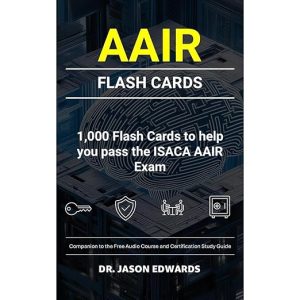
Flashcards were designed to be handled, shuffled and skipped, which makes a thirty-three-hour audiobook of them an unusual proposition. This one holds a thousand cards written against the ISACA AAIR exam, the Advanced in AI Risk certification, and it sets out to drill governance structures, accountability, risk appetite and tolerances, policy intent, evidence and assurance thinking, third-party controls, and the lifecycle checkpoints where AI risk surfaces. The material is coherent and the intent is honest. The format is where the questions start.
Thirty-Three Hours, Two Minutes a Card
Nothing on this record matches the title printed in its own description. The listing reads AAIR Flash Cards. The copy underneath calls the book AAIR for People With Jobs: 1,000 Flashcards, which names the parent volume, the audience and the card count in a single string. A buyer searching for either version will find only one of them, and the shorter title conceals the most useful fact about the product, which is that a thousand cards are in it.
Then the division nobody on the seller's side appears to have done. A thousand cards across thirty-three hours and forty-seven minutes works out at roughly two minutes per card, prompt and answer together. The copy prescribes a quiet study block of ten to twenty minutes a day. At two minutes a card, that daily block buys five to ten cards, and one full pass through the deck takes somewhere between a hundred and two hundred days. Nobody reaches a test date on that schedule by accident.
Two minutes per card also tells you what the recording has to be. A card is a prompt and an answer; stretched to two minutes, it becomes a prompt, an answer, and a fair amount of explanation wrapped around both. That is closer to a lecture series than to a deck, which may well be more useful for a working professional, though not what the word flashcards leads a buyer to expect from a study product.
Governance and Risk Appetite Anchor the Syllabus
Syllabus coverage is the strongest thing on offer. Governance structures, accountability, risk appetite and tolerances, policy intent, evidence and assurance thinking, third-party risk controls, and lifecycle checkpoints amount to a genuine map of what an AI risk certification tests, and the copy is explicit that the target is decisions and definitions rather than trivia. For anyone at the last-mile stage of preparation, having that map recited back has obvious value.
Study method is the other strength on offer, and it is refreshingly unhyped. Small daily sets, tracking the cards you miss or hesitate over, returning to those the next day and again a few days later, then drilling a weak topic until the answers come out cleanly before mixing the sets back together. That is spaced repetition explained properly rather than invoked as a slogan, and the page states outright that it promises no outcomes and no shortcuts.
Independent publishing is doing real work in this corner of the catalog, and this is a decent example of it. A certification this new is unlikely to attract a trade publisher's study line quickly, so candidates get self-published material or they get nothing. Jason Edwards has built the product as one part of a set, naming the main text and a free optional audio course as the other two, which is more structure than most independent exam material bothers with.
Buy This Alone and Own Just One Leg
Two minutes per card is not the only arithmetic problem here, nor the worst of them. Every instruction in the description assumes a deck you can see and control: pick a fixed number of cards, track which ones you miss, return to those tomorrow, drill only the cluster where the misses group together. A linear audio file supports none of it. You cannot pull the eleven cards you keep failing, reshuffle them, or jump to the governance block without scrubbing through hours of unrelated prompts.
Virtual Voice is the credited reader, meaning a text-to-speech production rather than a person. On material of this kind that choice carries more weight than it would on prose, because the gap between prompt and answer is the entire pedagogical mechanism of a flashcard, and nothing on the record says whether the production leaves one, how long it lasts, or whether answers are separated at all. Sample the file before you commit to it.
The series line names Bare Metal Cyber Study Guides and then leaves the number blank, so a candidate who wants the rest of that shelf cannot tell what this entry is, how many exist, or where to go next. Combined with a title that omits the parent book, the record makes a three-part study system look like a standalone purchase. Buy this alone and you own one leg of a stool the copy itself describes as having three.
No ratings and no written responses have accumulated since publication on March 12, 2026, which is worth noting without over-reading. A niche certification aid released a few months ago into an independent catalog is precisely the sort of product that stays quiet for a year. It does mean, though, that every judgment available to you comes from the seller, and the seller wrote the study method as well as the cards.
Companions Test What Teaching Already Put in Place
Candidates preparing for the ISACA AAIR exam who already own the main text are the intended buyer, and the copy says so directly. If the primary book has been worked through and the concepts need moving from recognition into recall, hearing a thousand prompts on repeat during otherwise dead time is a legitimate use of the format. The same applies to anyone refreshing a certification they already hold and wanting the vocabulary back at speed.
Nobody studying without the main text should start here. The description calls this a practice companion, and companions do not teach; they test what teaching has already put in place. Listeners who need to see an answer, mark it, and come back to it will find the format working against them too, since audio cannot be sorted, filtered or shuffled. Print or an app remains the better instrument for the drilling loop this copy recommends.
Used as designed, alongside the parent book and during hours you were going to lose anyway, this earns a place in a study plan. Used as your only preparation, it asks a linear file to do a job that needs a sortable deck, and the running time will wear you down before test day does. Budget several months rather than several evenings, and check that the parent volume is on your shelf first.
How many cards are in the AAIR Flash Cards audiobook, and how long does each one take?
A thousand cards across thirty-three hours and forty-seven minutes, which averages a little over two minutes per card with prompt and answer together. The recommended daily block of ten to twenty minutes therefore covers five to ten cards, putting one complete pass through the deck at somewhere between a hundred and two hundred days.
Can this audiobook replace the main AAIR study book?
No, and the description never claims it can. It calls itself a practice companion to the main AAIR for People With Jobs text and prescribes a three-part loop: read a chapter, reinforce it with the free optional audio course, then test what stuck using the cards. Bought on its own, you have one third of that system.