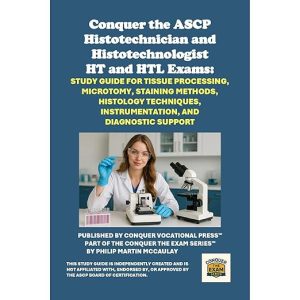
Nobody records a nine-and-a-half-hour audiobook about tissue processing for pleasure. This exists because two certification exams exist, and because a histology technician driving to a shift would rather revise than listen to the radio. Judge it on that job. The complication is that the page offers almost nothing to judge it with: no rating, no counter, not one written response, and a reader credited only as Virtual Voice.
Coverage is genuinely complete. Fixation and decalcification through processing, embedding, sectioning, and staining, then routine stains, special stains, enzyme histochemistry, microorganism detection, immunohistochemistry, and in situ hybridization. Advanced material follows: electron microscopy preparation, resin embedding, frozen sections, cryostat handling, and artifact recognition. It closes on the operational half candidates underestimate, laboratory safety, documentation, accessioning, tissue identification, and the information systems modern labs run on.
Sequence is the strongest thing about it. Chapters follow the specimen rather than the syllabus: what happens to the tissue first, then next, then last, with quality control threaded through rather than parked in a chapter at the end. For a subject where a mistake at step two only becomes visible at step six, that ordering does real teaching work, which is what makes the guide read as a discipline instead of a list of facts.
One caution about scope comes straight from the title. HT and HTL are two separate credentials with different remits, and a single guide covering both means neither gets the whole recording. A technologist candidate should expect the technician material to be thorough and the higher-level content to be proportionally compressed. Nothing on the page states the split, so treat this as a spine and not a sole source.
Nine Hours of Spoken Guide Fill a Gap
Audio suits one part of exam prep extremely well: the part where you already understand a technique and need the vocabulary to become automatic. Ribbon formation, section stability, blade behavior, orientation, temperature, timing. Those are terms you have to produce under pressure rather than derive, and hearing them in context repeatedly beats rereading a page you highlighted three months ago.
The operational chapters are the sleeper value. Accessioning, documentation, tissue identification, safety, and laboratory information systems are the domains candidates skip because they are not the interesting part of the job, and they are exactly the material that survives being heard on the drive in. Nothing about a documentation workflow needs a picture. That stretch of this recording does work the printed edition cannot claim to do better.
It also fills a gap in the format itself. Histotechnology is not a category with a deep audio catalog, and this is an independently published title rather than a house production. That independence explains why the page looks so thin, and it also explains why a nine-hour spoken guide to microtomy exists at all, which a candidate previously could not assume.
Immunohistochemistry Is Not a Word to Mispronounce
Virtual Voice is the credited reader, meaning synthesized speech rather than anybody in a booth. On most nonfiction that comes down to taste. Here it is a technical question, because the vocabulary runs to long technical compounds and clipped initialisms, and how a synthetic reader handles those is precisely what a candidate needs to know first. Immunohistochemistry and in situ hybridization are not words you want guessed at.
Nothing on the page lets you check that. A rating has never been filed, no counter appears at all, and not a single written response exists, so the preview clip is the only evidence available before purchase. On a listing whose central uncertainty is pronunciation, that clip is not a nicety. It is the entire due diligence a buyer gets, and skipping it here would be reckless.
Histology is a visual discipline and this recording never pretends otherwise. Artifact recognition, ribbon formation, section stability, and blade behavior are all judged by looking at something. The description mentions no companion PDF and no downloadable figures, which means the visual half of the subject has to come from you, from a textbook, a course, or the bench. That limit is real and the copy discloses it nowhere.
Two smaller items. The guide sits under a Healthcare Exams heading with no number attached, so a candidate cannot tell whether it belongs to a run of similar titles or stands alone. And the copy closes by stating the guide is independently created and not affiliated with, endorsed by, or approved by the ASCP Board of Certification, which is honest and worth reading before treating any content list here as the official blueprint.
Bench Experience Makes Revision the Right Frame
Candidates who have already worked a bench are the right buyer. If you have cut sections, fought a ribbon, and watched a stain go wrong, this is revision, and revision is what audio does best. The sequence gives you an order to hang details on, and the operational chapters cover domains you cannot practice at work because nobody assigns them as tasks.
A practicing histotechnician preparing for nothing in particular gets value too. A structured pass from fixation to finished slide, with quality control running through it, is a decent refresher for somebody who learned the workflow piecemeal on the job and never saw it laid out as a system. The safety and documentation chapters earn their place for that reader as well.
Do not spend a credit if you are starting from zero. The guide assumes you know what a cryostat is and why decalcification matters, and a first encounter with microtomy needs pictures this format cannot supply. Skip it too if your weak area is instrumentation you have never touched, since hearing a machine described is not being shown one. Without a companion file and without one word from a previous buyer, that preview clip stands between you and a blind purchase.
In Brief
- Big ideas: Fixation to finished slide, microtomy mechanics, routine and special staining, immunohistochemistry, laboratory safety and documentation.
- Atmosphere: Methodical, calm, built for repetition rather than for reading.
- Worth it?: A complete spoken syllabus for HT and HTL revision, held back by a synthetic reader nobody has reported on and a subject that wants pictures.
Frequently Asked Questions
Can I use this audiobook while working at the bench?
The vocabulary drills and the operational chapters on safety, accessioning, and documentation suit background listening. The technique chapters do not, since following a microtomy troubleshooting sequence takes the same attention as the cutting itself. Save those for the drive or the gym.
How long is the audiobook, and how should a candidate schedule it?
Nine hours and thirty-three minutes. Because the chapters follow the specimen through the lab rather than following an exam outline, they map onto workflow stages, so a sensible plan is one processing stage per session rather than a fixed number of minutes a day.
Can it teach artifact recognition without any images?
Half of it, honestly. Causes, mechanisms, and the vocabulary of a given artifact all transmit fine in speech, and those are what a written exam question tests. Spotting one on an actual slide is a looking skill, and this recording gives you nothing to practice looking at.