Quick Take
- Narration: Virtual Voice reads the practice questions and answer explanations at a flat, consistent pace, adequate for the format but without the teaching cadence that would help listeners internalize why correct answers are correct.
- Themes: College credit by examination, DSST test readiness, health and human development across the lifespan
- Mood: Purposeful and concise, built for learners close to exam day who need structured practice more than new concepts
- Verdict: A compact, no-frills practice test collection for the DSST Health and Human Development exam, most useful as a final-week diagnostic rather than a comprehensive study resource on its own.
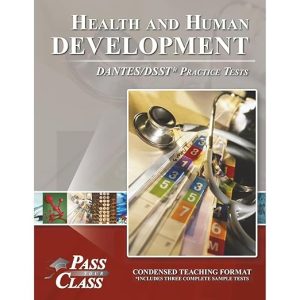
The DSST examination program exists for a specific kind of learner: someone who has accumulated real-world knowledge or prior coursework in a subject area and wants to convert that into college credit without paying tuition for a course they do not need. Health and Human Development DANTES/DSST Practice Tests from PassYourClass is built for that learner at a specific moment in their preparation, close enough to exam day that what they need is not more conceptual reading, but structured rehearsal under something that approximates exam conditions.
I came to this one on a quiet Saturday afternoon, treating it the way it is meant to be used: running through sample questions methodically, checking my answers, noting the categories where I was slowest to answer. At just under seven hours, the runtime reflects a focused practice-test collection rather than a comprehensive study text. Ten sample tests, 500 questions, a brief study skills orientation at the front. PassYourClass has built the same architecture across their CLEP and DSST catalog, which means learners who have used their materials before will recognize the format immediately.
The DSST Health and Human Development Scope
This exam covers a broad sweep: the biological bases of health and development across the lifespan, nutrition and physical activity, mental health and illness, substance use and addiction, reproductive health and sexuality, chronic and communicable disease, consumer health concepts, and environmental health basics. It is a health literacy exam in the broadest sense, designed to test whether a test-taker can think coherently about health across the human lifespan, not whether they have memorized specific medical terminology.
That scope shapes what the practice questions are actually testing. PassYourClass frames the content as teaching you only what you need to know to pass, which is accurate in the sense that the question bank is calibrated to DSST exam logic rather than to academic depth. The questions reward recognition and applied reasoning: given a scenario involving nutrition or substance use or chronic disease risk factors, which option reflects the evidence-based understanding the exam expects?
Audio Format and the Active-Recall Challenge
As with all practice-test audiobooks, the format creates an active-recall challenge that passive listening cannot address. The questions arrive, the listener either has an answer ready or does not, and the response follows. Without deliberate pausing and active engagement, forming an answer before the response plays, the questions become background noise rather than retrieval practice. PassYourClass does not appear to build extended explanations into the answer sequences here, which means missed questions require external follow-up with the companion study guide rather than in-audio remediation.
That is the design. This is a practice tool, not a teaching resource. Listeners who understand that distinction and approach the audio accordingly will get more from the format than those expecting the questions to explain the subject to them as they go.
The Role of the Companion Study Guide
PassYourClass explicitly positions their practice test books as complements to their separate study guides. The two-book system has a logical internal logic: the study guide builds the knowledge base in a condensed, exam-focused format, and the practice test book then stress-tests that knowledge through repetitive questioning. Learners who try to use the practice tests as their primary resource without the foundational coverage of the study guide will find the experience less productive, they will identify their gaps but have no in-format resource to close them.
For the DSST specifically, where the exam tests health literacy broadly rather than clinical depth, the study guide foundation is particularly important. The practice tests can reveal whether you understand the relationship between lifestyle factors and chronic disease risk, but they cannot teach you that relationship from scratch.
Who Should Listen / Who Should Skip
Listen if you are within two to three weeks of your DSST Health and Human Development exam date, have already covered the core content through the companion study guide or equivalent background, and want a structured final-stage practice mechanism. Skip it if you are starting your DSST prep and need conceptual grounding first. And approach the audio actively, passive listening through 500 questions will not produce the diagnostic value this format is designed to deliver.
Frequently Asked Questions
What specific content areas does the DSST Health and Human Development exam cover, and does this book address all of them?
The exam covers health across the lifespan including nutrition, mental health, substance use, reproductive health, chronic and communicable disease, and environmental health. PassYourClass calibrates their question banks to DSST exam domains, but verifying current coverage alignment against the official DANTES exam objectives before your test date is always recommended.
Is this the same format as the PassYourClass CLEP titles, or is the DSST content structured differently?
The architecture is identical: ten sample tests, 500 questions, a study skills orientation, and a two-book system pairing the practice tests with a separate companion study guide. PassYourClass uses this format consistently across their CLEP and DSST catalog.
Does the audio include explanations for why answers are correct, or just the correct answer itself?
Based on the format description and PassYourClass’s standard approach, the audio provides questions and answers without extended instructional explanations. Learners who need to understand why a specific answer is correct will want to use the companion study guide for remediation rather than expecting in-audio explanations.
How does the DSST Health and Human Development exam differ from a standard college health course final exam?
DSST exams are standardized credit-by-examination tests designed to demonstrate college-level competency rather than testing a specific course’s curriculum. Health and Human Development covers a broader interdisciplinary scope than most single-semester health courses, spanning lifespan development alongside the health content, which is why dedicated exam prep calibrated to the specific DSST domain mix is valuable.