Quick Take
- Narration: Virtual Voice reads the 1,000-card bank with consistent clarity but zero instructional energy, the absence of human pacing is most noticeable when conceptually dense clusters arrive without any vocal signal that the difficulty has shifted.
- Themes: Exam recall, CompTIA Tech+ domain mastery, spaced repetition for busy schedules
- Mood: Methodical and practical, designed for short daily sessions rather than extended listening
- Verdict: A purposeful recall tool for CompTIA Tech+ candidates who are already mid-prep, most effective when used as the third component of Edwards’s three-part study system alongside the main text and companion audio course.
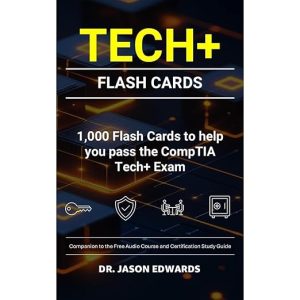
I spent some time with Tech+ Flash Cards on a slow Wednesday morning, earbuds in, notebook open, pausing after each question before letting the answer play. That is the only way this format makes sense, and I want to be direct about that from the start. Passive listening through 1,000 flashcard prompts at 25 hours is an exercise in forgetting, not learning. Active engagement, genuine retrieval pressure before each answer arrives, is where the format justifies its existence.
Jason Edwards has built Tech+ Flash Cards as part of the same architectural philosophy that runs through the broader Bare Metal Cyber Study Guides series. The card bank mirrors the coverage of the companion Tech+ For Busy People text, with a focus on the CompTIA Tech+ exam’s foundational domain: terminology, core concepts, and the recognition skills that help candidates navigate exam questions efficiently. The design is deliberately not exhaustive trivia. It is targeted toward the patterns of reasoning the exam rewards.
A Card Bank Designed for Recognition, Not Memorization
The distinction the synopsis draws between memorizing disconnected facts and keeping important ideas active in memory is the right framing for this kind of content. CompTIA Tech+ sits at the entry point of the CompTIA certification ladder, it is designed for learners who are building foundational IT literacy, not demonstrating advanced specialization. That audience profile shapes what the flashcards need to do: reinforce breadth of recognition across essential terminology, core system concepts, and the logic behind IT operations basics, rather than drilling deep into any single domain.
The 1,000-card count across 25 hours puts each card at approximately 90 seconds of audio, which includes question, processing pause (if you create one), and answer. At that density, the format rewards daily consistency over marathon sessions. Edwards recommends keeping sets small enough to finish reliably, then repeating missed cards until correct answers feel automatic, a spaced repetition approach that is well-matched to the workday rhythms of the busy professionals this series targets.
The Three-Part System in Practice
Like the AutoOps+ Flash Cards companion, this title is designed as the third layer of a study loop: read a section in Tech+ For Busy People, reinforce the same concepts through the free companion audio course during commute or workout time, then use the flashcards to prove recall is fast and reliable. That architecture makes sense because it separates the functions. The main text builds comprehension. The audio course provides repetition in a passive-listening context. The flashcards create the retrieval pressure that converts exposure into durable memory.
Listeners who try to use this as their only prep resource will find the experience unsatisfying. Without the conceptual scaffolding the main text provides, a missed card has nowhere to send you for remediation. The flashcard format reveals gaps; it does not fill them.
What Virtual Voice Costs You Here
At 25 hours and 49 minutes, the Virtual Voice narration is a sustained presence. The narration is technically clean, questions are read clearly, answers follow without ambiguity, but the flatness of delivery creates a specific problem for a flashcard format. Human instructors, even in simple review sessions, unconsciously modulate their pacing and tone around difficult material: a slightly longer pause before a tricky question, a more measured delivery around a concept that tends to trip candidates up. Virtual Voice delivers every card at the same cadence. Listeners who already know which areas give them trouble will not receive any audio signal that they are approaching those areas.
This is not a disqualifying problem. The content is intelligible and the card bank is well-structured. But it is worth setting realistic expectations: this is a study tool that happens to be in audio form, not an instructional experience that uses audio as its medium.
Who Should Listen / Who Should Skip
Listen if you are in the active prep phase for CompTIA Tech+ and want a structured daily recall mechanism to reinforce your work in the main text. The card bank is well-calibrated to exam-relevant content and the spaced repetition approach the synopsis outlines is genuinely effective. Skip it if you are new to IT concepts and have not yet built the foundational knowledge the flashcards test against, the three-part system works in sequence, and the cards are most useful last.
Frequently Asked Questions
How is Tech+ Flash Cards different from the main Tech+ For Busy People book in the Bare Metal Cyber series?
The main book builds conceptual understanding across the Tech+ exam domains. The flashcard collection tests that understanding through active recall, using 1,000 prompts designed to mirror the recognition and reasoning skills the exam measures. They are designed to work in sequence, not as substitutes for each other.
Is 25 hours of flashcard audio actually usable for daily commuting?
Yes, in short daily sets. The format works well during commutes if you treat it as an active exercise, pausing after each question to answer before the response plays. Passive listening while driving or exercising will produce very little retention. The methodology requires mental engagement even if the physical setting is mobile.
Does the flashcard content align with the current CompTIA Tech+ exam objectives?
The card bank is derived from the Tech+ For Busy People main text, which Edwards positions as aligned with current exam objectives. As with any third-party prep resource, cross-referencing the covered topics against the official CompTIA exam objectives before test day is a reasonable precaution.
Can this be used for the CompTIA IT Fundamentals exam or is it specific to Tech+?
The title is specific to CompTIA Tech+. While there is some topical overlap with IT Fundamentals content, the card bank is calibrated to the Tech+ exam’s domain structure and should be treated as Tech+-specific prep rather than a general entry-level IT certification resource.