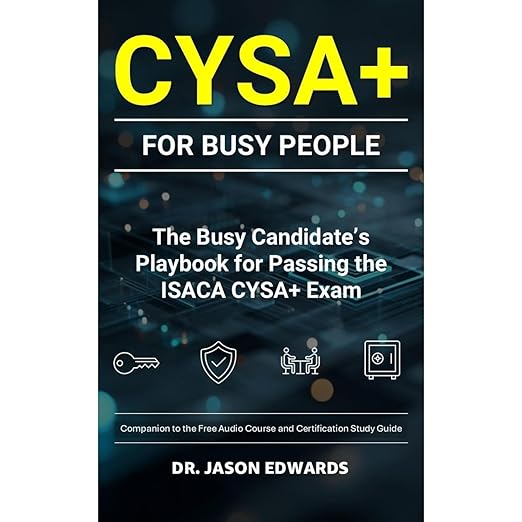
CYSA For Busy People arrives in a crowded certification prep market with a specific and defensible claim: it teaches the CompTIA CYSA exam the way a working analyst actually thinks, not the way a textbook organizes topics by domain. Jason Edwards, writing as part of the Bare Metal Cyber Study Guides series, has structured this audiobook around the exam's actual cognitive demand, and at nearly twenty-five hours, the production gives that approach enough room to actually demonstrate itself rather than simply assert its value as a methodology.
An Analyst's Discipline Replaces Memorized Definitions
The core argument that animates this audiobook is worth taking seriously. The CompTIA CYSA exam is scenario-based, which means it tests the ability to reason through realistic security situations rather than the ability to recall definitions and tool names. Edwards builds the entire structure of the guide around that insight. Rather than organizing chapters by exam domain and filling them with memorizable facts, the book trains listeners to approach scenario-based questions with an analyst's systematic discipline: identify what the evidence actually shows, evaluate competing interpretations, eliminate noise, and choose the most defensible next step given what is known. That framing is accurate to how the exam works, and it distinguishes this guide from certification materials that treat cybersecurity as a trivia contest.
The coverage addresses the full range of CYSA exam domains. Alert triage and investigation workflow are handled not as abstract processes but as decision chains where the order of operations matters. Log and event interpretation is presented through the lens of what specific evidence types actually reveal about attacker behavior rather than how to use specific tools. Incident response thinking covers containment, eradication, and recovery as reasoning problems with real tradeoffs rather than checklists to memorize. The section on communicating findings and selecting the best next step is particularly well-conceived for an exam that frequently tests the analyst's judgment about when to escalate versus when to continue investigation independently.
The Bare Metal Cyber series positioning as study guides for busy people is more than a marketing frame; it shapes the actual organization of the content. Each section is written to stand independently enough that a listener who last engaged with the material three days ago can re-enter without needing to backtrack extensively. The focus on decision-making patterns rather than encyclopedic coverage means the density per hour is lower than a traditional study guide, which actually serves the busy-person use case better than more comprehensive treatments would.
Virtual Voice Narration Suits Header-Heavy Exam Prose
The audio format has a genuine practical advantage for certification study that the field has not always acknowledged clearly. Working professionals preparing for the CYSA exam while employed full-time often have exactly two kinds of available time: concentrated desk time for active practice questions, and fragmented background time during commutes, exercise, and household tasks. An audiobook that covers the conceptual and reasoning dimensions of the exam fills the second category efficiently in a way that a traditional study guide cannot. Twenty-five hours of audio consumed at thirty minutes per commute represents roughly six weeks of supplementary study that would otherwise not exist at all.
Edwards designed the material for short sessions explicitly, and the section structure reflects that. Listeners who encounter a particularly dense passage on detection concepts or threat behavior can replay it without losing their place in a broader chapter-long argument. The Virtual Voice narration is a practical consideration rather than a significant limitation for this format. Structured, declarative, section-header-heavy exam prep prose suits Virtual Voice performance better than narrative or literary material, and most candidates preparing for a technical certification are more concerned with content clarity than vocal expressiveness. The delivery is consistent and unambiguous, which matters more here than it might in other genres.
Scenario-Driven Exercises Replace a Traditional Question Bank
No reviews are currently available for this title, which makes independent verification of the exam-preparation claims harder than usual. The synopsis is detailed and specific enough to suggest genuine familiarity with how CYSA exam questions are constructed, and the Bare Metal Cyber Study Guides series branding implies a consistent methodology. Listeners should approach with the understanding that twenty-five hours is a commitment, and the return on that investment is tied directly to active engagement with the material rather than passive absorption. Certification audio requires the same focused attention as a classroom session, not background listening mode.
The guide's explicit position is that it does not use traditional practice question banks, instead building reasoning skills through scenario-driven exercises embedded in the explanatory content. Candidates who feel they need high-volume question drilling to feel confident should supplement this with a dedicated question bank resource. Used together with a question-heavy supplement, this audiobook provides the conceptual scaffolding that makes individual exam questions easier to parse correctly, especially the tricky scenario-based items that the CYSA is known for. Listeners targeting a first-attempt pass should plan for both the reasoning framework this audiobook provides and the pattern recognition that repetitive practice questions build separately.
Career Changers Learn How Scenario Questions Work
Working cybersecurity professionals preparing for the CompTIA CYSA certification who have limited concentrated desk-study time will find this audiobook's format genuinely practical rather than a compromise. Career changers entering the security analyst field who want to understand how the exam's scenario-based questions are actually structured, rather than just what subject areas they cover, will benefit from Edwards's analyst-mindset framework. Listeners who have previously studied for the CYSA using conventional domain-by-domain materials and found themselves underprepared for the reasoning demands of the actual exam should find this a useful corrective. Those who need extensive practice questions as their primary study mode or who require hands-on lab guidance will need to build those elements separately, as this audiobook focuses on conceptual and reasoning foundations rather than practical execution or drill-based pattern recognition.
At a Glance
- Read by: Virtual Voice narration is functional for structured study guide content, though listeners who prefer human readers should account for an adjustment period over nearly twenty-five hours.
- At its heart: Analyst mindset for CompTIA CYSA, scenario-based exam reasoning, cybersecurity investigation workflow
- Vibe: Structured, clinical, and practical
- Short version: Genuinely useful for working professionals who need CompTIA CYSA preparation that prioritizes decision-making patterns over rote memorization.