Quick Take
- Narration: Virtual Voice delivers the conceptual prose clearly enough but flattens the practical reasoning passages where a human instructor’s inflection would help listeners distinguish core logic from supporting context.
- Themes: Cloud security operations, GIAC GCLD exam preparation, working-professional study rhythms
- Mood: Focused and methodical, structured for learners with constrained schedules and real operational contexts
- Verdict: A well-scoped cloud security primer for working professionals preparing for GIAC GCLD, though the Virtual Voice narration and absence of listener reviews means this requires some tolerance for uncertainty about production quality.
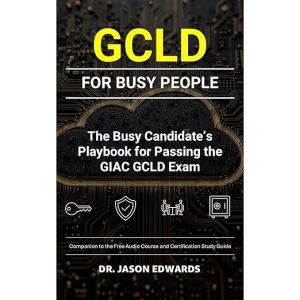
I have a specific type of listener in mind when I approach books like GCLD For Busy People, because the author has a very specific type of learner in mind too. This is not for someone who can block out three-week study sprints. It is for the security professional who has agreed to pursue the GIAC GCLD certification while also running an incident queue, sitting in vendor meetings, and trying to preserve some semblance of a non-work life. That listener is real, that schedule is real, and the question is whether this audiobook’s approach actually serves them.
Jason Edwards’s Bare Metal Cyber Study Guides series has developed a consistent philosophy across its titles: respect your reader’s time, teach operational reasoning over isolated facts, and build a multi-format study ecosystem that works in the margins of a packed calendar. GCLD For Busy People applies that framework to the GIAC Cloud Security Essentials certification, which is SANS-adjacent and covers cloud security fundamentals across the major public cloud platforms.
What the GCLD Exam Actually Demands
GIAC GCLD is designed for professionals who need to demonstrate they can defend cloud workloads using preventive, detective, and response techniques. The exam covers cloud account fundamentals, identity and access management patterns, cloud networking concepts, logging and monitoring frameworks, and the operational mindset for assessing cloud risk and responding to cloud-specific incidents. It sits at the practitioner level, not an introductory cloud survey, but not an advanced red-team certification either. The target audience is the security professional who works in or near cloud environments and needs a structured credential to formalize that knowledge.
Edwards positions the learning outcome explicitly: finish the book able to explain core cloud security concepts in plain English, spot common failure points, and choose controls that make sense in real environments. That operational framing, what to check first, what evidence matters, what good looks like when assessing cloud risk, is the right design choice for an exam that tests applied judgment rather than memorization.
Chapters Built for Interruption
The structural decision to design chapters for short reading blocks with frequent reinforcement is meaningful for this audience. Cloud security material at the practitioner level has real conceptual density: the relationships between identity, network, logging, and response components are not trivially simple, and learners who can only study in 20-minute windows need the material organized so that resuming after a gap does not require re-reading the previous session to reorient. Whether the chapter architecture fully delivers on this promise is something each listener will need to assess against their own working memory, but the intent is sound.
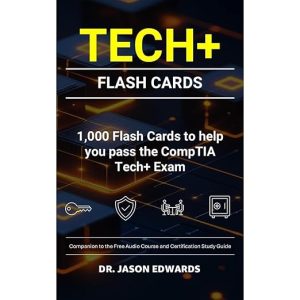
The three-part system Edwards has built for this title mirrors the other Bare Metal Cyber entries: the main book builds conceptual understanding, a free companion audio course provides repetition during commute time, and a separate Kindle eBook with 1,000 flashcards drives active recall. GCLD For Busy People is the entry point, not the complete study package, and listeners who want to maximize their preparation should plan to engage all three components.
The Limit of No Listener Data
There are no ratings and no reviews available for this title at the time of writing. For a GIAC certification prep resource, that is a meaningful data gap. GIAC certifications are relatively specialized, and the GCLD in particular is newer than the established SANS curriculum standards. Learners who are betting exam fees and professional development time on this book deserve to know whether the content accurately maps to current exam objectives. The absence of reviewer feedback makes that harder to verify independently.
The series disclosure, not affiliated with, endorsed by, or sponsored by GIAC or SANS, no proprietary exam content, is the standard responsible disclaimer, and it is appropriately foregrounded. But it does reinforce that this is independent preparation material, and learners should supplement with official GIAC exam objective documentation before assuming full coverage alignment.
Who Should Listen / Who Should Skip
Listen if you are a working security professional pursuing GIAC GCLD and need a study resource that acknowledges your time constraints and builds operational reasoning rather than memorization. The structured chapter design and three-part ecosystem are well-suited to busy-professional prep rhythms. Skip it if you are approaching cloud security from scratch, this is practitioner-level material that assumes some existing familiarity with security fundamentals and cloud environments. Also consider supplementing with official GIAC resources given the absence of listener feedback to verify content accuracy.
Frequently Asked Questions
Is GCLD For Busy People enough to pass the GIAC GCLD exam on its own, or does it need to be paired with other resources?
Edwards explicitly positions the audiobook as part of a three-component system: the main book, a free companion audio course, and a separate Kindle eBook with 1,000 flashcards. The book alone builds conceptual understanding but the full preparation rhythm requires all three. Additionally, given the absence of listener reviews verifying coverage accuracy, supplementing with official GIAC exam objective documentation is prudent.
How does this compare to SANS courseware for the GCLD exam?
Edwards is clear that this is independent preparation material with no affiliation to GIAC or SANS. SANS official courseware is the authoritative preparation track for GIAC certifications. This book is positioned as an efficient, schedule-friendly alternative or supplement for professionals who cannot commit to a formal SANS course, not a direct replacement for it.
Does the book cover all three major cloud platforms (AWS, Azure, GCP) or focus on one?
The synopsis describes coverage of public cloud platform fundamentals broadly, including cloud account structures, identity and access patterns, networking, logging, and monitoring. It does not specify platform-specific depth breakdowns. Candidates who need platform-specific coverage depth should verify this against their target exam objectives.
Is the Virtual Voice narration a significant barrier for technical cloud security content?
For conceptual explanations of cloud security principles, Virtual Voice is functional, the content is intelligible and the prose is clear enough to follow in audio. The limitation is in the reasoning passages where a human instructor would use inflection and pacing to help listeners distinguish foundational logic from supporting context. Listeners who find AI narration distracting will want to test their tolerance before committing to a 24-hour preparation resource.