At a Glance
- Themes: water treatment and distribution fundamentals, regulatory compliance and monitoring, exam-oriented operational reasoning
- Mood: Plain, procedural, unhurried
- Verdict: A workable second pass for candidates already studying, but not a syllabus, not a question bank and not a place to start.
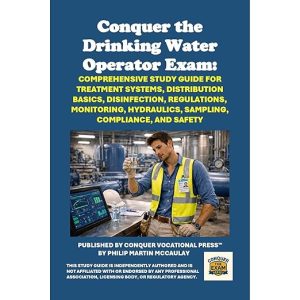
Nine subject areas sit in the title of this audiobook and seven hours and thirteen minutes are allotted to cover all of them. Divide it out and each heading gets roughly forty-eight minutes: treatment systems, distribution, disinfection, regulations, monitoring, hydraulics, sampling, compliance, safety. That is a survey rather than a course, and working out which of the two you are buying is most of the decision.
Coverage Follows the Water System's Own Sequence
Coverage runs the length of a water system, from source collection through treatment and storage to distribution, which is the right spine for the subject. Hydraulic principles, chemical treatment fundamentals, infrastructure maintenance, regulatory requirements, monitoring strategies and emergency response all get named in the description. The stated method is system relationships and operational reasoning rather than isolated facts, and for a working operator that framing earns its keep.
Missing an Exam Name and Any Practice Questions
Nothing in the copy names an exam. No certifying body, no state or provincial program, no operator grade, no syllabus this maps against, on a listing tagged for study guides and test preparation. A buyer therefore has to hold the nine headings against their own program's published outline and decide, unaided, whether the overlap justifies the money. Do that comparison before you buy, not after.
Practice material is the other absence. A guide tagged for test preparation might reasonably be expected to carry questions, an answer key or a worked paper, and the description promises none of the three. What it promises is explanation: chapters that build step by step toward a complete operational perspective. That is revision reading rather than drilling, and the two do different jobs in the last month before a test.
Synthetic Narration Leaves Every Signal to You
Revision by ear has one real advantage, and it is why this format exists for exam material at all. Content you have already met on paper survives a second pass while your hands are busy, and a water system is a sequence by nature: source collection, treatment, storage, distribution. Sequences hold up well when spoken aloud. Formulas and tables do not, and hydraulics is one of the nine headings on offer.
Emphasis on reasoning rather than memorization is the pitch, and it is the correct pitch for this subject. Operators are not asked purely for recall; they are asked why a decision follows from a condition. Copy promising system relationships and the practical logic behind treatment and distribution decisions is aiming at the harder half of any technical paper, where the right answer depends on knowing what the plant is doing.
Virtual Voice is the credit here, meaning synthetic narration rather than a hired reader, and the listing states it plainly for anyone who checks. Consequences are practical rather than aesthetic. Synthetic delivery gives no emphasis to a definition, no pause ahead of a caution and no change of pace at a calculation, so every signal a human reader would use to mark what matters has to be supplied by you.
Leftover Print Language Still Talks About Readers
Copy on this listing was written for a printed object. It refers to the book, to chapters that build understanding step by step, and to readers who will develop an operational perspective, with nothing anywhere acknowledging that the product on sale is audio. No companion document is offered either. On a subject containing hydraulic calculations, the missing figure sheet is the most consequential omission of the lot.
Series information is half filled in. The record places this inside something called Skilled Trades Exams and then leaves the number blank, so a buyer cannot tell whether this is the first title in that line or the fifteenth, nor which other trades sit beside it. For a candidate who finds this useful and wants the next one, the trail simply stops.
Pressure Language Replaces Any Actual Evidence
Evidence is the largest gap of all. This listing carries no star average, no rating counter and no written response of any kind, on a title released in February 2026 through an independent publisher. Nothing sinister about that; new self-published guides start empty. It does mean every judgment has to come from the description and the sample, and that the usual shortcut of reading what other candidates said is unavailable.
Closing copy applies pressure rather than information. It tells a reader who has already invested time and money into preparing not to leave success to chance, then describes itself as a quick, focused review that will help you pass the first time. Read that as marketing. A seven-hour survey does not replace a course, and the honest version of the claim is that it consolidates what you already half know.
Wrong Purchase for Someone Starting From Nothing
Candidates already deep in a certification course are the natural buyers, and the value is specifically as a second pass. If a textbook and a classroom have covered the ground once, this puts the same shape of material into a shift or a drive where reading is impossible, and the reasoning-first framing suits that use better than a glossary would.
Working operators studying for an upgrade are the other clean fit, particularly anybody whose day already runs on the distribution side and who needs the treatment vocabulary to catch up. Supervisors briefing new hires could use it as a shared reference point. Anyone who learns by hearing an explanation a second time will get more from this than from the same span spent rereading a chapter.
It is the wrong purchase if you are starting from nothing, because a survey assumes a frame to hang things on and this one supplies no diagrams, no tables and no questions with which to build that frame. Anyone within a week of an exam needs drilling rather than review, and review is what this is. Nobody should buy it expecting a substitute for the syllabus their certifying program actually publishes.
A Few Questions About Conquer the Drinking Water Operator Exam
What does the Virtual Voice credit mean for this audiobook?
Synthetic narration rather than a reader hired for the job. The practical test is whether dense technical vocabulary survives it, so play the sample and listen specifically to how chemical and hydraulic terms come out. A term you first learn mispronounced is harder to recognize in an exam room than a term you have never met at all.
Does this audiobook cover a specific state or national certification exam?
The copy never identifies one. No board, no jurisdiction, no operator grade and no syllabus reference appears anywhere in the description, and the only structure offered is the run of topic areas in the title. That leaves the matching work with you, which is worth an hour of your time before any of the money changes hands.