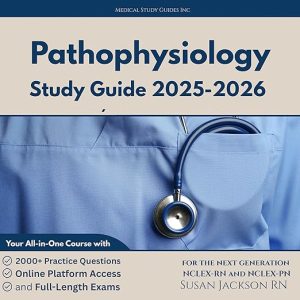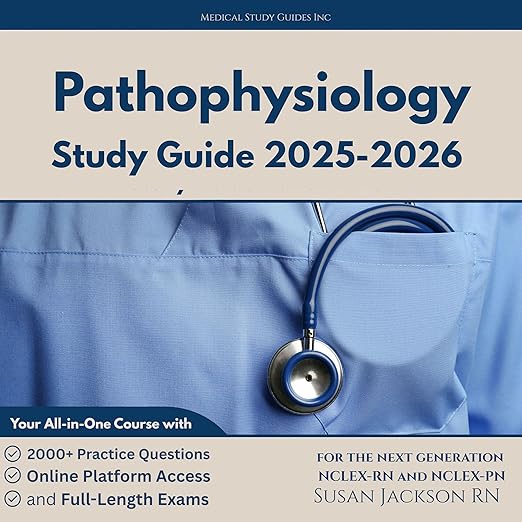
Ace the NCLEX-RN, says the opening line of the description, and a paragraph later that same description calls this book something other than the name printed on the cover. The listing sells Pathophysiology Study Guide 2025-2026. The copy underneath sells Pathophysiology Crash Course. One audiobook, two titles, and a buyer chasing either one of them will only ever find half the trail. Susan Jackson takes the author credit, Martin White reads, and the whole thing runs six hours and forty-nine minutes.
Two Titles, One Search Problem for Students
Two names for one product is not a typo, it is a search problem with a price attached. Somebody who heard about Pathophysiology Crash Course from a classmate in the library will type that phrase into a store and find nothing at all, while somebody browsing study guides by exam year will find this one and have no way to connect it to the recommendation they were given. Nursing students buy prep material on word of mouth far more than on browsing, so this mismatch costs the book its single most reliable channel.
Designed for nursing students, by nurses, the copy says. Nurses, plural, sitting above a byline that holds a single name. Either the guide was written by a team and the byline flattened them into a single name, or the plural is decoration. That distinction matters more for a clinical resource than for a novel: anybody deciding whether to trust a pathophysiology summary wants to know who wrote it, what they do for a living, and how recently they worked a floor. This page answers none of the three.
Most of a year after release, nobody has voted. The star display is blank, the counter is blank, and not one written response exists, on a product aimed squarely at a population that reviews prep material obsessively and argues about it in public. That absence is itself information, though it points two ways: either the guide has barely sold, or it sold to people who took the exam and never came back to the page afterwards. Neither reading is fatal. Neither is encouraging either.
White's Harder Job Is Surviving Without Spelling
The promise is specific enough to check against the runtime. Disease processes explained plainly and organized by body system. Summaries built for retention under pressure. NCLEX-style practice questions with detailed answer rationales. Proven tips for spotting patterns in signs, symptoms and interventions. That is the correct list for a review resource, and the body-system organization is the right call in audio particularly: cardiovascular as one block, then respiratory, then renal, gives a listener a frame to hang new material on instead of a stream of disconnected facts.
Pattern work is the part that genuinely gains from being spoken aloud. The exam does not reward definitions, it rewards telling one presentation apart from the neighboring one that shares half its symptoms, and that is a distinction a voice can walk you through while your hands are busy elsewhere. A rationale delivered in speech, with each wrong option taken apart in turn, builds the clinical reasoning the test actually measures rather more efficiently than a highlighted textbook page does.
Martin White has the harder half of the job here. Clinical vocabulary read aloud has to survive without its spelling, because a listener who has never seen a term written cannot reconstruct it from sound alone, and pathophysiology is thick with words separated by two letters and a shift of stress. Nearly seven hours of that, delivered with no page to glance down at and no diagram to check against, asks a reader for precision far more than for personality.
By Option D, You've Lost Option A
Practice questions are where this format meets its ceiling, and it is worth being blunt about it before you buy. A multiple-choice stem plus four options is five or six sentences you have to hold intact in working memory while a voice delivers them at speaking pace. On a screen you re-read the stem, cover the options, eliminate two and choose between the survivors. By ear you get one pass, in order, and somewhere around option D most people have quietly lost option A.
None of that makes the questions worthless, it changes what they are for. Treat them as rationale delivery rather than as self-testing: let the stem run, pause, answer out loud, then listen to why the three distractors fail. Used that way, the audio does real work that a printed answer key does not. Used as a stand-in for a question bank on a screen, it will quietly convince you that you know material you cannot actually retrieve under timing.
Edition years are a countdown rather than a label. A guide badged 2025-2026 is written against one specific exam cycle, and buying into the back half of that window leaves less time to use it before the next revision arrives and the current one starts drifting. Crash course is also an honest account of the scope: seven hours cannot be anybody's first encounter with pathophysiology, and copy that offers itself for last-minute review and daily prep sessions in the same breath is trying to be two products at once.
From Recognized to Retrievable During Clinical Drives
Nursing students in the last stretch before the exam are the right buyers, and specifically the ones who have already done the coursework and now need the concepts moved from recognized to retrievable. Commutes, clinical drives, laundry, the walk between buildings: this is material for the hours a textbook cannot follow you into, and the body-system structure means you can pick a block, run it, and always know roughly where you are inside the whole.
Look elsewhere if you are meeting pathophysiology for the first time, because a crash course assumes a foundation it makes no attempt to build. The same applies if you learn by drawing pathways, since cascades, feedback loops and flowcharts are visual objects and a description of one is not the same thing as one. No one should make this their only NCLEX resource either, whatever the copy implies about walking into the exam room ready.
Pair it with a screen-based question bank and a set of diagrams and this becomes a genuinely useful review layer inside a study plan that already exists. On its own, on a page carrying two different titles, one byline for a book credited to nurses in the plural, and not a single vote after most of a year in the store, it is asking for more trust than it has yet earned.
- Read by: Martin White reads for a publisher named after the exam itself, with no cast, no music and no page furniture to lean on.
- At its heart: Disease processes by body system, pattern recognition over memorization, exam-cycle cramming
- Vibe: Brisk and clinical, pitched at somebody already short on time
- Short version: A workable review layer for students who have done the reading, and the wrong place to meet pathophysiology for the first time.
Why does the description call this audiobook Pathophysiology Crash Course when the cover says Study Guide?
The listing and the copy disagree, and the page never reconciles them. It reads like promotional text written for one edition and pasted under another title. The practical cost is search: recommendations circulating under one name will not lead anybody to the product sold under the other.
Do the NCLEX-style practice questions actually work when you can only hear them?
Partly. A stem plus four options is more than most people hold in working memory at speaking pace, so they fail as timed self-testing. They work well as rationale delivery, where you pause after the stem, answer aloud, then listen to why each distractor is wrong.
Is this audiobook enough on its own to prepare for the NCLEX-RN?
No, and the description overpromises on that point. Six hours and forty-nine minutes is a review layer, not a curriculum. Pathophysiology also has a visual dimension, in cascades and flowcharts, that speech cannot reproduce. Pair it with a question bank and diagrams rather than substituting it for them.
Does the 2025-2026 label mean the content goes out of date?
It means the guide was written against a particular exam cycle. Content frameworks get revised periodically, so a guide badged for a two-year window becomes progressively less current inside it. Buying late in that window still works for concepts, but confirm the test plan you are studying against.