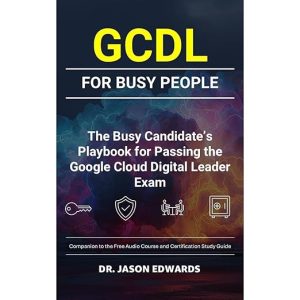
Quick Take
- Narration: Virtual Voice handles the business-facing cloud content with mechanical consistency, adequate for the non-technical explanatory passages, but unable to provide the analytical tone that would help a listener distinguish decision-critical concepts from supporting background.
- Themes: Google Cloud Digital Leader certification, cloud business strategy, cloud cost and security fundamentals
- Mood: Organized and practical, with the measured pace of someone who has thought carefully about how busy professionals actually study
- Verdict: A well-conceived prep resource for the GCDL exam that understands its audience unusually well, but Virtual Voice narration on a twenty-hour recording is a genuine listening endurance challenge that undermines the accessibility the content deserves.
The Google Cloud Digital Leader certification is not an engineer’s exam. It is designed for the people who sit in the meetings where cloud strategy is decided, product managers, program leads, business analysts, operations directors who get pulled into conversations about shared responsibility models and multi-region redundancy and AI tooling costs and need to be able to engage with those conversations without getting lost or nodding along at the wrong moments. Jason Edwards has clearly spent time with those people, because the framing of this guide is unusually accurate about what they actually need.
The opening positioning is worth quoting directly: this is for the person who gets pulled into cloud conversations, asked to explain the basics, expected to make sense of Google Cloud at a high level. That is a precise description of a real professional situation, and it immediately distinguishes this from the engineering-first cloud certification guides that dominate this space. The goal the guide articulates, that you should be able to explain what matters, choose sensible options, and recognize when a detail is important versus noise, is the right goal for the GCDL exam and for the digital leader role in general.
Shared Responsibility, Identity, and the Conceptual Architecture of Cloud
The GCDL exam has a distinct conceptual layer that distinguishes it from more technical cloud certifications: it tests understanding of why cloud decisions are made and how they map to business outcomes, not just what the technical components are. Edwards’ guide honors this by staying at what it calls the right altitude. The coverage of shared responsibility models, identity and access management as a business governance question, and the relationship between cloud adoption and organizational risk is appropriately pitched at a business audience.
This is harder to write than it sounds. The temptation in cloud certification prep is to go deeper on the technical content than the exam requires, because technical depth feels more credible. Edwards resists that temptation consistently. The coverage of networking basics, data and analytics building blocks, and application modernization stays at a level where the concepts are useful for decision-making without requiring engineering background to follow. For the target audience, this is exactly right.
Decision Mapping as the Core Study Method
The most pedagogically interesting aspect of this guide is its explicit training in decision logic: not what the answer is, but how to map requirements to outcomes. The practice framing, what problem are we solving, what constraints matter, what choice best fits the situation, is the kind of analytical scaffolding that the GCDL exam tests and that the digital leader role actually requires. Teaching this as an explicit skill rather than a byproduct of content review is a genuine differentiator.
This approach also has a specific advantage in audio format. Decision-mapping logic flows as narrative reasoning rather than as technical specification. A listener can follow the reasoning through a problem scenario in a way that they cannot easily follow a circuit diagram or a network topology. Edwards’ content is well-matched to audio in its structure, which makes the narration choice all the more frustrating.
Twenty Hours with Virtual Voice: The Endurance Problem
Virtual Voice across a twenty-hour recording is a significant ask of any listener. For the first few hours, synthetic narration is a mild distraction from the content. By hour ten, the absence of human tonal variation starts to create its own kind of listening fatigue, not from the content, which remains well-organized, but from the delivery, which does not modulate in response to the relative importance of what it is saying. A human narrator would lean into the sections where Edwards is making a particularly crisp analytical point. Virtual Voice treats those passages identically to transitional summaries.
The guide’s own advice about using short sessions, the structure favors short sessions and clean milestones, is the right approach to managing this. Treating it as a thirty-to-forty-minute daily study tool rather than a long-form listening experience is both what the guide recommends and what the narration format requires.
The Companion Flashcards and Audio Relationship
The guide is designed as the centerpiece of a three-part study system: the main text, a companion flashcard eBook with a thousand cards, and a free audio course that reinforces the same concepts in a listening-friendly flow. The audio version being reviewed here is the main study text, and understanding that context matters. It is not designed to be used alone, the flashcard companion is important for moving from recognition to active recall, which is the gap between a passive listener and a test-ready candidate. The system logic is sound; the pieces together are more valuable than any single component.
Frequently Asked Questions
Is the GCDL exam suitable for someone with no technical background, and does this guide reflect that audience?
The GCDL is explicitly designed for business and technical professionals who work with cloud at a strategic rather than engineering level, and the guide reflects that framing consistently. No coding or infrastructure background is required. The content stays at a decision-making altitude appropriate for non-engineers in cloud-adjacent roles.
The description mentions a free audio course separate from this audiobook, what is the relationship between the two?
The main audiobook is the primary study text. The companion audio course is designed for reinforcement during activities where you cannot engage with the text, commutes, workouts, household tasks. They cover the same conceptual territory but are formatted differently, with the audio course being a lighter review pass rather than the full content.
How does the guide handle the Google Cloud-specific content that distinguishes the GCDL from generic cloud concepts?
Google Cloud-specific services are covered in the context of how they fit common business and technical scenarios, data and analytics tools, AI and ML building blocks, reliability and infrastructure services. The guide does not go deep on product-level technical specifications, which is appropriate for the GCDL exam’s level of abstraction.
At twenty hours, how should this be structured into a realistic study schedule for someone with a full-time job?
The guide explicitly recommends short daily sessions with clean milestones rather than marathon study. Breaking it into thirty-to-forty-minute segments over several weeks, combined with daily flashcard review, matches both the guide’s design intent and what actually works for retention in a busy professional’s schedule.