The Short Version
- At its heart: CompTIA AutoOps+ preparation, automation and configuration treated as one workflow, applied judgment over memorization
- Vibe: Methodical and exam-focused, built for short sessions rather than long sittings
- Short version: A plausible reinforcement layer for a commute, provided you verify which edition and which product this listing actually delivers.
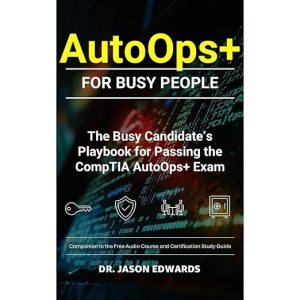
Certification study guides rarely run twenty-three and a half hours, and that number is the first thing worth sitting with here. AutoOps+ For Busy People is pitched squarely at people who study in short sessions between shifts, and it arrives as an audiobook longer than most epic fantasy novels. The two facts are not incompatible, but nobody on this page has reconciled them, and the buyer is left working out how a book built for fifteen-minute bursts becomes three full working days of listening.
Whether CI Arrives as Two Letters or a Word
Two titles are in play here, and they do not match. The listing says AutoOps+ For Busy People. The opening line of the description says AutoOps+ for People With Jobs is written for working professionals. Same idea, different words, and only one can be the published title. That kind of drift usually means copy written for one edition and pasted onto another, which turns out to be the pattern across this entire page.
Virtual Voice is the credited narrator, which is a fact rather than a complaint, and it is a fact that matters more on this book than on most. Synthetic narration has improved a great deal on ordinary prose. Technical study material is a different problem: acronyms defined once and then used constantly, tool names, command syntax, and the small question of whether CI arrives as two letters or as a word. Sample a section before committing.
Nothing else on this page tells you what you are buying. No rating, no written responses, no commentary of any kind, and a series field naming Bare Metal Cyber Study Guides without supplying a number, so you cannot tell whether this is the first volume or the ninth. On a study guide, series position is not decoration. A later volume routinely assumes the groundwork of an earlier one.
Listeners Cannot Flip Back the Way Readers Can
Automation coding concepts, system configuration, continuous integration and continuous delivery are the four domains the description says the exam measures, and the stated approach is to treat them as one connected workflow rather than as four separate chapters. That is the right instinct. Code choices affect configuration behavior, configuration affects the reliability of a pipeline, and pipeline reliability decides how much confidence anybody has at delivery. Teaching those four apart from each other is how most guides fail their readers.
Acronyms are defined the first time and then used consistently, the description promises, which is a small commitment that becomes a large one in audio. A print reader can flip back three pages to the definition. A listener cannot, and a guide that reintroduces its own terms carelessly turns unusable at speed. If the book delivers on that single promise, it is better suited to this format than most technical writing manages to be.
Judgment rather than memorization is the stated goal, and the description is unusually clear about what that means: look at an automation task, a configuration change, a pipeline failure or a deployment approach, then reason through the safest and most effective decision. Whether an exam can really measure that is a separate argument. As a study philosophy it is the correct one, and it explains why a long discursive audio treatment might genuinely outperform a stack of cards.
Print Structure Gets Explained to an Audio Listener
Companion products are where this listing turns genuinely confusing. The description offers a free companion audio course to support the main book, calls it optional, and states that the book stands on its own. Then it explains that the audio suits people who commute, walk or travel. All of that is written from the point of view of somebody holding a printed book. You are looking at an audio product, and the copy never once acknowledges the fact.
Flashcards get pitched as well, a separate ebook holding a thousand of them, to be worked in short daily sets with the misses marked and revisited later. Sensible advice for a study system. Completely inert on a listing where no card can be seen. The description also promises that each chapter breaks into four content-specific sections titled for the objective they serve, which is a print structure being explained to somebody who will only ever hear it.
Zero ratings and zero written responses is the other condition to price in before buying. This listing carries no stars at all, which is a different situation from carrying stars with nothing written underneath. Nobody has reported back on the accuracy of the material, the currency of the exam coverage, or how the synthetic reading holds up across a run this long. On a certification purchase, that absence is the biggest single risk on the page.
Visual Learners Should Stop Right Here
Working professionals with a long drive and a certification deadline are the intended audience, and for them the case is straightforward enough. Audio is the only format that converts dead time into study time, and a guide organized around reasoning rather than recall survives the conversion better than one built on tables. If your mornings are spent in traffic and your evenings are already gone, this is a real option rather than a compromise.
Anyone who studies visually should stop here. Configuration examples, pipeline diagrams, command output and code fragments do not survive being read aloud, and a guide leaning on them will leave you holding the narrative and none of the specifics. The description's own promise that sections carry titles naming the objective they serve implies a structure you are meant to see. Hearing a section title is not the same act as scanning one.
Bare Metal Cyber Study Guides is the series, and this entry is best understood as the audio layer over a text you should probably also own. Buy it for reinforcement during hours when reading is impossible, not as your only preparation. Bear in mind that the title on the listing and the title in the description are two different strings, which on a certification purchase is not a thing to discover afterward. Verify which edition you are getting before you buy.
Common Questions
How long is the AutoOps+ For Busy People audiobook?
Twenty-three hours and thirty-two minutes, which works out to roughly three full working days of listening. The description recommends moving through one section at a time in short sessions, so treat the total as a study budget spread across weeks rather than something to be finished in a couple of long sittings.
Who narrates this audiobook?
The narrator credit reads Virtual Voice, which means synthetic narration rather than a human reader. That is a material detail on a technical guide where acronyms, tool names and command syntax carry the meaning. Nobody has posted about how it handles that material, so listen to a sample covering an acronym-heavy topic before deciding.