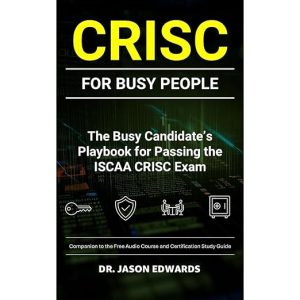
Twenty-five hours and sixteen minutes is a strange length for a book with the words For Busy People on the cover, and that tension is the first thing to understand about this audiobook. Jason Edwards has written a full treatment of how the CRISC exam thinks, then filed it under a title promising efficiency. Both halves of that are defensible, but a candidate with six weeks and a job should know which one they are buying.
Decision Order Beats Glossary Drilling Here
Most certification guides sell coverage. This one sells a decision order, and the distinction is stated in the opening line of the description: CRISC is a decision exam, measuring whether you can connect business objectives to risk scenarios, evaluate exposure, pick a response that fits the organization's risk appetite, and then communicate the outcome so that leaders can act. Study it like a vocabulary test, the copy warns, and you will miss what the questions are actually testing.
Instead of glossary drilling, the method is procedural. You learn the order in which decisions get made, practice reading scenarios the way the examiners construct them, and build a repeatable habit for eliminating wrong answers quickly. Anybody who has taken a scenario-based certification will recognize why that matters: the hard part is rarely knowing what residual risk means, it is spotting which of four plausible answers the question is really asking about under time pressure.
An Honest, No-Shortcuts Pitch for CRISC
Whether that translates into a passing grade depends on a candidate's starting point, but the framing is sound and unusually honest for the category. The copy makes no promises about pass rates, offers no shortcut, and describes the work as building judgment rather than absorbing content. For a self-published study guide that is a restrained pitch, and restraint in this corner of the market is worth something on its own.
Naming the Traps That Cause Wrong Answers
Risk identification, risk assessment, risk response, and monitoring and reporting are the four areas the book works through, and the treatment of each goes past definitions into practice. Translating a messy real situation into a clear risk statement is a skill, not a definition. So is telling an inherent exposure from a residual one once controls are in place, and knowing what evidence actually proves that a control was both designed properly and operating.
Traps get their own attention, which is the section I would most want in my ears on the way to a test center. Premature solutions, misaligned stakeholders, and answers that reach for technology when the question is really about governance: those three failure modes account for an enormous share of wrong answers on exams built this way, and naming them explicitly is more useful than another pass through the syllabus.
Length is the point here rather than an accident. Four domains across a recording of twenty-five hours works out to roughly six hours apiece, which is not cramming; it is a full course. Read that way the title is a description of the audience rather than a promise about duration: written for people with jobs, not written to be finished in an afternoon. Set expectations accordingly and the discrepancy stops grating.
Synthetic Delivery Across a Twenty-Five-Hour Recording
No ratings and no written responses appear on this listing at all, which for a January 2026 release from an independent publisher is normal rather than alarming, but it does mean nothing here is corroborated. Every judgment above comes from the description and the credits. Nobody has yet reported back on whether the method survives contact with the actual exam, and until somebody does, the pitch is the only evidence available.
Virtual Voice appears in the narrator field, which means the reading is machine-generated rather than performed. That is a real consideration across a recording this size, and particularly for material built on acronyms, control terminology and clause-heavy scenario text, where a human reader's phrasing carries a lot of the meaning. Sample it before committing, because tolerance for synthetic delivery varies enormously and no amount of good structure compensates for a voice you cannot stay with.
Study guides also fight the audio format in a way that novels do not. The copy promises scenario practice, a disciplined elimination method, and the ability to revisit key methods, all of which assume you can stop, look, annotate and flip back. No supporting file accompanies this recording. That leaves the practice element working entirely from memory, which is a poor way to drill answer elimination and a fine way to absorb the underlying framework.
A Thinking Layer for Risk Professionals
Candidates preparing for CRISC who already work in risk, audit or governance will get the most from this, especially those whose weakness is exam technique rather than subject knowledge. The decision-order framing is genuinely the thing most people get wrong, and hearing it argued at length while commuting or walking is a reasonable supplement to written practice questions you work through at a desk.
Anyone starting from zero should pair this with something searchable. The material assumes comfort with the vocabulary of controls, appetite and exposure even while explaining how to apply it, and a first-time listener without that base will spend the early hours reconstructing terms rather than absorbing method. The same goes for anyone who needs a question bank; this is a way of thinking, not a set of practice items.
Given the format constraints, my recommendation is conditional but real: use it as the thinking layer and keep a written question bank alongside it. The framework Edwards lays out is the right one, the exam-trap material is the best part, and a long recording is the correct shape for building judgment slowly. Just do not expect a synthetic voice and no companion file to replace the desk work this exam demands.
At a Glance
- At its heart: Decision order over vocabulary, inherent versus residual exposure, controls as responses rather than decoration, exam-trap recognition
- Vibe: Methodical, unhurried, exam-room serious
- Short version: The right framework for this exam, delivered in a format that fights the way certification prep actually gets used.