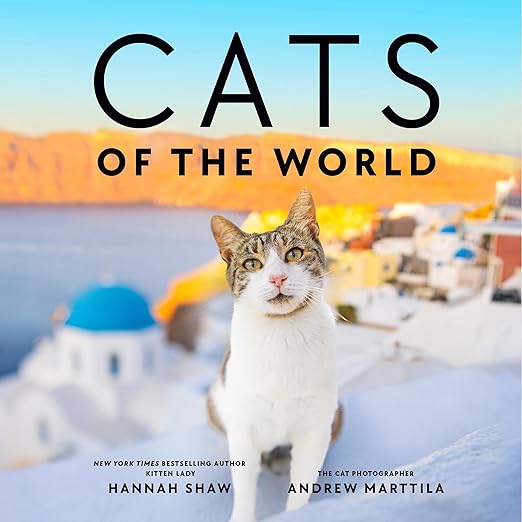
Chile's produce markets, Türkiye's spice bazaars, and England's candle-lit cathedrals all appear early in Cats of the World, Hannah Shaw's self-narrated audiobook travelogue built from thirty countries of cats she and photographer Andrew Marttila met along the way. Shaw, known online as Kitten Lady for her neonatal kitten rescue work, and her husband Marttila have made feline welfare their shared career, and this audiobook is the largest expression yet of that partnership: a global tour organized entirely around the animals and the people who care for them, from bustling South African streets to lush mountain towns, told in Shaw's own voice rather than a hired narrator's.
Welfare Practitioners Traveling With Their Day Job
The project's scale is genuinely ambitious for what could have been a simple photo-caption book read aloud. Thirty countries in under four hours means the pacing moves briskly, but the throughline holds together because Shaw and Marttila are not tourists collecting cat photos, they are practitioners of animal welfare using travel as a lens for that same work they already do at home. The synopsis frames the takeaway plainly: across every culture and landscape they visit, 'compassion is truly a universal language,' and the book spends its runtime demonstrating that claim location by location rather than just asserting it once and moving on.
What keeps the travelogue from feeling repetitive is the variety of context Shaw and Marttila find in each stop. A market cat in Chile and a cathedral cat in England are living in completely different human systems, different attitudes toward strays, different levels of institutional support for animal welfare, and the book uses those differences to say something real about how a culture treats its most vulnerable creatures, cats included, without ever turning preachy about it.
It is worth remembering that travel is not actually Shaw and Marttila's day job; kitten rescue and rehabilitation is, and that grounding shows throughout the book. Every stop on this thirty-country tour gets filtered through the lens of two people who spend their non-traveling lives elbow-deep in neonatal kitten care, which means the book notices things a casual tourist with a camera would not, how a community handles strays, what kind of informal support networks exist for street cats, which places have real infrastructure for animal welfare and which are improvising.
Kitten Lady Narrates in Her Own Voice
Self-narration is the right call here, and it is not a minor detail. Shaw is not reading someone else's account of her travels, she is narrating her own memories in her own voice, which gives the book a warmth and specificity that a professional voice actor reading the same script simply could not replicate. Her established public persona as Kitten Lady is intact throughout, so listeners already familiar with her rescue work get the same voice and sensibility they already trust, applied to a much bigger canvas.
The reviews consistently point to the emotional register as the book's real strength. One listener wrote that 'the captions and stories, oh my, they filled my heart,' praising the 'wonderful communities of humans, kitties, and other living parts of our world' the book documents. Another called the project 'beautiful images and inspiring prose' and noted that Shaw and Marttila 'put their lives where their passion is,' which is precisely the credibility that makes the travelogue format work rather than feeling like a vanity project.
The specific geography chosen also does real work. South Africa's bustling streets and lush mountains sit only a chapter away from England's quieter, more institutionalized relationship with its cats, and Chile's vibrant produce markets offer yet another entirely different backdrop for the same basic question the book keeps asking: how does this particular place treat its most vulnerable animals? That range keeps the travelogue from ever feeling like the same observation repeated in a new location.
Shaw's rescue background also shapes the emotional register of the storytelling itself. She has spent years working directly with the most vulnerable animals in the field, orphaned newborn kittens with no mother to care for them, and that hands-on intimacy with fragility and survival carries into how she describes even the healthiest, most contented cats she meets abroad. It gives otherwise light travel anecdotes an undercurrent of real stakes that a narrator without her specific background would likely miss entirely.
A Photography Book First, an Audiobook Second
This is, at its core, a photography book, and audio cannot deliver photographs directly no matter how well-written the surrounding prose is. The included downloadable PDF of more than one hundred photos is not a bonus extra here, it is close to essential; listeners who skip grabbing that companion file are missing the half of this project that reviewers consistently single out as its main draw.
Eight Minutes a Country, Vignettes Over Depth
Runtime is the other honest caveat. Just under four hours for thirty countries means each stop gets a relatively brief treatment, closer to a warm highlight reel than an in-depth cultural or journalistic study of animal welfare policy in any single place. Listeners wanting rigorous investigative depth on global animal welfare systems should treat this as a heartfelt travelogue rather than a policy-focused work.
Because the book moves so quickly between countries, individual cat stories get compressed into vignettes rather than fully developed narratives; listeners hoping for the kind of sustained, single-animal storytelling found in a memoir like Dewey or Homer's Odyssey should adjust expectations accordingly. This is closer to a curated photo essay narrated aloud than a single continuous story, which is exactly what it sets out to be.
Divided evenly, the book's four-hour runtime works out to roughly eight minutes per country, a pace that keeps the travelogue moving briskly without ever settling long enough in one place to risk repetition; Shaw uses that brevity efficiently, letting a handful of vivid details stand in for each location rather than attempting exhaustive coverage anywhere. That same brevity is precisely why the companion PDF matters so much, since the photographs carry detail the compressed narration simply does not have room to describe in full.
Kitten Lady's Existing Fans Already Know What They Want
Cat lovers, animal rescue and welfare community members, and existing fans of Shaw's Kitten Lady platform are the obvious core audience, and this delivers exactly what that audience wants: warmth, firsthand storytelling, and a genuine sense of the people doing this work worldwide. Travel-adjacent lifestyle listeners looking for something light-hearted and big-hearted will also find plenty to enjoy here.
Skip it, or at least prioritize the print or ebook edition instead, if photography is the entire reason you want this book; audio alone cannot deliver that half of the experience even with the companion PDF included. Listeners wanting deep investigative journalism about international animal welfare policy should also look elsewhere, since this stays personal and anecdotal by design.
- Narration: Hannah Shaw narrates her own travels with the warmth and specificity only the actual traveler and rescuer could bring, keeping her established Kitten Lady voice intact throughout.
- Themes: global cat welfare and rescue, cross-cultural connection through travel, compassion as a shared human language
- Mood: Warm, breezy, and big-hearted
- Verdict: A heartfelt, fast-moving travelogue that works best paired with its companion photo PDF, ideal for cat lovers who want Shaw's own voice guiding the tour.
Frequently Asked Questions
Does the Cats of the World audiobook include the photographs from the print book?
It includes a downloadable PDF of more than one hundred photos alongside the narration, which listeners should grab since photography is central to the project.
Is Hannah Shaw's self-narration different from hiring a professional voice actor for this audiobook?
Yes, noticeably. Shaw narrates her own firsthand travels and rescue work rather than reading a script written about someone else, which gives the storytelling a personal warmth a hired narrator would not carry the same way.
Is this audiobook mostly about cat rescue or travel photography?
Both, woven together. It is framed as a travel photography project, but Shaw and Marttila's actual expertise and daily work in kitten rescue and feline welfare shape how each location is discussed.