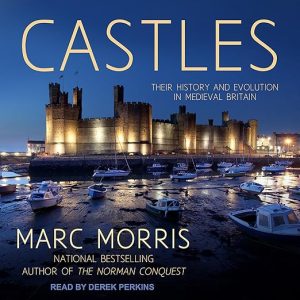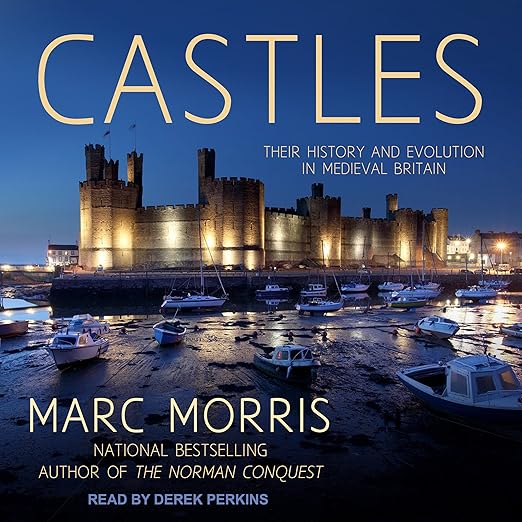
Castles were never just fortresses, Marc Morris argues across this audiobook, and the nine hours it takes to make that case are consistently well spent. From their introduction in the eleventh century through their widespread abandonment in the seventeenth, Morris treats the castle as a home first and a weapon second, even when the home in question happens to be William the Conqueror's or Edward I's. That framing sounds like a scholarly quibble until you actually hear it demonstrated, siege after siege giving way to domestic detail, a lord's household accounts, a garrison's daily routine, until the fortification starts to feel inhabited rather than merely besieged. Narrator Derek Perkins carries that dual register capably across the entire runtime, and the audiobook earns its verdict early: this is popular medieval history done with real command of both the epic and the intimate.
Selectivity Over an Exhaustive Six-Century Catalog
Morris organizes the book around specific, mostly famous sites, moving chronologically from the earliest Norman motte-and-bailey structures through the elaborate concentric fortresses of Edward I's Welsh campaigns and on to the country houses castles eventually became once their military purpose faded. 'His take on the destructive impacts along the Borders (for centuries) because of Edward I are so accurate,' writes reviewer mikey d., a detail that speaks to how far the book's scholarship extends beyond the buildings themselves into the political violence that produced them. This is not an architecture book pretending to be history; it is history that happens to use buildings as its through-line.
The book's structure lets Morris move fluidly between register: the epic scale of a siege, full of collapsing curtain walls and starving garrisons, sits comfortably next to intimate domestic detail about who actually lived inside these buildings and how. Jim Schmidt's review calls the writing 'interesting, engaging, and even a bit cheeky,' which is an accurate read on Morris's voice, scholarly without ever tipping into dry recitation of dates and dimensions. That cheekiness matters for a book covering six centuries of history in under ten hours; it keeps the pace moving without sacrificing the specificity that makes any single castle's story worth telling.
Morris's approach to structure also does real work here: rather than surveying every fortification built across six centuries in equal, exhausting detail, he clearly favors a smaller set of sites explored in genuine depth, each one standing in as a case study for a broader building era. That selectivity keeps the book from turning into a dry catalog and instead lets each featured castle carry real narrative weight, its own cast of builders, residents, and besiegers, rather than reducing every structure to a single sentence of architectural description.
Perkins Keeps Weapon and Home Both Audible
Derek Perkins is well cast for this specific material. His narration handles both the epic and intimate historical registers this book demands without favoring either, treating a siege description with the same careful, unhurried authority he brings to a passage about medieval household management. That range matters more than it might sound: a narrator who leans too hard into battle-scene drama would flatten the domestic material, and one who stays too measured throughout would drain the sieges of their tension. Perkins keeps both halves of the book's identity, castle as weapon, castle as home, audible at once, and his pacing across just over nine hours never feels rushed even as the book covers ground spanning six centuries.
Funner things' review notes the book covers castles across England, Scotland, and Wales built after the Norman Conquest, and recommends it specifically to a sibling planning actual site visits, calling it a better companion than 'a touristy book.' That use case, history as trip-planning material, works well in audio precisely because Perkins's pacing gives you time to absorb which sites get discussed before you would need to look anything up. Listeners who already know they will be touring British castle sites in person at some point get real practical value layered under the scholarship, even though the book itself is not organized as a guidebook.
Lighter on Anglo-Saxon Defenses Before 1066
Nine hours covering roughly six centuries and dozens of individual castles means density is unavoidable, and listeners unfamiliar with medieval English political history, the rough sequence of Norman kings, Plantagenets, and the Wars of the Roses, may find themselves needing to pause and reorient more than once. The book assumes a general audience rather than a specialist one, but 'general audience' for British popular history still means a baseline familiarity with names like William the Conqueror, King John, and Edward I is genuinely useful going in, even if not strictly required. Names and place names accumulate quickly across the runtime, and without visual aids, a map or timeline pulled up separately can help newer readers of medieval history keep the geography straight.
One reviewer's account also flags that the book leans toward castles built after the Conquest, with earlier fortifications and Anglo-Saxon defensive structures given comparatively lighter treatment; readers hoping for deep pre-Norman context should know the emphasis sits firmly in the 1066-onward period the synopsis itself describes. That is a reasonable scope decision for a single audiobook rather than a flaw, but it is worth knowing before starting if pre-Conquest fortification history specifically is what drew you to the subject in the first place.
A Genuine Bonus for Anyone Touring UK Castles
British history readers who enjoyed Morris's earlier books on King John or Edward I, both of which mikey d.'s review mentions rereading multiple times, will find this a natural next listen, and it also works well as a starting point for anyone new to Morris specifically. Fans of narrative-driven popular history in the vein of Dan Jones or Alison Weir will recognize the approach: real scholarship delivered with enough momentum and personality to work as entertainment, not just reference material. Anyone planning a UK trip built around historical sites gets a genuine bonus, functional trip-planning context wrapped inside a real work of history.
Listeners who enjoy audio-first history for its portability, something to accompany a long drive or a stretch of yard work, will find the nine-hour runtime genuinely manageable in two or three sittings, unlike denser multi-volume histories that demand a much longer commitment. Perkins's clear, unhurried diction also makes this a reasonable pick for listeners newer to nonfiction audiobooks generally, not just seasoned history buffs.
A reader chasing a single dramatic throughline, rather than a wide survey moving briskly between sites and centuries, may find the structure closer to a well-organized reference work than a page-turner. Pre-Conquest specialists and anyone wanting exhaustive Scottish or Welsh castle coverage specifically, rather than England-centered history with excursions elsewhere, should also temper expectations slightly. Within those honest limits, though, Perkins's steady narration and Morris's cheeky, well-sourced prose make for one of the more accessible entry points into British medieval history currently available in audio.
Quick Take
- Voice: Derek Perkins handles both epic siege sequences and intimate domestic history with equal, scholarly confidence.
- Big ideas: medieval British history, castles as both weapon and home, six centuries of architectural change
- Atmosphere: Engaging, cheeky, briskly paced for a history this dense
- Worth it?: A strong, accessible entry point into British castle history for readers who want scope over a single deep dive.