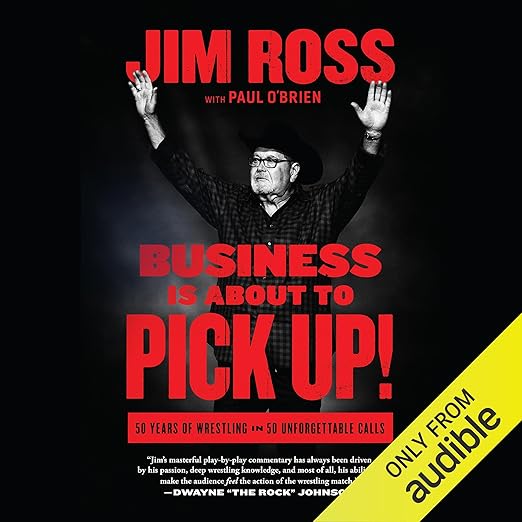
Wrestling's biggest moments reached most of us through one voice, and for a large stretch of the last fifty years that voice belonged to Jim Ross. This audiobook is his account of the calls themselves: fifty chapters, fifty famous calls, fifty years, running nine hours and twenty-five minutes from Audible Studios. He reads it himself, which for this particular book is less a bonus feature than the entire premise. The copy sells it as a ringside ticket from the announcer who made those moments iconic, and on that promise it is at least aiming at the right target.
Jim Ross has occupied an unusual position in his industry: not a wrestler, not an executive for most of it, but the person whose reaction told millions of viewers what they had just seen. The book tracks that vantage point across the territorial days of the 1970s with NWA, the rise of WCW, the WWF and WWE years, and on to his current work as on-air talent and senior advisor at AEW. Few people have watched the business change from one seat that long.
Fifty chapters organized around fifty calls is a structure with obvious appeal and a built-in risk. When it works, each call becomes a doorway into what was happening backstage, why the moment was booked, and what it cost the people involved. Steve Austin against Bret Hart, the debut of Dwayne Johnson, John Cena and Dave Bautista becoming film stars, the founding of AEW: the list the copy advertises is a decent map of four decades.
A March 2025 five-star describes the payoff plainly, saying the book takes you behind the scenes and delivers a great deal of information about the business and the people inside it. That matches what the structure promises. The copy even invites the argument that always follows a list like this, asking readers to debate which moments had to be included and which ones were left out, which is the correct instinct for a fan book.
What Works
Broadcast memoirs live or die on whether the writer can put you back inside a moment you already remember. Ross has an advantage most memoirists lack: his listeners can hear the original call in their heads while he explains what was happening around it. That doubling, the remembered broadcast against the account of the night, is the specific pleasure this book offers and the reason it works better in audio than on paper.
Fans want two things from a book like this, and the responses suggest they get one of them without much friction. An October 2025 five-star calls it a fast read and reports learning a lot, then recommends going and finding his other book too, which places this in the second half of a two-title shelf rather than as a standalone memoir. Momentum, in other words, is not the problem.
Self-narration settles the casting question and opens another one the page never answers. Fifty years of live announcing trains a very particular instrument, one built for thirty-second bursts of escalating volume over crowd noise, and nine and a half hours of continuous prose asks for something closer to the opposite: sustained, quiet, conversational pacing. Nobody who filed a written response mentions hearing him do it, so a sample is the only way to find out how the two registers meet.
Before You Commit to Business Is About to Pick Up!
A January 2026 four-star lodges the one substantive objection anywhere on this listing, and it deserves attention. That listener went in unsure, found the content a pleasant surprise, and still concluded that when Ross simply reprints his announcer calls the effect is redundant, while the book shines when he moves into the stories around them. Fifty calls transcribed by the man who made them will inevitably include some that read as a lap of honor.
Filed under combat sports and self-defense, this record sits in a category that fits the subject matter and not the book. Nothing here is instructional or athletic. It is a broadcasting memoir about an entertainment business, and anyone browsing that shelf for training or fight analysis will be in the wrong place, while the readers who would love it are browsing somewhere else entirely.
One hundred and forty-one ratings sit behind the 4.5 average, and only five of them carry any text at all. That ratio is ordinary for a popular release, but it does mean the average works as a show of hands rather than an argument. It also means the five voices that did explain themselves were all weighing a book rather than a recording, which for a title whose selling point is hearing a famous voice deliver its own material is the gap worth knowing about before you buy.
Who It's For
Lifelong wrestling fans are the obvious audience, particularly anyone whose memories of the WWF era arrive with Ross narrating them. A September 2025 five-star recommends it flatly to anyone who is a fan of wrestling, and that recommendation is well calibrated: the book assumes you know the names, the promotions and roughly when things happened. Nine hours with a good storyteller who was actually in the room is a strong offer if you have the background.
Newcomers to the business will find the going harder. Fifty calls presuppose fifty pieces of context, and the copy does not slow down to supply them. Anyone curious about professional wrestling as a cultural phenomenon would do better with a history than with an insider's greatest-hits list.
Listeners who want a full career memoir should also calibrate expectations, since the book is organized around moments rather than chronology, and a life told through fifty highlights leaves gaps between them. Come for the calls and the backstage detail behind them, and the runtime earns itself. Come for a life story told straight through, and the structure will keep interrupting you.
Before You Press Play
- Read by: Jim Ross reads his own book, which puts an instrument trained on thirty-second live calls in front of nine and a half hours of continuous prose.
- At its heart: fifty years of wrestling history, the announcer's vantage point, territories to global business, moments behind the microphone
- Vibe: Loud memories recounted at conversational volume
- Short version: A fan's book in the best sense, strongest when Ross leaves the transcript and tells you what happened around it.
A Few Questions About Business Is About to Pick Up!
Why choose the audiobook over the print edition?
Because Jim Ross reads it himself. The nine-hour-twenty-five-minute edition puts fifty famous calls back in the voice that first delivered them, which is the one thing a printed page cannot reproduce. The publisher copy makes exactly that argument, presenting the book as narrated by the voice of wrestling himself.
Will the audiobook make sense to someone who does not follow wrestling?
Only partly. The book assumes familiarity with the promotions, the era and the performers, and the calls are treated as shared memories rather than explained events. A curious outsider can follow the business history, but most of the emotional payload depends on recognizing the moments.
What is the most common criticism from readers?
That the transcribed calls themselves add less than the stories around them. A January 2026 four-star made exactly that point, finding the reprinted commentary redundant while praising the backstage material. A September 2025 five-star had no such reservation and recommended it to any wrestling fan.