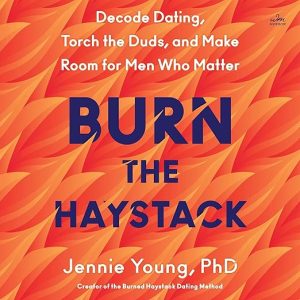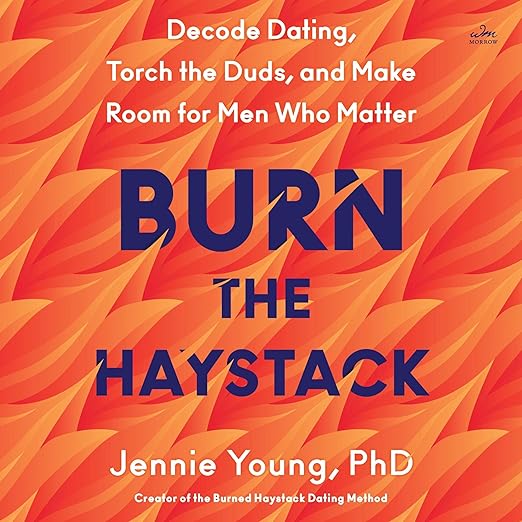
- Performance: Jennie Young PhD narrates her own material alongside Kiiri Sandy, splitting the book between Young's professorial introduction and a personal sign-off letter. The dual-voice structure reinforces the book's blend of academic rigor and intimate candor.
- What it covers: Feminist rhetoric applied to dating, decoding manipulative communication patterns, self-advocacy in the digital age
- Feel: Witty and sharp, with genuine intellectual substance underneath the humor
- Our call: A compact, genuinely useful audiobook that teaches communication decoding skills applicable well beyond dating apps, delivered with academic precision and enough humor to keep the medicine going down.
Burn the Haystack arrives as something rarer than it might appear: a dating audiobook that is actually a rhetoric textbook in disguise. Jennie Young holds a PhD in feminist rhetoric, and her framework for analyzing men's dating profiles grew out of professional frustration. She downloaded a dating app and immediately recognized the manipulative communication patterns she had spent her career studying in other contexts. This audiobook captures that lecture-hall energy, with Kiiri Sandy handling the main body of the text and Young herself bookending the content with her own introduction and a personal closing letter. That structural choice is worth noting upfront: this is not a single-narrator performance but a deliberate collaboration that mirrors the book's argument about who gets to speak and in what register.
The central metaphor gives the book its title. Young argues that conventional dating advice, give him a chance, look past the profile, keep an open mind, serves the wrong party. Among her community, the needle is a genuine long-term partner, and the haystack is the available pool of men on apps. Her prescription is counterintuitive: give almost no one a chance. Burn the haystack and retrieve the needle from the ash. This is a strong argument, and the audiobook earns it methodically across 9 hours and 30 minutes.
Naming Gambits Like Test and Apologize
What distinguishes Young's approach from the usual dating-advice format is the taxonomy she has built. The Burned Haystack method is not intuition-based but pattern-based. She has identified and named specific rhetorical gambits that appear in men's profiles and opening messages, and each chapter dissects a pattern with examples, analysis, and real-world implications. Test and Apologize, Disciplinary/Directive, Blue Ribbon for Bare Minimum: these categories are specific enough to be genuinely useful. Listeners will recognize the patterns immediately, which is both satisfying and slightly dispiriting. The fact that these gambits are common enough to warrant named categories says something about the landscape women navigate online.
The audiobook's structure works well in practice. Young positions this as picking up where The Elements of Style leaves off, but for interpersonal communication rather than prose. That comparison points toward the book's real ambition: the skills Young teaches are transferable. Reading a manipulative dating profile and reading a manipulative memo from a manager require the same underlying decoding apparatus. Young makes this explicit, and it is the argument that elevates the book beyond its nominal subject. The classroom and the boardroom she mentions in the synopsis are not afterthoughts but central to the framework's value.
Sandy and Young Split the Narration
Sandy's narration maintains the right tone throughout: authoritative but not cold, instructional but not condescending. The professor-as-funny-friend register that the synopsis describes is genuine rather than advertised. Young's own segments carry the warmth of a personal letter rather than an academic performance, and the contrast between the two voices gives the audiobook a structural variety that a single narrator would not provide.
The supplemental PDF that accompanies the audiobook is worth acknowledging. Some of the examples and frameworks may be easier to absorb in visual form, particularly the named rhetorical patterns laid out in taxonomic sequence. Listeners who can access the companion material will get more from the more analytical sections. That said, the audio-only experience is substantive enough to stand on its own: Young's examples are vivid and the patterns, once named, are memorable in a way that sticks past the listening session. The professor-quality specificity of the pattern names, Test and Apologize, Blue Ribbon for Bare Minimum, means they function as cognitive handles you keep reaching for after the book ends.
Feminist Rhetoric Aimed at a Straight Audience
Young's approach is explicitly feminist in its framing, and the book's argument assumes a heterosexual-women audience navigating apps populated by men. Readers outside that demographic will find the rhetorical decoding tools applicable but may need to do some translation work on the specific examples. The book's tone is also unapologetically critical of a certain type of male dating-app behavior. Listeners looking for a both-sides treatment of online dating communication will not find it here. Young's argument has a clear thesis and she does not soften it. That is part of its strength and part of its limited applicability to audiences outside its intended reader.
The absence of listener reviews at the time of writing means the community response is not yet known, but the book's academic credentials are solid. Young's expertise in feminist rhetoric is real, and the system she has built has generated a substantial online following through her Burned Haystack content. The audiobook is the most comprehensive articulation of that framework to date, and the dual-narrator structure gives it a distinctive identity in the crowded dating-advice genre.
Expect a Manifesto, Not a Balanced Take
Women navigating online dating who want a systematic rather than intuitive approach to profile evaluation will find this audiobook genuinely practical. Readers with interest in rhetoric, communication theory, or feminist media criticism will appreciate the intellectual scaffolding Young has built. Anyone who has ever read a dating profile and felt a low-level unease without being able to name why will find Young's taxonomies both illuminating and vindicating.
Listeners expecting a softer, more balanced take on modern dating should approach with adjusted expectations. This is a manifesto, and the subtitle makes that clear. It argues a position rather than presenting options. That is also precisely what makes it more interesting than most books in its genre, and more useful over time than the kind of advice that tells you to keep an open mind about someone whose profile already told you everything you need to know.