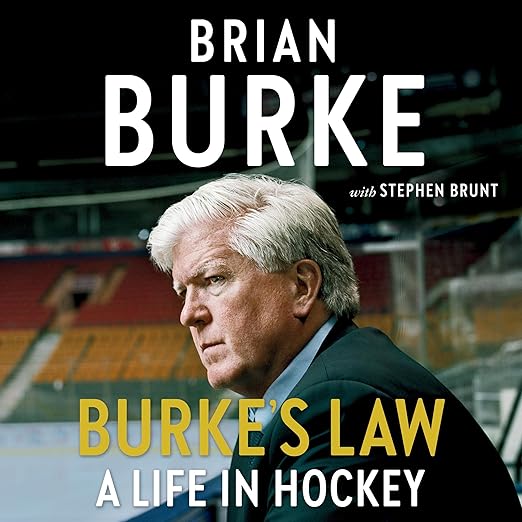
- Narration: Brian Burke performs his own book, which makes the blunt public persona and the recorded delivery a single object across eight and a half hours.
- Themes: Hockey management, public combativeness, grief, advocacy after loss
- Mood: Blunt, unsentimental, occasionally devastating
- Verdict: Strong for anyone who wants the front office explained by someone unafraid of the consequences.
One reviewer says the writing style here is true to Burkie's personality, an odd compliment to find on an audiobook listing, because the person being described is also the person delivering the sentences. Brian Burke fills both the author line and the narrator line on this record. Viking published the recording in October 2020, it runs eight hours and thirty minutes, and the description opens by calling its subject the gruffest man in hockey.
The Review
Brian Burke has held nearly every job the sport offers. The description lists them without much modesty: player, agent, league executive, scout, Stanley Cup-winning general manager, Olympic general manager, media analyst. It also quotes the phrase that made him famous beyond the game, the demand for "pugnacity, truculence, testosterone, and belligerence" he made while running the Maple Leafs. Working alongside Pat Quinn, Gary Bettman and a long line of future Hall of Fame players gives the book its access, and a Harvard Law School degree gives it a second vocabulary most hockey memoirs cannot reach.
Brendan Burke is the reason this book is not simply a career retrospective. The description states plainly that Burke lost his youngest son in a car accident and has had to carry that grief in public, and that many Canadians already knew Brendan's name because his father became one of the country's most outspoken gay-rights advocates after Brendan came out in 2009. That material sits underneath the settled scores and the old beefs, and it changes the register of everything around it.
Viking sits in the publisher field, Brian Burke in both credit lines, and that arrangement is the production decision worth examining. A memoir built on a reputation for saying the unsayable is, in a real sense, a book about delivery. Handing it to a hired reader would mean asking a professional to imitate a voice the audience has heard on television for years. Doing it himself removes that problem and introduces the ordinary risk that comes with an untrained narrator, whose usual weakness is pacing sustained across eight and a half hours. Memoirists who read their own work tend to be strongest on the passages that cost them something and weakest on the connective tissue between them, and this book has an unusual amount of both.
Burkie, as two reviewers here call him, is the whole proposition. One entry praises the writing for staying true to that personality and adds a comparison with John Tortorella, respecting both men as tough but fair, and contrasting them with coaches who seemed mild in public while mistreating players behind closed doors. Another admits to having always thought Burke somewhat abrasive and to being curious how that would read at book length, then reports finding the stories heartfelt and honest. Both responses are really about voice, which is exactly what a self-narrated recording sells.
Kernel gives the most quantified endorsement in the column and does it in the currency of paper. Over two or three months, that reviewer might finish a four-hundred-page book. This one took less than two weeks. The same entry begins to explain that Burke discusses his career far more than his childhood, a choice attributed to something said during an interview, and then the text stops mid-word at "an interview on t." Whatever the source was, the page does not carry it.
WDX2BB holds the lone four in this column, inside its strangest entry, one that doubles as a memoir of its own. It opens by recalling a first meeting with Burke without being able to date it, places the encounter around 1988 during a Buffalo Sabres road trip to Boston, and describes a cocktail hour hosted in general manager Gerry Meehan's hotel suite where Burke was the one unfamiliar face. Reviews written by people who were in the room are rare, and this one has the texture of the thing it is grading.
Before You Commit to Burke's Law
Timing is worth a look. Three responses arrived within six weeks of the October 2020 release, and the remaining two turned up in May 2025 and January 2026, more than four years later. That is a launch spike followed by a long silence and a late trickle, which is the normal shape for a sports memoir tied to a publicity cycle. It also means most of the column was written by people who bought the book on reputation rather than by people who found it later. Nothing in the two late entries suggests a rediscovery, either. Both read like ordinary catch-up purchases by hockey readers working through a backlist.
Harvard Law School and a career in executive suites give the book its second half, and the publisher copy sells that material as hard-earned lessons drawn from highly scrutinized decisions at the top of multi-million-dollar companies. The sentence making that claim is missing a space, running two words together, a small thing but a reminder of how lightly these listings are proofed. Buyers interested in the business content should know it is promised in the description and barely mentioned by anyone in the column.
What the reviewers actually measure is worth naming. One counts pages. One counts weeks. Two describe personality. One reconstructs a hotel suite from 1988. Nobody addresses the recording at all, and on a self-narrated book that omission costs more than usual, since the performance and the persona are the same object here. The credit tells you who is speaking. Nothing tells you how well.
Who It's For
Management-minded hockey fans are the core audience, and the column says so in its own words: one entry recommends it for anyone wanting more behind-the-scenes action from inside management, and another calls it among the best hockey books that reviewer has read. Anyone who followed the Leafs years, or who has argued about the truculence quote, will find the source explaining himself at length and without much interest in being liked. Executives and agents in any industry will recognize the shape of the decisions described, even where the sport means nothing to them.
Readers with no interest in the sport still have a route in through the grandmother's advice the description quotes, never to start a fight but never to run from one either, and through a father talking about a son in public. Hockey aside, it is a father's book, and it is read aloud by the father.
Frequently Asked Questions
Does Brian Burke narrate his own audiobook?
Yes. The same name fills the author and narrator fields, so the eight and a half hours come in the voice the reputation was built on. For a memoir whose subject is partly a habit of saying uncomfortable things out loud, that removes the awkwardness of hiring someone to imitate it.
What share of the book is hockey and what share is personal?
The description splits it three ways: a career spanning almost every role the sport offers, a business education from Harvard Law School applied to scrutinized decisions, and the loss of a son alongside the advocacy that followed. Reviewers respond mostly to the first and third.
Do I need hockey knowledge to follow this audiobook?
Some helps, since names like Pat Quinn, Gary Bettman and John Tortorella arrive without much introduction. The personal material needs none at all. A listener with no interest in the sport can follow the family chapters and the lessons drawn from decisions made under public scrutiny.