Before You Press Play
- Narration: William Hope brings measured scholarly authority to twenty-two hours of dense material without losing momentum.
- Themes: Urban reinvention, colonial violence and civic ambition, architecture and failed grand schemes
- Mood: Sweeping, rigorous, occasionally unflinching
- Verdict: A serious, essential listen for anyone with real interest in Brooklyn or American urban history, not a casual overview.
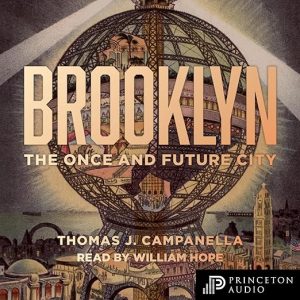
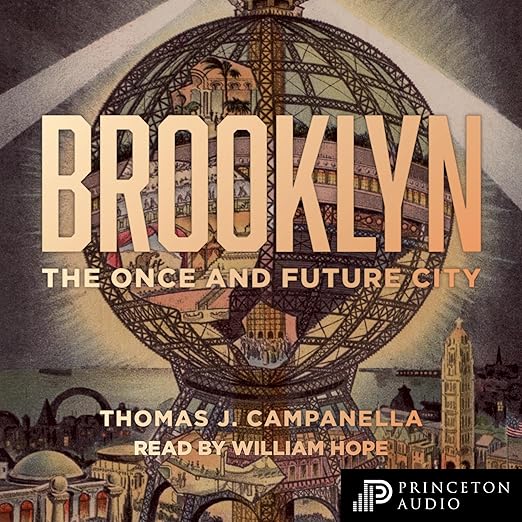
Picture Frederick Law Olmsted, fresh off dropping out of Yale, standing in what would become Prospect Park and imagining an open-space system ambitious enough to reach all the way back into Manhattan. That's one of dozens of vivid, specific moments Thomas Campanella reconstructs in this audiobook, a sweeping architectural and social history of Brooklyn that runs from the Leni Lenape through Dutch colonization to the borough's current status as an internationally recognized brand. Campanella was born in Brooklyn, and that personal stake shows in how much affection survives even the book's unflinching accounts of the borough's failures, its slaveholding Dutch settlements, its collapsed urban renewal projects, and the highway construction that gutted whole neighborhoods.
William Hope narrates, and across twenty-two hours and twenty-three minutes he never lets the density of the material curdle into monotony. Reviewer ulysses4 calls the book 'a magisterial reflection,' and that phrase fits both the scholarship and the performance behind it. This is not a light listen; Campanella moves through centuries and neighborhoods with real academic rigor, from English emigre Deborah Moody founding the town of Gravesend, the first town in America founded by a woman, to Samuel Friede's failed bid to erect the world's tallest building. The audiobook asks genuine commitment from anyone expecting a breezy borough-pride tour instead of serious urban history.
A Slow-Motion Highlight Reel, One Reviewer Says
Campanella structures the book around specific people and their competing visions for the borough, which keeps twenty-two hours of history moving rather than settling into a chronological march of dates. Deborah Moody gets her due as an unusually independent figure for her era; Olmsted's Prospect Park ambitions get contrasted against the failures that followed, like the aborted Jamaica Bay deepwater seaport scheme meant to rival Manhattan's harbor and the racetracks and amusement parks that briefly made Brooklyn a playland recognized worldwide before fading. The throughline is reinvention, the borough falling and rising again across four centuries, and Campanella never lets that cycle feel inevitable or tidy.
The book doesn't flinch from the uglier chapters either. Dutch colonization involved a dense, active slaveholding economy, and Campanella traces that history alongside the postwar urban renewal, public housing, and highway projects that battered immigrant and working-class neighborhoods well into the twentieth century. Reviewer Bibliophile MK XLI pushed back on this balance, describing the book as landing like 'a slow-motion highlight reel of' colonial violence and its aftermath rather than the personal, borough-pride narrative they'd hoped for. That's a fair reaction to have going in; this is a history willing to sit in discomfort rather than smooth it over for a celebratory narrative.
Friede's Doomed Skyscraper Gets Novelistic Detail
Samuel Friede's doomed skyscraper scheme and the racetrack-and-amusement-park era both get the kind of specific, almost novelistic detail that keeps this from reading like a textbook, even at its most academic. Campanella clearly relishes the borough's grand failures nearly as much as its successes, treating overreach and unrealized ambition as just as revealing of Brooklyn's character as anything that actually got built. That approach, weighing the failures as seriously as the landmarks, is what elevates this above a standard architecture-and-neighborhoods survey into something closer to a genuine civic biography.
The book's opening emphasis on Brooklyn's outsized modern reputation gives Campanella a clear present-day hook before he plunges backward into the seventeenth century, and he returns to that framing periodically to remind listeners why any of this deep history still matters commercially and culturally today. Understanding how a borough gets branded, marketed, and mythologized turns out to require understanding the centuries of specific civic decisions, failures, and reinventions that built its raw material in the first place.
Hope Never Loses Momentum Across Twenty-Two Hours
Hope's steadiness is the real enabler of a book this long and information-dense. He handles the constant chapter transitions between eras and neighborhoods cleanly, never losing momentum during Campanella's more digressive stretches, and his measured scholarly register suits a text this rigorous better than a more theatrical narrator would. Twenty-two hours of dense urban history could easily become fatiguing in the wrong hands; Hope's steady, unhurried delivery is built for exactly this kind of long-form academic nonfiction.
For anyone with a personal connection to the borough, whether you grew up there, live there now, or just love New York City history generally, the audiobook format has a specific advantage over reading the print edition: you can let twenty-two hours accumulate gradually across weeks of commutes or walks, absorbing the scope the way you might absorb a place itself, slowly and in pieces, rather than needing to sit down with a nine-hundred-page book in a single stretch of dedicated reading time.
Maps and Photos Live Only in the PDF
The print edition includes an accompanying PDF, which signals that maps, photographs, and other visual material play a real role in how Campanella supports his arguments. None of that transfers to the audio edition, and for a book this deeply concerned with physical place, specific streets, buildings, and neighborhood boundaries, that's a real loss for listeners who want to follow along visually rather than just conceptually. Pairing the audiobook with the PDF, even just to glance at occasionally, will likely deepen the experience considerably.
A History of Place and Power, Measured
Twenty-two hours is a genuine commitment, not a figure of speech, and Campanella's prose, while never dry, assumes a listener willing to track a large cast of historical figures across four centuries without much hand-holding. This isn't a book to start if you're looking for a quick primer on Brooklyn's history; it rewards patience and sustained attention more than it accommodates casual, in-and-out listening.
It's also worth knowing going in that this is very much a history of place and power, not a collection of nostalgic neighborhood anecdotes. Readers expecting a lighter, more personal-essay style Brooklyn memoir, closer to a lifelong resident's affectionate recollections than rigorous scholarship, should look toward a different kind of book; Campanella is working as a historian and professor first, and the emotional register stays measured even when the material itself is wrenching.
Unflinching About Slavery, Not a Love Letter
Serious urban history readers, students of American architecture, and anyone with a genuine personal or intellectual stake in Brooklyn specifically will find this one of the more thorough single-volume histories of the borough available in any format. It's also a strong pick for listeners who enjoyed dense, ambitious single-city histories elsewhere and want the same scholarly rigor applied to a place as culturally mythologized as Brooklyn has become in the last two decades.
Committing twenty-two hours to one borough's history is a genuine ask, and listeners hoping for a breezy overview or a purely celebratory love letter to Brooklyn should recalibrate before starting. The book's unflinching treatment of colonial violence, slavery, and failed civic projects means this isn't comfort listening, and casual tourists looking for trivia rather than sustained historical argument will likely find the density more than they bargained for.