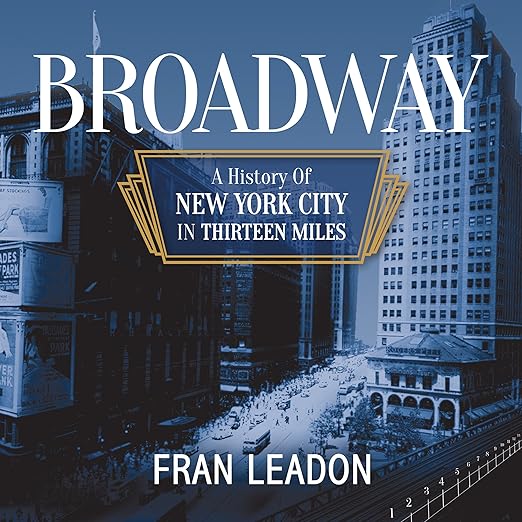
Broadway, the 17th-century muddy cow path the Dutch called the Brede Wegh, is an implausible candidate for the world's most famous thoroughfare, and Fran Leadon's audiobook narrated by Kevin Pariseau is most interesting when it makes that implausibility feel logical. The 14-hour and 4-minute journey from the dirt-track origins of lower Manhattan to the Great White Way is organized as a literal mile-by-mile progression up the street, and the structural conceit works because Leadon is genuinely curious about why each stretch became what it became rather than content to accumulate famous names and buildings.
The cast of characters who appear along the way is suitably improbable. Alexander Hamilton, Edgar Allan Poe, John James Audubon, Emma Goldman, and the wonderfully nicknamed Bill the Butcher Poole all inhabit specific stretches of Broadway at specific moments, and Leadon is precise about the connection between character and place. This is not New York history assembled around convenient proximity but history in which the geography itself explains why particular people and institutions ended up where they did.
One Side of the Street Was More Fashionable
Leadon's method has the virtues and occasional limitations of the walking-tour format. The virtues are real: the sense of physical accumulation, of a city building on top of its own past layer by layer, gives the history a spatial quality that more conventional chronological approaches miss. The story of how one side of the street was once considered more fashionable than the other, which seems like a minor detail, turns out to illuminate how real estate, social aspiration, and the direction of urban expansion interact over centuries. Leadon understands that the mundane details of property development contain the DNA of the culture that developed on top of them.
Pariseau's narration is consistently well-suited to the material. His voice has a New York intelligence about it, not in the sense of accent but in the sense of a particular urban knowingness that the material requires. He does not oversell the famous set pieces, the burning of P. T. Barnum's American Museum, the construction of the Flatiron Building, the raising of Trinity Church, but he gives each one the breathing room to register fully before moving on. The 14-hour format becomes a feature rather than a burden because each section of the street generates its own discrete history that is satisfying as a unit.
Columbia Sits Where an Asylum Once Stood
The reviewers who read this book report feeling impelled to walk the actual street afterward, which is a genuine measure of what Leadon achieves. The audiobook is arguably the better format for this aspiration: Pariseau's narration has the quality of a guide's voice, knowledgeable but not pompous, and the mile-by-mile structure makes it easy to absorb information in chunks that correspond to actual geography. Listeners who know Manhattan well will find the book recontextualizing streets they walk habitually. Listeners who have never been to New York will find a legible map of the city's development from Dutch settlement through the twentieth century.
The Columbia University section, revealing that the university was built on the site of an insane asylum, is a good example of Leadon's approach at its best. The institutional history contains a social history, and the social history contains a story about what kinds of buildings succeed other kinds of buildings in a city that is perpetually erasing and rebuilding itself. Pariseau delivers this kind of embedded history with the dry pleasure it deserves, and listeners who enjoy that mode will find it maintained across the full length of the book.
A Non-Linear Walk Up Through the Gilded Age
The mile-by-mile structure is the book's primary organizational principle, and listeners who prefer thematic organization over spatial organization may find it mildly disorienting. Leadon moves through time as he moves up the street, which means the chronology is non-linear in ways that can occasionally require a moment's orientation. This is a feature of the method rather than a flaw in the execution, but it requires listeners to hold multiple time periods in mind simultaneously as the walk progresses.
The book's coverage becomes denser as it moves uptown through the nineteenth century, which is both historically accurate and occasionally demanding in audio. The sections covering the Gilded Age development of upper Broadway, the theaters that gave the Great White Way its name, and the political and criminal ecosystem that surrounded that entertainment district are among the richest in the book, and Pariseau's sustained energy through these longer stretches is one of the audiobook's reliable pleasures.
Texas Guinan Only Fits Because of Geography
The figure of Texas Guinan, the saloon hostess and entertainment impresario who appears in the upper Broadway sections, is a good example of the kind of historical figure the street-as-organizing-principle surfaces. Guinan would not appear in a history organized around politics or architecture or the theater alone; she appears because she operated in the specific overlap between all three on a specific stretch of Broadway, and that geographic logic is what makes the mile-by-mile structure productive rather than arbitrary. Pariseau's delivery of Leadon's sketches of these secondary figures has the energy of someone who finds them genuinely interesting, which sustains the listener's attention through the longer biographical digressions.
The Right Audiobook for One Long Thread
Broadway is the right audiobook for anyone fascinated by urban history told through a single physical thread, or for New York listeners who want the history beneath the geography they already inhabit. Listeners who enjoyed Robert Moses histories or the urban sociology of Jane Jacobs will find Leadon's approach complementary rather than competing. Skip this one if you need a thematic narrative with a clear argument; the book is structured as a walk rather than a thesis, and the pleasure is in the accumulation of detail rather than the arrival at a conclusion.
A Few Questions About Broadway
Do I need to be familiar with New York City geography to enjoy the Broadway audiobook?
Prior familiarity enriches the experience but is not required. Leadon provides enough geographical context that listeners who have never visited Manhattan can follow the mile-by-mile structure, and Pariseau's narration gives the spatial progression a tangible quality.
How does Kevin Pariseau's narration handle the Broadway audiobook's unusually wide cast of historical figures?
Pariseau maintains a consistent conversational intelligence across the diverse cast, giving each figure enough distinctiveness to register without adopting character voices that would feel theatrical relative to the material's tone.
Is the Broadway audiobook a good choice for non-specialists, or is it written primarily for historians?
It is written for general readers and listeners. Leadon's prose has the qualities of good popular history, and the reviewer consensus emphasizes that the material is both well-researched and immediately accessible.
Does the Broadway audiobook cover the street's theatrical history in depth, or is the Great White Way aspect relatively minor?
The theatrical history receives substantial coverage, particularly in the sections dealing with the Gilded Age development of upper Broadway. But the entertainment district is one thread among many that include architecture, crime, immigration, and real estate development.