
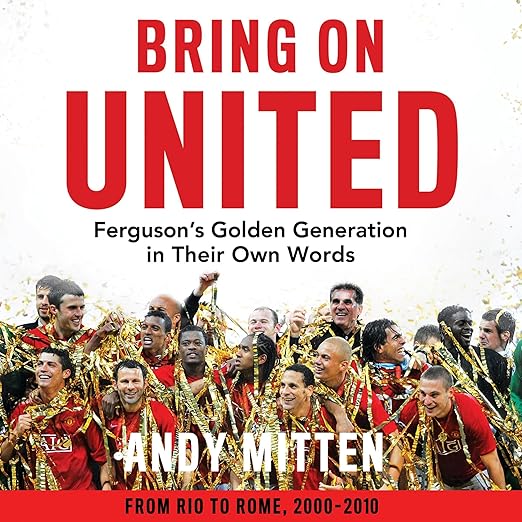
Eleven former players sat down with Andy Mitten and talked, and the audiobook is what came out of those conversations. Bring on United covers Manchester United from 2000 to 2010, a decade the publisher's copy inventories as a Champions League, a Club World Cup, six Premier League titles, an FA Cup, three League Cups, four Community Shields and one legendary manager who is counted but never named. Matthew McNulty reads it in nine hours and thirty-six minutes.
What Andy Mitten Delivers
What separates this from the standard trophy retrospective is access, and access here is a function of who was asking. Mitten is a United supporter as well as a journalist, and the August 2025 five-star puts the mechanism plainly: the players trust the man asking, and that trust is why the interviews go somewhere. The stated brief is not the cup finals and the parades but the half-time rows, the pranks, the nights out and the training-ground fights, which is a promise a lot of sports books make and very few keep, because the people involved have no reason to answer.
Reassurance comes from the roster. Gary Neville, Ryan Giggs, Jaap Stam, Patrice Evra, Wes Brown, Dwight Yorke, Dimitar Berbatov and John O'Shea are among the eleven, which spans defenders and forwards, homegrown and imported, one-club men and passers-through. That spread matters more than the star wattage, because the interesting disagreements in a book like this come from players who experienced the same dressing room from different positions in its hierarchy.
Ruud van Nistelrooy supplies a foreword, which makes a twelfth voice on a book advertised as eleven, and no field anywhere states whether that foreword is included in the recording. On a title whose selling point is exactly which players agreed to talk, that is worth a question before you buy.
What Andy Mitten Gets Right
Matthew McNulty has a structural problem that print solves for free. A book assembled from eleven separate interviews relies on quotation marks, name headers and white space to tell a reader who is speaking, and none of that survives into audio. One actor has to signal every handover between Mitten's framing and a player's own words, and between one player's account and another player's contradiction of it, using nothing but pace and placement. When it works you stop noticing; when it slips you lose track of whose dressing room you are standing in.
The reader who posted five stars in November 2025 called it a decent read for any United supporter and, more usefully, said the material turned up things previously unknown even to someone well inside the subject. That is the honest measure for this kind of book. Anyone who followed the decade in real time already owns the results, so the value sits entirely in what the players are willing to add.
Audio also suits the register. This is conversational material with jokes, grudges and asides in it, and hearing a story told rather than reading it transcribed restores some of what the transcription flattens. Nine and a half hours across eleven subjects works out to short runs each, so the book keeps moving.
Where Andy Mitten Loses Some Ground
The visible pool is thinner than the count suggests. Of five responses, one reads Good nook and another runs to two words, which leaves two that engage at any length and one line about excellent stories from a bygone era. The reader who filed four stars on January 5, 2026 typed three characters, and the record still carries it as a graded verdict alongside the rest.
The description shows its origins. A row of underscores runs across the middle of the copy, and two separate boasts collide without punctuation between them, so the foreword credit and a bestseller line arrive as one sentence. Publisher copy lifted straight off a print jacket is common enough, but it means the audio listing was never actually read by anyone.
The five responses share a shape as well. All were filed in the United Kingdom, all between August 2025 and January 2026, which is nine months or more after the November 2024 release, and every one of them uses reading language. The October 2025 five-star, framing the decade as a bygone era that will come again, is written from inside the fandom rather than from outside it, and that is true of the whole visible column. The posted 4.5 across a hundred and seventy-eight votes is drawing on a population you cannot see, and the sliver you can see is entirely partisan.
Who Should Pick Up Bring on United
United supporters who lived through those years are the obvious buyers, and the pool bears that out without a single dissenting voice among the five. The book is aimed squarely at people who already know what happened between Rio and Rome and want to hear who was shouting at whom at half-time. Anyone in that group is getting what the copy promises.
Curiosity about how elite teams actually function is served here regardless of allegiance, since the interviews reach into the boardroom as well as the dressing room and the subject is a winning culture rather than a set of results. Followers of other clubs with a professional curiosity about squad dynamics will find plenty, provided they can tolerate the reverence.
Analysis rather than testimony is the one thing this cannot supply. Nobody here is neutral, the manager is a presence rather than a subject, and the book does not pretend to weigh the era against anything outside it. Context is missing too: the copy assumes you can place every name and every final without help, and the recording offers no scene-setting for a newcomer. The January 13, 2026 five-star sums up the transaction in two words, brilliant value, which is exactly the level at which most of this audience is judging it.
Which players are interviewed in the Bring on United audiobook?
Eleven in total, drawn from the squads of that decade and spanning defenders, midfielders and forwards, homegrown players and imports. Eight of them appear by name in the body of this review, with three more listed in the publisher's description. A twelfth figure writes the foreword.
Does one narrator make eleven interview subjects hard to follow?
That is the central risk. Print separates speakers with quotation marks and headers, while audio has only Matthew McNulty's pacing to mark where one voice stops and the next begins. Listeners who dip in and out of chapters will feel it more than anyone going straight through.
Is the audiobook a full history of Manchester United?
No. It covers one decade, 2000 to 2010, told through players who were there, and it assumes you already know the results. The trophies function as chapter markers rather than as narrative, and the material the book actually chases is dressing-room conflict, pranks and boardroom access.
Will the audiobook work for someone who does not support the club?
Partly. The squad-dynamics material and the boardroom access carry across to anyone curious about how a dominant team is held together. What does not carry is neutrality, since every voice in the book is invested and the tone stays admiring throughout.







