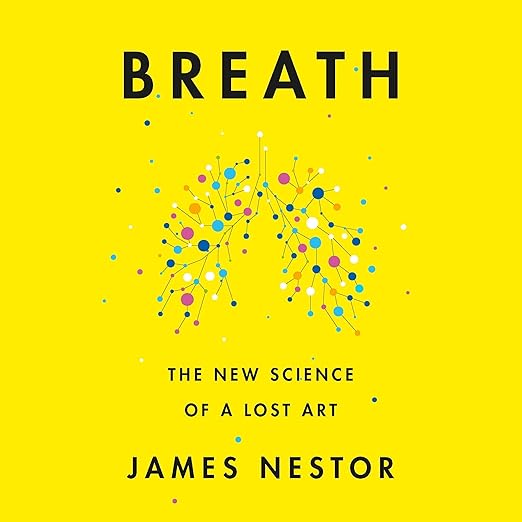
- Narrator: Nestor voices his own travels, so the interviews arrive filtered through the person who conducted them rather than performed by a third party.
- Subjects: Respiration as a lost skill, nasal breathing, ancient practice tested by modern instruments
- Tone: Curious, evangelical, occasionally alarming
- Bottom line: The rare health book with real reporting under it, worth eight hours even if you discount some of the claims.
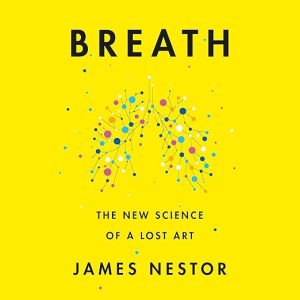
Twenty-five thousand times a day, by Nestor's count, and almost none of them done properly: that is the premise of this audiobook. James Nestor reads his own reporting, seven hours and fifty-five minutes of it, and the reporting is genuinely strange. The trail runs through muddy digs at ancient burial sites, secret Soviet facilities, choir schools in New Jersey and the smoggy streets of São Paulo, and it arrives at claims implausible enough to need every bit of the sourcing he puts behind them.
One-Word Title Hides Breath's Real Subtitle
The most detailed entry in the written column is not a review at all. A September 2021 five-star reads like a library bulletin: it gives the full title as Breath, The New Science of a Lost Art, names Riverhead Books and the year, quotes a hardcover price of $18.37, lists the county library systems holding copies, notes which formats exist, and reports that the book has been placed on a purchase request list. Not one sentence of it grades the writing. It is a procurement notice wearing five stars, and the average absorbs it exactly like any other verdict.
That entry also does the record an accidental favor, because the title field on this page reads Breath and nothing more. The subtitle naming the actual subject survives only inside somebody else's summary. A one-word title on a book about respiration is not a trivial omission: it is the difference between a product a browser can recognize and a common noun.
What the book does is more interesting than the pitch around it. Nestor treats the nose and mouth as an engineering problem with a history, working back through thousands of years of medical texts and forward into pulmonology, psychology, biochemistry and physiology, and submitting long-held beliefs to actual testing rather than repeating them. The claims that follow, about athletic performance, snoring, asthma, autoimmune disease and even scoliotic spines, are enormous. The copy concedes as much: none of this should be possible, and yet it is.
Pulmanauts and Travel Scenes Fit This Format
Usefulness is the honest reason to start it. A January 2025 five-star lists the conditions the book speaks to, mouth breathing, snoring, sleep apnea, hyperventilation, shortness of breath, asthma and bronchitis among them, and notes that Nestor interviewed dozens of the breathing experts that entry calls pulmanauts. That list is the real market. Almost everyone is somewhere on it, which is how a book about an involuntary function became a million-copy seller.
The material also survives audio better than most health writing, because Nestor built it as travel reporting rather than as a program. Burial digs, a Soviet facility, choir schools, self-experiments alongside pulmonary tinkerers: these are scenes, not bullet points, and scenes are what audio is for. The named practices, Pranayama, Sudarshan Kriya, Tummo, arrive with context wrapped around them instead of as items on a checklist, which is why the book holds up on a walk.
Nestor Narrates While Asking You to Practice
The single deduction on this page is worth reading before you buy. A four-star filed on January 5, 2025 is enthusiastic about most of the book, crediting the writing and the humor with bringing levity to a subject with life-or-death stakes, then removes a star specifically for a passage in the first chapter about where human beings came from, which that reader found comical and fantastical. Whatever you make of the evolutionary framing, it is the stretch people argue with, and it arrives early enough to color the rest.
Nestor voices it himself, which on first-person reportage is the natural call and also the one that carries a hidden demand: this is a text that repeatedly asks you to do something while you listen, to close your mouth, to slow an exhale, to count. A reader performing his own instructions has to shift between reporter and coach, and that shift is the thing worth auditioning. Test the sample on a passage where a technique is being described rather than on the opening minutes.
Two of the five written responses are not in English, and both award five stars. That is not a defect. It does tell you what the average is made of: a readership grading this book in more than one language, all of it resolving into a single figure over thirty-one ratings, with no way to separate readers of the original from readers of a translation.
Snorers and Plateaued Athletes Should Press Play
Anyone who snores, or sleeps beside someone who does, has a reason to press play. So does anyone whose training has plateaued, anyone managing a chronic respiratory condition, and anyone who simply enjoys watching a journalist chase a strange idea across continents. A March 2025 entry from Germany, five stars, describes finishing it within a few days and passing it to friends, and calls the material relevant whether you come at it medically, therapeutically, socially or privately. That is a fair account of the reach.
Anyone wanting a clinical protocol will be frustrated. This is reportage with practices embedded in it rather than a program, and the exercises are described in prose instead of laid out as sequences you can follow along with. The same applies if large claims put you off, because the argument runs against settled advice and says so openly. And if you intend to try the techniques while listening, plan on rewinding, since a recording is a poor place to keep a set of instructions you need to consult twice.
Good to Know
Does this audiobook include the new material the copy advertises?
The description promotes new material in this edition, and the record supplies no separate contents list, so nothing distinguishes the additions from the original text on the file. Just under eight hours is what you get, and no note anywhere indicates where the newer passages sit.
Can I follow the breathing exercises while the audiobook plays?
Only partly. The practices are described inside the reporting rather than presented as numbered steps, so you can absorb the ideas passively but will want to stop and go back before trying one properly. No supplementary file is listed on the record to hold them.
How much of this is science and how much is travel writing?
The balance leans toward travel. The science arrives through people: the pulmonary tinkerers Nestor tests beliefs with, practitioners of named breathing traditions, and researchers across pulmonology, psychology, biochemistry and physiology. The citations are genuinely there; the delivery is narrative rather than clinical.