
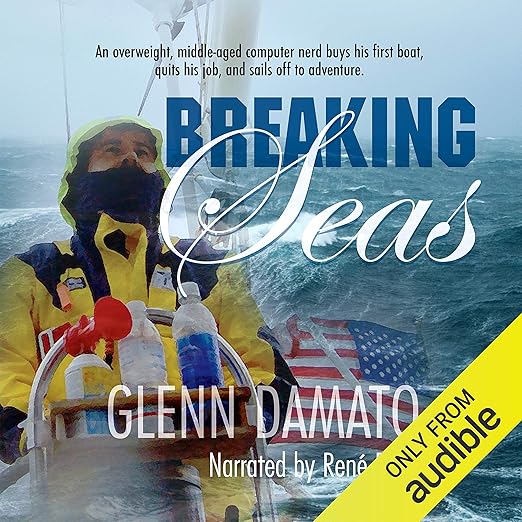
In Brief
- Narrator: Rene Ruiz's narration captures Glenn Damato's self-deprecating register without softening it - the voice matches the author's own honest assessment of his limitations, which keeps the more harrowing passages credible.
- Subjects: Radical self-transformation, the cost of beginner incompetence at sea, middle-age reinvention
- Tone: Honest and frequently funny, with actual danger running underneath the comedy
- Bottom line: Breaking Seas earns its 4.2 rating through Damato's willingness to document his own failures as carefully as his eventual competence.
Glenn Damato's craft in Breaking Seas - narrated by Rene Ruiz in this 9-hour-and-27-minute audiobook - is not seamanship, not at first. It is a particular kind of writing honesty that is rarer than it sounds: the willingness to document your own incompetence in real time, without the retrospective polish that most adventure memoirs apply to their authors' worst moments. Damato was a 41-year-old software instructor with no sailing experience and a body that his own account describes as significantly overweight when he decided that what his comfortable but stagnant life required was a circumnavigation of the globe on a vessel he did not yet know how to operate. The absurdity is Damato's first point, and he makes it freely.
The Verdict, Briefly
What distinguishes this book from the standard adventure memoir is its refusal to locate the incompetent phase at a comfortable narrative distance. Damato does not begin as a slightly rough-around-the-edges adventurer who needed only experience and confidence to become a capable sailor. He begins it as someone who genuinely has no business being on open water, who makes serious errors, who encounters conditions for which his preparation was inadequate, and who tells you all of this without constructing a redemption arc that papers over the specifics. One reviewer's description - 'brutally honest' - is the right framing, and that honesty is the book's primary argument: that genuine transformation requires moving through the embarrassing phase without skipping it.
The portrait of learning to sail as a middle-aged beginner is one of the more unusual things about the book. Sailing culture, as Damato portrays it, includes a certain amount of casual expertise-signaling and a fairly direct hierarchy of experience, and he documents his position at the bottom of that hierarchy without self-pity but without false modesty either. The people who help him are rendered with the specificity of someone who remembers that he needed them and is grateful he got them. The book is funny in proportion to Damato's actual situation, not in proportion to what a comedic adventure memoir is supposed to be. A reviewer who has actually sailed with Damato confirms that his writing captures exactly who he is in person - patient, friendly, and a good storyteller - but notes that having the book in front of you is more absorbing than hearing the stories live, which is a genuine endorsement of the writing's density.
Why Listen to Breaking Seas
Rene Ruiz's narration suits the book's register precisely because he does not try to inflate it. Damato's prose is direct and self-aware rather than lyrical, and Ruiz reads it as such - there is no attempt to give the open-water passages more grandeur than Damato's account claims for them. This restraint pays off in the sections where the danger is real and the inadequacy of Damato's preparation is most apparent. A more dramatic narrator would inadvertently signal that everything was going to be fine; Ruiz keeps you inside the uncertainty. The 9-hour-and-27-minute runtime is appropriate for the scope of the story - this is a full-scale life transformation, not a weekend adventure, and the audiobook takes the time it needs to establish what Damato was leaving and what he was moving toward. One reviewer described it as a 'wonderful, funny, and very informative wake-up-call about owning and sailing a yacht over great distances,' which identifies the dual function that makes it work: it is simultaneously a specific sailing account and a broader argument about the necessity of discomfort in any meaningful change.
What Might Not Land
Listeners expecting a purely triumphant adventure should know that Damato's self-assessment never fully relaxes into the conventional success-story mode. Even as his skills develop, he maintains a clear-eyed accounting of his limitations that some readers find refreshing and others find exhausting. The sailing specifics are substantial - Damato is precise about equipment, conditions, and the mechanical demands of ocean sailing - which means listeners with no nautical background will occasionally be navigating technical material without a glossary. The book rewards the kind of patient attention that lets the technical details accumulate into something vivid rather than skimming past them for the emotional narrative. Listeners who need more conventional forward momentum should be aware that progress on the goal of circumnavigation is deliberate rather than rapid, and that Damato's value as a narrator comes from his candor about setbacks, not from his triumphs.
Should You Listen to Breaking Seas?
This audiobook is for listeners drawn to self-transformation stories with a high tolerance for honest failure and a genuine interest in the logistics of what they are reading about. It works well for anyone who has thought seriously about making a radical life change and wants a realistic account of what that looks like in practice. Dedicated sailing enthusiasts will find the technical content substantive. Listeners looking for pure adventure story without the self-reflective apparatus will find the book's emphasis on Damato's inner accounting more prominent than they might prefer. The humor throughout is specific and earned rather than reflexive, which makes it more durable across the full runtime. Damato's willingness to document the specific mechanics of his mistakes - the misread weather reports, the equipment failures he did not anticipate, the moments when his physical limitations became directly relevant to his safety - gives the book an instructional layer that sits alongside the memoir layer without overwhelming it. Those coming to the book with some sailing ambitions of their own will find it an unusually honest accounting of what competence actually requires.
Common Questions
Does Breaking Seas require any prior sailing knowledge to follow the audiobook?
No, though Damato includes substantial sailing-specific technical detail. The book is structured as a memoir for a general audience, and the emotional and practical dimensions of the story are accessible without prior nautical knowledge.
How honest is Glenn Damato about his failures in the Breaking Seas audiobook?
Unusually honest, by reviewer consensus. Damato documents his incompetence, his errors, and his physical limitations in real time rather than positioning them at a retrospective distance. This quality is consistently singled out as the book's most distinguishing feature.
Is the Breaking Seas audiobook suitable for listeners who are currently considering a major life change?
Reviewers in that situation have found it both inspiring and sobering - it provides a realistic picture of what radical change actually requires, including sustained discomfort, genuine risk, and a willingness to be genuinely bad at something for an extended period.







