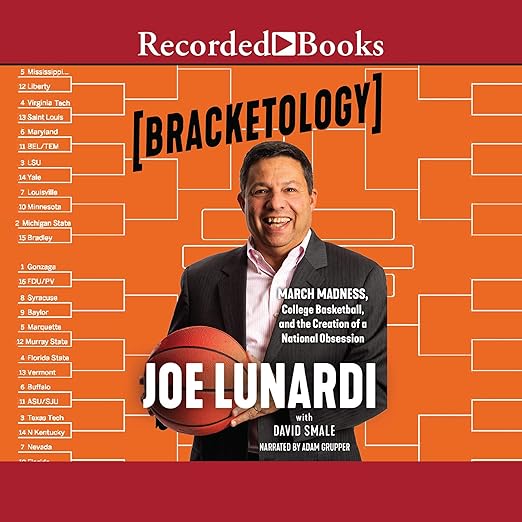
Joe Lunardi invented the term bracketology, and that fact alone gives this audiobook a kind of authority that most sports titles can only approximate. The ESPN analyst has spent decades predicting NCAA Tournament seedings with enough accuracy to become the single most-cited voice on the subject, and in Bracketology: March Madness, College Basketball, and the Creation of a National Obsession, narrated by Adam Grupper, he lays out exactly how he does it. At six hours and fourteen minutes, this is not a quick listen, but for the college basketball fan who has spent years arguing about bubble teams and seed lines, the investment pays off substantially. Lunardi speaks from inside the process he helped create.
David Smale's name appears as author on the listing, though the book's perspective is clearly organized around Lunardi's career and methodology, built from his direct experience watching the selection process evolve. Whatever the publishing arrangement, the result feels firsthand. Lunardi describes the Selection Committee's deliberations, the criteria they use, and the data they analyze with the specificity of someone who has watched that process change over many years. The demystification here is genuine, not the kind of surface-level disclosure that fills sports books with empty access and little insight.
Is Bracketology Worth Your Time?
The core of this book is an explanation of how the bracket actually gets built, which is both more methodical and more subjective than most fans assume. Lunardi walks through concepts like the NET ranking, quality of wins, conference strength, and road versus neutral-site records, but he also addresses the human element: committee members bringing different priorities into the room, debates that don't always resolve cleanly, and the reality that no metric captures everything. That honesty about the limits of quantification is one of the book's strongest qualities. He could have written a book that makes his process sound infallible. He chose not to.
He also has real fun comparing teams across eras, asking what a 1990s powerhouse would look like measured against today's evaluation criteria. These sections are speculative but anchored in genuine analysis, and they give the book a broader historical sweep that prevents it from reading like a technical manual. The coaches, players, and media voices Lunardi interviews throughout add texture and confirm that his methodology has earned respect across the college basketball ecosystem, not just among fans who follow the bracket closely.
What David Smale Gets Right
Adam Grupper's narration is well-suited to this material. He reads with a pace that feels natural for sports conversation, neither rushing through the analytical sections nor dragging through the historical ones. His tone conveys enthusiasm without hyperbole, which is exactly right for a book that takes the intellectual side of March Madness seriously while never losing sight of why people care in the first place. The audiobook format works particularly well here because Lunardi's writing has the rhythm of someone used to making his case verbally, on television, in real time. Grupper captures that energy without making it feel like a broadcast performance.
The treatment of mid-major programs earns particular praise. Lunardi takes seriously the tension between a team that dominated a weaker conference and a bubble team from a Power Five program with a split record against tough competition. He does not pretend the committee has a perfect answer to that question, and his willingness to sit in the ambiguity of it reflects genuine analytical maturity rather than false certainty. Listeners who have had those exact arguments in their office pools will find this section the most practically useful part of the book.
Before You Commit to Bracketology
Listeners who are not already somewhat invested in college basketball will find parts of this experience slow going. Lunardi assumes a base level of familiarity with conference structures, historical programs, and tournament terminology that newcomers to the sport may not have. This is not a book that explains what the NCAA Tournament is from the ground up. It assumes you already know and care, and it builds from there. For that audience, it works beautifully. For anyone approaching it cold, the middle third in particular may feel like dense insider material without enough context to land fully.
There is also a natural limitation to any book covering an evolving topic. College basketball's evaluation landscape shifts regularly, with metrics being refined and committee criteria adjusted. Lunardi addresses the future of the sport and signals awareness that the formula will continue to change, but some specifics will date as seasons pass. Listeners approaching this a few years after publication should treat the methodological sections as a foundation rather than a current blueprint, and confirm updates with Lunardi's more recent ESPN work.
Should You Listen to Bracketology?
This audiobook is built for the serious college basketball fan: the kind who fills out multiple brackets, follows the bubble conversation in February, and argues with friends about whether a team's strength of schedule outweighs its conference tournament record. For that listener, Bracketology offers a level of inside access that no amount of fan analysis can replicate. Coaches, players, and committee members all weigh in, and Lunardi synthesizes their perspectives into a coherent picture of why March Madness is genuinely difficult to predict, even for someone who has spent a career trying.
Casual fans who simply enjoy the Tournament without digging into the mechanics will find the book interesting but occasionally more granular than they need. And if you've never filled out a bracket in your life, there are better starting points for understanding why college basketball matters. But if you are the person who checks Lunardi's projected bracket seedings every Monday in February, this is the audiobook that finally explains what he actually does to arrive at those numbers.
Before You Listen
Do you need to follow college basketball closely to get value from the Bracketology audiobook?
A working familiarity with the NCAA Tournament structure helps considerably. Lunardi assumes you understand what seeds mean, how conferences work, and why the Selection Committee exists. Fans who follow the sport casually will find enough context to follow along, but deep bracket obsessives will get the most out of the analytical sections.
Does the Bracketology audiobook cover real historical examples with specific teams and years?
Yes, extensively. Lunardi draws on decades of tournament history, comparing programs across eras and examining how specific bubble decisions played out. These case studies are some of the book's most enjoyable sections for anyone with a long memory of college basketball.