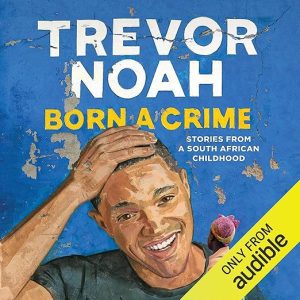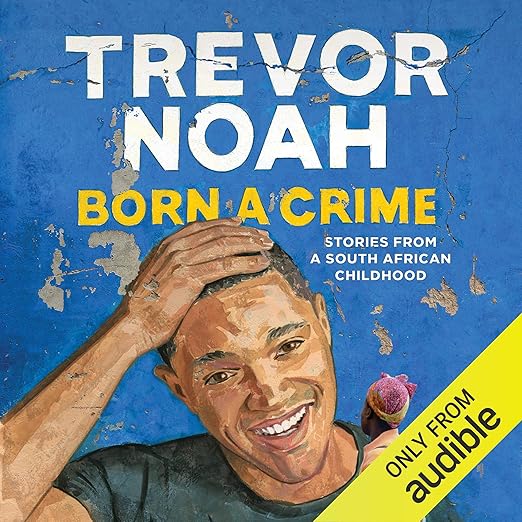
Trevor Noah's craft as a performer is inseparable from what makes Born a Crime work as an audiobook. The memoir exists in print, but this is the version that won the Audie Award for Best Male Narrator in 2018 - an Audible Studios original production - and the distinction matters in a way it does not for most celebrity narrations. Noah's virtuoso embodiment of his childhood's full cast of characters, his mother Patricia, the gangsters and neighbors and church congregations and the men whose violence shaped his adolescence, is not an enhancement of the text. It is the text's proper form.
The title refers to Noah's literal legal status under apartheid South Africa: his mother, a Black Xhosa woman, and his father, a white Swiss man, were forbidden to be together under the Immorality Act, which meant that Noah's existence was itself a criminal act at the moment of his birth. That fact is not deployed as a metaphor or treated as background color. It is the specific lived reality that shaped every day of his childhood in ways the memoir traces with remarkable precision - the hiding, the calculations, the specific rules of movement in a society organized around racial classification, and the particular comedy and grief of being a child who did not fit any of its categories cleanly.
Noah Voices His Mother with Real Tenderness
The opening scene, in which his mother throws him from a moving van to save him from gangsters, is not a novelistic conceit. It happened. What follows is an account of how a child navigates that level of ambient danger, poverty, and racial classification while also being, by his own description, a profoundly difficult kid. One reviewer noted the book functions primarily as a tribute to Patricia Noah, and that observation is accurate: she is the overwhelming presence in the narrative, her faith and determination and refusal to allow her son to understand himself as limited by the system that classified him structurally defining his entire formation. Patricia as voiced by her son steals the show, as the synopsis puts it - Noah performs his mother's voice with a tenderness and precision that makes her one of the most fully realized characters in recent memoir writing, which is a significant thing for an account told through her son's limited childhood perspective.
The humor in this audiobook is real, consistent, and working in service of something serious. Noah is incapable of narrating his own life without finding the comedy in it, and his ability to perform multiple languages and embody each voice from his childhood with distinct presence gives the listening experience a quality that print cannot replicate. The switch between languages - English, Xhosa, Zulu, Afrikaans - is not a party trick. It is the documentary record of how code-switching worked as both survival mechanism and identity formation tool in the specific world Noah grew up in.
Noah's Narration Makes This an Apartheid Memoir
The performance is the reason to listen rather than read. Noah's narration across eight hours and forty-four minutes covers his childhood and adolescence in South Africa during the transition out of apartheid, his various entrepreneurial schemes including several illegal ones, his complicated relationship with violence in the township, and the gradual emergence of the person he would become. One reviewer who came to the audiobook as a Daily Show fan noted that the book reveals almost nothing about how Noah became a comedian. It is not a showbiz memoir. It is an apartheid memoir written by someone who survived apartheid's aftermath with his humor intact, and understanding that distinction is essential to approaching it with the right expectations.
A reviewer who was a student described it as excellent and educational while being fun and humorous - which captures the dual register the audiobook maintains across its full runtime without either dimension undermining the other. The historical context Noah provides about the apartheid system and its specific mechanisms is more comprehensible in his first-person account than in most historical summaries, because the laws are explained through their lived effects rather than as policy abstractions.
Daily Show Fans Should Recalibrate Their Expectations
Listeners expecting a celebrity memoir structured around Noah's comedy career will need to recalibrate significantly. The Daily Show, the stand-up career, and the international profile do not feature in any substantial way. The narrative stops well before that phase of his life begins, and the book contains one brief mention of starting to tour in England without any account of the process of becoming a professional comedian. Reviewers who came looking for that story found something they valued more rather than less, but the distinction is worth knowing upfront. The stepfather's violence is not softened or made palatable by comedy. The poverty is not romanticized. The apartheid system is explained with historical specificity rather than reduced to atmospheric backdrop. This is a serious book that is also frequently very funny, which is harder to achieve than either element alone.
Skip Print for Noah's Irreplaceable Narration
Anyone interested in South African history during and after apartheid who wants to experience that history through a personal narrative rather than a historical account will find this one of the most accessible and emotionally honest documents available in audio form. Listeners who have enjoyed Noah's public persona and want to understand where it comes from will find the answer, though not the showbiz version of it. Readers drawn to exceptional mother-child memoir will find Patricia Noah one of the most extraordinary maternal figures in recent writing of any kind. The audiobook format is specifically recommended over the print edition - this is one of the genuinely rare cases where the author's narration performance is irreplaceable to the full experience.