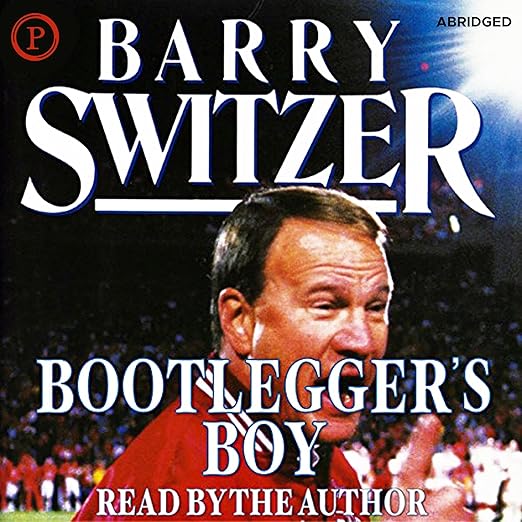
Barry Switzer narrating his own memoir is about as on-brand as it gets. He has never been the kind of figure to let someone else speak for him, and at two hours and forty minutes, this is a tight, direct listen that moves the way Switzer himself seems to move: fast, opinionated, and without much patience for what he considers irrelevant detail. I finished it on a Sunday afternoon while the game was on in the background, and that felt appropriate.
The story Switzer tells is genuinely difficult. His father served prison time for bootlegging. His mother committed suicide. These are not footnotes; they are the foundation of the biography, and the memoir earns its title before it ever gets to the Sooners or the Cowboys.
Switzer's arc from that Arkansas childhood to his distinction as one of only three individuals ever to win national championships in both college football and the NFL is remarkable on its face, and he knows it. The memoir does not agonize; it recounts. There is a directness to how he handles the difficult material, including the scandals and controversies that followed him through his Oklahoma years, that makes the listening experience feel candid rather than carefully managed. Reviewers have noted that this is more a book about the man than about football, and that is accurate. The OU history is here, and the Cowboys years are represented, but the emotional core is biography, not strategy.
Why Bootlegger's Boy Works as an Audiobook
You listen to this because Switzer's life does not fit the standard coach-biography mold. Most coaching memoirs are structured around wins, systems, and philosophy. This one is structured around survival and transformation, which gives it a different weight. The detail that he led America's team to Super Bowl XXX victory after being labeled an outlaw throughout his college career is the kind of second-act turn that would feel contrived in fiction. In a memoir narrated by the man himself, it lands differently. One reviewer described his upbringing as less than average and his accomplishments as remarkable, and that summary is accurate, if understated. Another noted that this is genuinely a book about the man more than about football, which is part of what makes it unusual in the coaching-memoir genre.
Weak Spots in Bootlegger's Boy
At two hours and forty minutes, this is a very short listen for a full biography, and some listeners will want more depth, particularly around the Oklahoma program's controversial periods and the Dallas Cowboys tenure. The brevity is both a strength, the narrative never drags, and a limitation, certain chapters feel compressed in ways that leave questions open. Switzer's self-narration is unpolished in the technical sense; he is not a trained narrator and there are moments where a professional reader would have brought more control. But the tradeoff is that you are hearing the actual voice of the actual person, which carries its own authenticity. Listeners who came of age watching the Sooners in the 1970s or the Cowboys in the 1990s will get the most out of this; for everyone else, some background knowledge of the eras will help considerably.
The book's framing as a memoir told from Switzer's point of view means that some of the more difficult chapters in his career receive sympathetic treatment. That is not necessarily a flaw; a memoir is always a constructed perspective. But listeners looking for an adversarial examination of Switzer's more controversial coaching decisions should look for a biography written at arm's length rather than this first-person account.
The Right Listener for Bootlegger's Boy
Football fans with an interest in the Oklahoma dynasty or the 1990s Cowboys will find this rewarding. Readers drawn to survival-and-ambition American stories will also connect with the first half of the book in particular. Listeners expecting a detailed tactical memoir of coaching philosophy should look elsewhere; this is personal biography first, and football history second. At under three hours, the commitment is minimal.
Questions Listeners Ask
Does Switzer address the controversies and scandals that ended his time at Oklahoma?
Yes, though the memoir is relatively brief and Switzer's treatment of the difficult periods reflects his characteristic directness rather than extended self-examination. He gives his perspective without much hedging.
How does Switzer's self-narration compare to a professional narrator?
It is unpolished technically but brings an undeniable authenticity. You are hearing his voice and cadence, which suits a memoir of this kind even if it lacks the precision of a studio narrator.