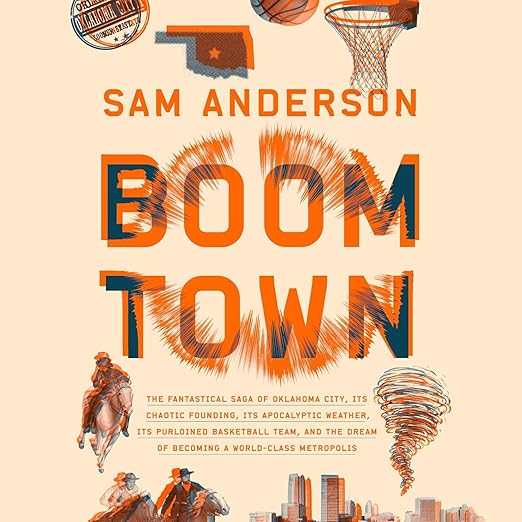
I started Boom Town expecting something in the vicinity of a very good sports book. What I got was something stranger and more generous than that: a gonzo cultural history of a city that should not exist, organized around one of the most controversial trades in NBA history and held together by Sam Anderson's willingness to follow his curiosity wherever it takes him. By the time he got to the man who shot the man who killed Jesse James, I had stopped expecting the book to behave like anything I had anticipated.
Oklahoma City was founded in a single afternoon. On April 22, 1889, the Land Run opened unassigned territory to settlement, and by nightfall a city of ten thousand people stood where nothing had been that morning. That foundational act of organized chaos, which Anderson treats as the DNA of everything that followed, is the first of many moments in the book where fact reveals itself to be stranger than anything a fiction writer would dare invent. The OKC Thunder's 2012-13 season, and specifically Sam Presti's decision to trade James Harden days before the season opened, functions as the book's spine but not its subject. Oklahoma City is the subject.
What Sam Anderson Delivers
Anderson is a staff writer at the New York Times Magazine, and his prose operates at the level you would expect from that context. He is funny, specific, and willing to follow a thread into unexpected territory. The chapter on Wayne Coyne of the Flaming Lips, who grew up in Oklahoma City, sits alongside sections on the Murrah Building bombing, urban planning battles, catastrophic tornadoes, and the Thunder's run to the Finals. The range of material should feel chaotic. Somehow it does not. Anderson's governing conviction is that all of these things are about the same essential question: what does it mean to build something in a place that keeps trying to tear it back down?
Reviewers longlisted the book for the Andrew Carnegie Medal for Excellence in Nonfiction, and the critical reception from the New Yorker, the New York Times, and NPR was uniformly enthusiastic. The one honest caveat, which several readers note, is that pure basketball fans hoping for an in-depth Thunder analysis will find considerably more history than basketball. That is not a failure; it is a genre question. This is not a basketball book that mentions Oklahoma City. It is an Oklahoma City book that uses basketball as a lens.
What Sam Anderson Gets Right
Anderson narrates his own book, and this is exactly right for this material. The sections that function as personal essay, where Anderson reflects on his own relationship to Oklahoma City and its people over the year he spent embedded there, need a voice that carries genuine investment. He sounds like a person who actually fell in love with a place he did not expect to. That quality is not reproducible by a professional narrator reading someone else's words.
At nearly fifteen hours, Boom Town asks for patience. The book rewards it. The Murrah Building section, which one reviewer predicts will reach even the coldest reader, is among the most effective pieces of long-form journalism Anderson has produced. The Thunder basketball sequences are exciting and knowledgeable without requiring deep NBA expertise to follow. The historical detours are almost always more interesting than they sound in summary.
Where Sam Anderson Loses Some Ground
Anderson's structure is associative rather than linear. He follows thematic and emotional logic rather than chronological sequence, which gives the book its particular energy but means listeners who prefer strict narrative order may occasionally feel unmoored. The effect is intentional, and it reflects the city itself, which Anderson argues has always been constituted by competing energies that refuse to resolve into a single direction.
The book was published in 2018 and covers through roughly the 2012-13 season. The Thunder's more recent history, including their 2024 championship, is not addressed. Some of the urban planning tensions Anderson describes have since resolved or evolved. The historical material, which constitutes a substantial portion of the book, remains entirely current.
Who Should Pick Up Boom Town
An excellent listen for readers who enjoy creative nonfiction at the intersection of sports, urban history, and American identity. Also recommended for anyone who appreciates the work of journalists like David Grann or Wright Thompson at long-form magazine length. Basketball fans looking for deep analysis of the Thunder's basketball decisions will need to recalibrate expectations toward cultural history. Oklahoma City natives will find personal recognition alongside surprise.
Common Questions
Is Boom Town primarily a basketball book about the OKC Thunder?
Not primarily, no. The Thunder's 2012-13 season and the James Harden trade provide the narrative spine, but the book's actual subject is Oklahoma City itself. The history, urban development, tornadoes, the Murrah Building bombing, and civic culture occupy far more space than basketball analysis. Readers expecting a sports-focused book should adjust those expectations.
Does Boom Town cover the OKC Thunder's 2024 NBA championship?
No. The book was published in 2018 and covers through the 2012-13 season. Readers interested in the more recent Thunder history will need to supplement with current sources.
Is Sam Anderson's self-narration effective across a 15-hour audiobook?
Yes. His journalism background gives him strong instincts for pacing and emphasis. The personal essay sections benefit enormously from his authentic affection for the city. Some listeners may occasionally miss the polish of a trained professional narrator, but the investment he brings to the material outweighs that trade-off.
Does a listener need knowledge of Oklahoma City or NBA basketball to enjoy Boom Town?
Neither is required. Anderson builds context for both the city's history and the basketball events as he goes. Reviewers with no prior investment in Oklahoma City or the Thunder have found the book compelling on its own terms as American cultural history.